
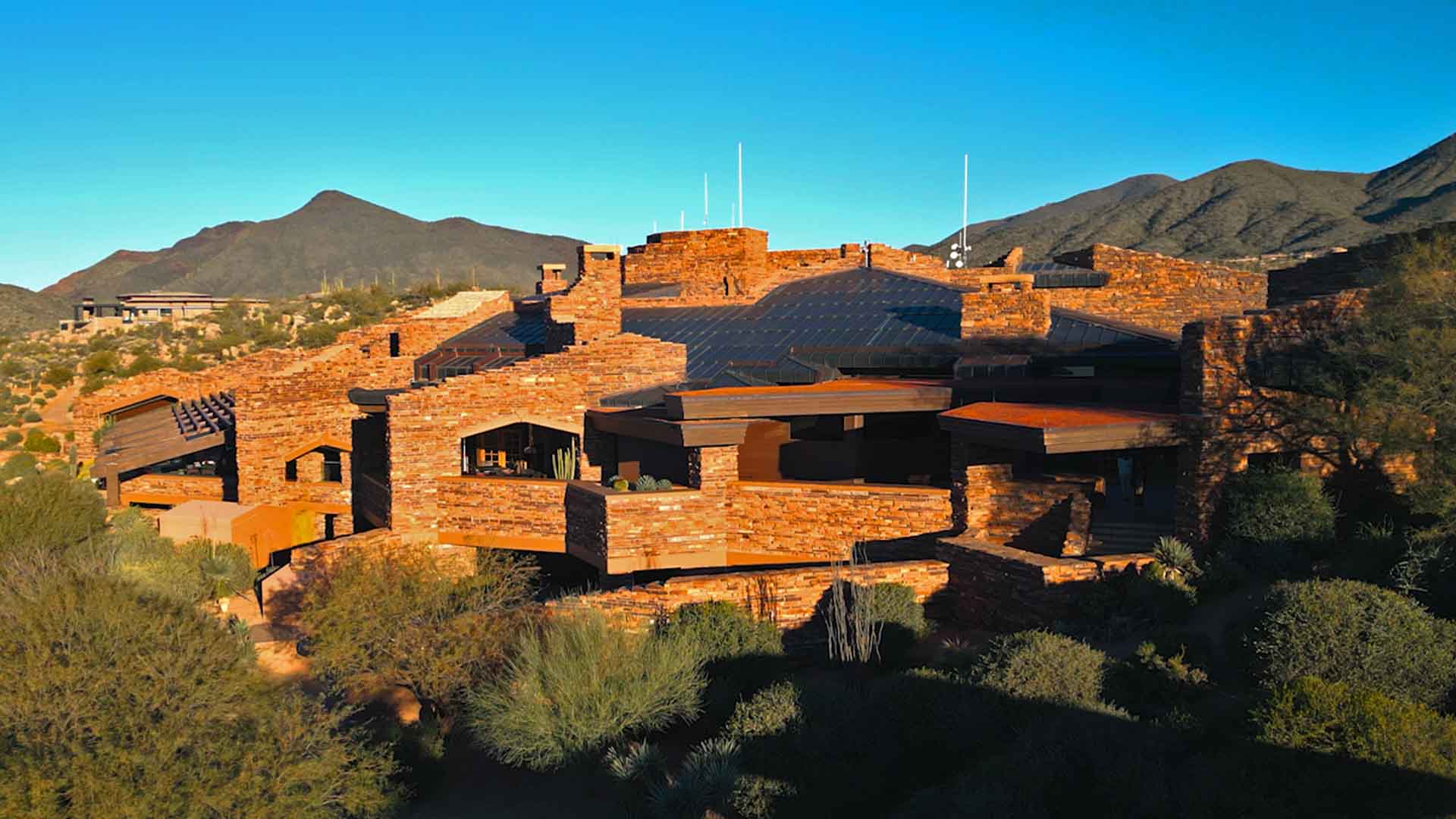
Mention modern minimalism and most golfers know what you’re getting at. The term describes light-on-the-land designs that move with the terrain rather than riding roughshod over it. It’s been the dominant aesthetic in golf course architecture for decades. But it’s also evident in clubhouse design.
Consider Desert Mountain Club.
The North Scottsdale landmark, hosting this week’s U.S. Amateur Four-Ball Championship, has seven clubhouses, one for each of its courses. But its signature structure — and the central stitch in the club’s social fabric — is the Cochise-Geronimo clubhouse: a 72,000-square-foot space that is as subtle as it is sublime.
On a recent visit, GOLF.com received a guided tour from architect Bob Bacon, who set out to create something functional, enduring, and understated. In his view, the desert is “a visually fragile environment” where trees top out around 20 feet. “If you’re not careful,” Bacon said, “buildings can overwhelm it instantly.” So he designed a structure that doesn’t jump out of the mountain. It grows out of it. Walls reach into the landscape, anchoring the building to the earth, transitioning from the ground rather than leaping up from it.
“It looks like it belongs there,” Bacon said.
The stonework deepens that sense of rootedness. Bacon described the materials as an homage to the Anasazi ruins at Chaco Canyon, a UNESCO World Heritage Site in New Mexico. That’s a cultural reference as much as an aesthetic one, lending the building “a timeless anchor.”
“This is the southwest,” Bacon said. “It needs to be durable. It needs to look like it’s been here forever.”
The features of the building are both hard-lined and fluid. The interior gives way seamlessly to the exterior, allowing for an interplay that Bacon said is only possible in the southwest. Even the views are carefully managed: the clubhouse offers 360-degree sightlines across desert and peaks, but Bacon resisted the temptation of unframed panoramas, which he believes are almost numbing in their lack of nuance. So he designed columns and rooflines to frame the vistas, re-proportioning sky and ground to keep the emphasis on the horizon while creating multiple intriguing views instead of a single, uninterrupted vista.
He wasn’t chasing any particular architectural style, he said. The goal was something functional, beautiful and unobtrusive. Which is to say, both simple and complex.
Minimalist? Sounds about right. You can watch the entire clubhouse tour below.
<figure class="youtube-facade" data-content="
“>
Disclaimer : This story is auto aggregated by a computer programme and has not been created or edited by DOWNTHENEWS. Publisher: golf.com



