NextEra Energy’s massive $67 billion deal to acquire Virginia-based Dominion, announced on May 18, will effectively build the world’s largest utility in a bid to dominate the AI data center boom. It’s a goal big enough that NextEra was willing to pay a hefty premium—and risk overpaying—to make it happen.
On a call with analysts, NextEra chairman and CEO John Ketchum said the acquisition was necessary to create a player big enough to satisfy enormous and fast-growing demand for electricity. He emphasized the combined scale needed to build power projects more quickly and affordably to accommodate hyperscalers, increased electrification, population growth, and more.
The two companies’ combined construction backlog of 130 gigawatts exceeds their existing power generation, Ketchum said. That represents enough electricity to power 100 million homes—out of roughly 150 million in the entire U.S.
“Our country is at an inflection point. The demand for electricity is increasing unlike anything we’ve seen in generations,” Ketchum said on a call with analysts. “Today, energy infrastructure projects are larger and more complex than ever before. Practically every corner of America needs power solutions, not someday, but right now.”
In a recent interview with Fortune this spring, Ketchum foreshadowed these concerns and goals. He touted his desire to grow NextEra to become the industry leader in building massive data center and AI factory hubs nationwide. Attaining that scale, Ketchum said then, is the only way to grow affordably and avoid the AI affordability backlash sweeping across the country.
The biggest energy deal in decades
The all-stock deal is the largest energy acquisition this century—indeed, the largest since Exxon acquired Mobil in 1998—and would make NextEra the biggest U.S. energy company by enterprise value at $420 billion, behind only Exxon Mobil and Chevron.
The acquisitions represents a big 23% premium on Dominion’s $54.3 billion market cap as of market close on May 15. Dominion’s value has steadily risen since late 2023. NextEra already led the U.S. power and utility industry by market cap. But NextEra’s stock fell by almost 5% on May 18 on the deal news—while Dominion’s stock rose 9%—amid concerns of that NextEra is paying too much for Dominion at a time when utility stocks are already inflated by the AI boom.
Ketchum is betting the risk pays off. The combined company will be the biggest utility in the world, the largest renewable energy and battery storage developer in the world, the U.S. leader in total power generation and gas-fired generation, and second nationally in nuclear power. The deal merges NextEra’s massive Florida Power & Light utility and its power generation in 44 U.S. states with Dominion’s large regulated utility presence in Virginia—home to the nation’s biggest “data center alley”—and in the growing Carolinas.
“We are the only ones out there really building across the United States,” Ketchum said. “We are a builder at our heart.”
Growth and affordability
Ketchum told Fortune last month that power and utility players can only win the AI game if they have the scale and nationwide footprint to develop data center hubs in cooperation with communities—and without raising customers’ utility bills.
“We see a lot of pushback in certain parts of the country on, ‘Don’t locate data centers in my backyard,’” Ketchum said. “But once you’ve already planted our flag in one area, it’s a lot easier to expand there with local politics, water resources, and the things you have to go through.”
There are two keys to success, he said: requiring hyperscalers to pay for their own generation (“build your own power”); and having the scale and capital to grow rapidly with the data center developers.
“We can grow while they grow,” Ketchum said. “They like the idea of having a power provider that can grow along with them.”
A data center campus might require 1 gigawatt of power, he said, already enough to power three-quarters of a million homes, but some plan to expand to 5 gigawatts or more. The growing company has the expertise to offer every solution, starting with solar and battery storage power to get a data center online, then adding gas-fired power as it expands, and eventually nuclear power as well.
NextEra developed a massive fleet of gas-fired power plants in Florida. And over the past 20 years, it became an industry leader in renewable energy construction nationwide at a time when U.S. power demand was relatively flat.
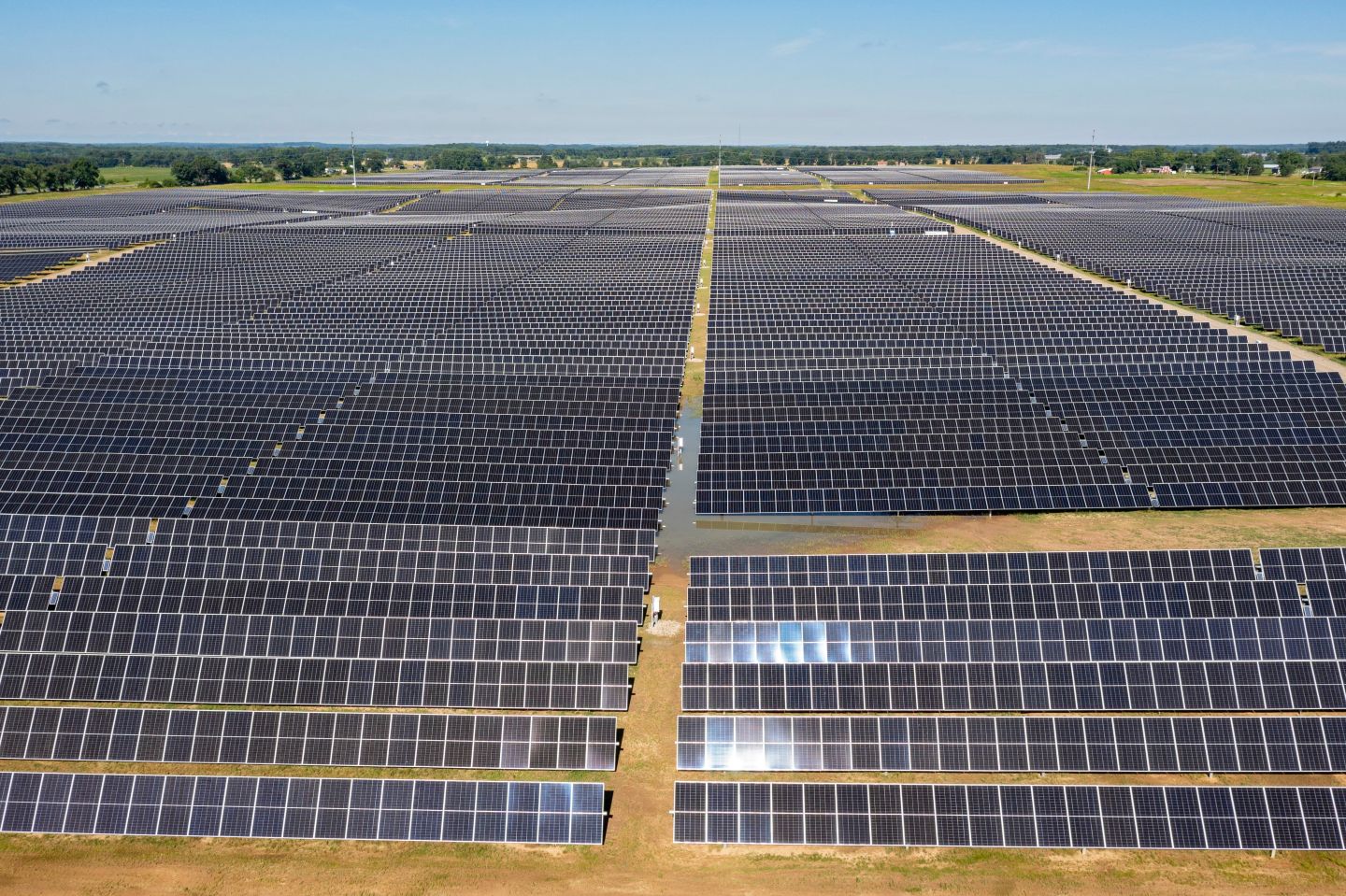
“Customers had incremental demand. They didn’t need a gas plant, but they could have a 100-megawatt wind farm or solar facility, or 40 megawatts of batteries,” Ketchum said. “It was just enough to get them to accommodate the increased demand they were seeing. We were able to build up and scale around renewables and storage, which transformed our business outside of Florida.”
Jim West/UCG/Universal Images Group—Getty Images
All of the above
Now, Ketchum said in the prior interview, “The paradigm has changed to serve the hyperscaler”—meaning solutions must combine renewables, batteries, gas power, gas transmission, nuclear, and more, assembled as quickly and cheaply as possible.
“Our approach is very pragmatic rather than ideological. It’s really, ‘What does a customer want?’,” Ketchum said. “We can build these larger data center hub complexes because they oftentimes require putting all the different pieces together.”
NextEra has developed over 30 potential data center campuses across the U.S. with the goal to reach 40 by year’s end. That portfolio allows them to offer hyperscalers the best solutions—and sometimes better ideas than the customers envision. Most recently, NextEra agreed to build almost 10 gigawatts for two large data center hubs in Texas and Pennsylvania, to be co-owned by the U.S. and Japanese governments as part of the Trump administration’s $550 billion trade deal with Japan.
“We can say, ‘Well, here’s why we think you’re wrong. Here are the areas that you should be looking at because they have better water resource, better gas pipeline access, better transmission access, the ability to expand 5 gigawatts because of land positions,’” Ketchum said. “Those informed decisions easily lead to the next opportunity where we can work with the hyperscaler on a more advanced buildout.”
Among its myriad projects, many involve alternatives to fossil fuels. NextEra is reopening the Duane Arnold nuclear plant in Iowa for Google. NextEra also is developing 2.5 gigawatts of solar and battery projects for Meta in Texas, New Mexico, and beyond. For its part, Dominion is completing the Coastal Virginia Offshore Wind project—after it was temporarily paused from opposition by the Trump administration.
Deal details
The all-stock deal, which isn’t expected to close until 2027, will give NextEra shareholders about 74.5% ownership of the combined company.
Ketchum will continue to lead NextEra as chairman and CEO, while Dominion CEO Robert Blue will serve as CEO of regulated utilities. Dominion will maintain its brand name in Virginia and the Carolinas.
NextEra’s 12-person board will grow to 14 with four directors coming from Dominion, including Blue. The combined company will have dual headquarters in Juno Beach, Fla., and in Richmond, Va., and will serve about 10 million customer accounts.
“The stakes couldn’t be any higher. Demand is coming from all sectors of the U.S. economy,” Blue told analysts on Monday. “Meeting this moment requires the company to buy, build, finance, and operate more efficiently. It’s easier said than done. It requires scale, deep skills, and experience.”
To accommodate all the planned growth, Ketchum said NextEra would have an annual capital spending budget of $59 billion for the foreseeable future—far more than any other power or utility player.
“At the end of the day, we’re selling a commodity. That commodity is electricity,” Ketchum said. “One electron is not distinguished from another other than its price. We need to make sure we’re always the low-cost provider. Our goal is to combine these different technologies and solutions to give the customer what they want at the most affordable price.”
Disclaimer : This story is auto aggregated by a computer programme and has not been created or edited by DOWNTHENEWS. Publisher: fortune.com