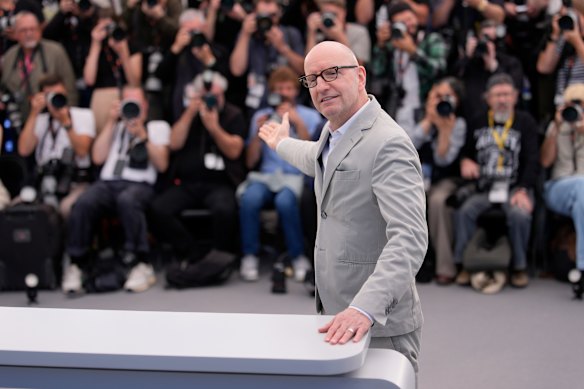

Cannes: “Is it necessary and is it better? And if the answer’s not yes, why are you using it?” says Steven Soderbergh, whose use of AI imaging in John Lennon: The Last Interview has stirred considerable anxiety among film technicians running scared of being replaced. He added firmly that the key to using the new technology is to be transparent about it – and that Cate Blanchett is leading the way.
“I’m not worried personally that this thing will ever be near a human, that it will ever replace a human in my world. It will always to me just be a piece of technology. But there is this issue of transparency and intention,” he says.
There are sequences in his film, he says, that are funny precisely because we know they’re not real. “So you get into this question of being fooled with your consent or fooled without your consent.”
Blanchett is co-founder of RSL Media, which is trying to formulate international standards around consent to the use of images.
“So these tools can continue to be developed within some sort of framework that addresses artists’ rights. I hope it works. It’s the only thing I’ve seen so far that could work because it’s independent and nobody owns it. But we’ll see,” he says.
Soderbergh, whose award-winning films include sex, lies and videotape; Out of Sight and the Oceans series, was speaking at the Cannes Film Festival about his new documentary, a visual interpretation of an interview John Lennon and Yoko Ono gave to radio station RKO to support their album Double Fantasy in 1980.
With the interview and music clips providing a soundtrack, he uses photographs from the family archives and AI images to illustrate points Lennon makes. A series of squalling babies flashes up when he talks about ageing ’60s hippies’ resentment that the world wasn’t changing fast enough; a caveman appears when he talks about men blundering through relationships with women.
Double Fantasy was Lennon’s first musical release in five years; the couple had decided to give just one interview and were “ready to spill”, in Soderbergh’s words. The interview lasted for nearly three hours, buoyed by their enthusiasm. “I consider that my work won’t be finished until I’m dead and buried, and I hope that’s a long, long time,” Lennon says. A few hours later, he was assassinated outside The Dakota, the apartment building where the interview took place.
The three journalists who conducted the interview held the rights to it and, until Soderbergh’s producer, Nancy Saslow, discovered what they had, were prepared to keep it under wraps. “They’d been sitting on this thing for four-and-a-half decades and had many opportunities to exploit it and didn’t. There seemed to be this unspoken feeling between the journalists that if this was going to go into the world again, that it be made in a way that is consistent with what John and Yoko are about. That is made by an artist about other artists.”
The interview we hear is about 90 minutes long; Soderbergh homed in on subjects he thought were essential, such as Lennon first meeting Yoko Ono, and tracing a typical day spent with their son Sean, who was five when Lennon died. Neither participated, beyond giving access to the images we see, but Sean Lennon watched the film in New York with a lawyer.
Soderbergh and Saslow sat in the theatre’s back row. “I think he was hearing a lot of this for the first time, which must have been very strange,” says Soderbergh. “I was really stretching my imagination to conjure what must be going through his head, especially as we got near the end. But he seemed very pleased.”
All things Beatle are certainly having a moment. Soderbergh’s film appears ahead of an omnibus of four features currently in production in the UK that will each focus on one of The Beatles. Harris Dickinson plays John Lennon in all four films, all of which are directed by Sam Mendes. “I’ll be first in line for that,” says Soderbergh. Earlier in the Cannes festival, Sir Peter Jackson enthused about his experience making Get Back, an eight-hour docuseries about the recording of Let it Be.
Soderbergh says he is unsure why they remain so compelling. “I can only say what they mean to me, just as an individual but also as a creative person,” he says. “They’re a clinic in creative evolution.” From writing songs that sounded like Carl Perkins, they found their way to the psychedelia of I Am the Walrus; like Soderbergh, they were also very interested in new technology. “They’ve gone through every crazy permutation,” he says. “And they were so young. That’s what you forget. There was no blueprint for being them.”
Get the day’s breaking news, entertainment ideas and a long read to enjoy. Sign up to receive our Evening Edition newsletter.
 Stephanie Bunbury is a film and culture writer for The Age and The Sydney Morning Herald.
From our partners
Disclaimer : This story is auto aggregated by a computer programme and has not been created or edited by DOWNTHENEWS. Publisher: www.smh.com.au