
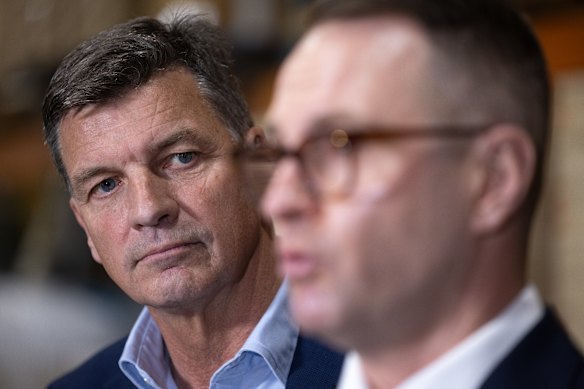

Angus Taylor would cut migration by just 5 per cent under his signature policy if Labor delivers its projected fall in migration and boost to housing supply by the next election.
The opposition leader wants to cap net overseas migration at the number of new homes completed in Australia, vowing to make one of the most significant immigration cuts in history in his budget reply speech.
The government and opposition have been locked in a debate over net overseas migration – which tracks long-term arrivals to the country minus departures – after arrivals peaked at more than 555,000 in 2023 when borders reopened following the COVID-19 pandemic. Both parties have vowed to lower migration levels, which were closer to 225,000 pre-pandemic.
Overseas migration is forecast to decline to 225,000 in 2027-28 – the next election year. The government also projects housing completions will reach 213,000, leaving Taylor a gap of just 12,000 between the net number of migrants and the number of houses completed.
Taylor has danced around putting an exact number on his target, saying the Coalition would need to assess how many homes were being built closer to the election. By one metric, Taylor billed it as a 70 per cent cut to the more than 555,000 peak. Based on that three-year-old figure, the Coalition would want net overseas migration to be closer to 166,000.
Opposition housing spokesman Andrew Bragg on Monday defended the policy and rejected Labor’s projections, saying the government had proven unable to deliver on its housing targets.
“Past performance is a good indicator of future performance. I’d be surprised if this government ever builds 200,000 houses in a year, let alone the 250,000 needed,” he said.
A spokesman for Taylor said Labor had left a 400,000 person shortfall by building enough homes for 1.4 million people over the same period the population had grown to 1.8 million.
The moderate senator spoke out against the policy, accusing his party of stoking anxiety and fear in the community and alienating migrants with its rhetoric.
“Leaders have to explain to the community how we’re going to meet the challenges of the nation, and we have to have a positive vision going forward, and I’m concerned that the rhetoric of many people on my side of politics is being misinterpreted,” McLachlan told Radio National.
Former Department of Immigration deputy secretary Abul Rizvi said Labor did not have enough in its policy platform to hit its migration projections, but warned cutting net overseas migration too far and too fast risked tanking the local housing market.
Rizvi said letting in one migrant for each home built would quickly generate an oversupply of homes because the occupancy ratio was roughly 2.5 people per home.
“In the short term, that’ll be very good because we’ll catch up to some of the backlog, but within a few years you’ll be in a situation similar to Canada,” he said. Housing prices have fallen significantly in some Canadian cities after a crackdown on foreign arrivals in 2024.
“The risk for a property developer, in particular, is that they’ll build a house and they can’t get a price for it that covers cost,” Rizvi said, adding homeowners would be hurt by falling home values.
Bragg said the Coalition would consider the average number of people per home as it developed the policy detail, despite the leader’s office billing the policy as limiting “net overseas migration at housing completions”.
“We never said it was one-to-one,” Bragg, who has shied away from using the controversial term “mass migration” repeatedly deployed by Taylor in his speech, said.
Multicultural leaders have quickly decried the opposition’s policy as an attack on migrants, while industry leaders have emphasised the importance of skilled migration.
Master Builders Australia acting chief executive Melissa Byrne said neither side of politics was focused on what she described as the key challenge for housing supply.
“The main gap that we see in terms of the discussions around immigration policy is the need for skilled migration,” Byrne said.
“For us, that’s the critical piece of the puzzle in terms of construction activity, and goes to addressing some of those issues with workforce shortages.”
She said Master Builders has projected that construction activity will begin to drop off from 2027-28 largely because of workforce shortages, both across skilled migration and domestic apprenticeships.
Bragg said the Coalition understood the importance of skilled migration and would undertake “careful consultation” on the details of the policy, such as which visa classes would be targeted.
Prime Minister Anthony Albanese said on Tuesday the Coalition’s housing and social services policies were an attack on migrants.
“[Taylor] spoke about Australians as if they’re separate from migrants, in particular, singling out permanent residents, as if permanent residents aren’t contributing to this country,” Anthony Albanese told reporters in Western Australia.
“Angus Taylor’s budget reply was all about fighting One Nation. What I’m about is fighting for our nation, the entire nation.”
Get across all our coverage
 Brittany Busch is a federal politics reporter for The Age and Sydney Morning Herald.Connect via email.
From our partners
Disclaimer : This story is auto aggregated by a computer programme and has not been created or edited by DOWNTHENEWS. Publisher: www.smh.com.au


