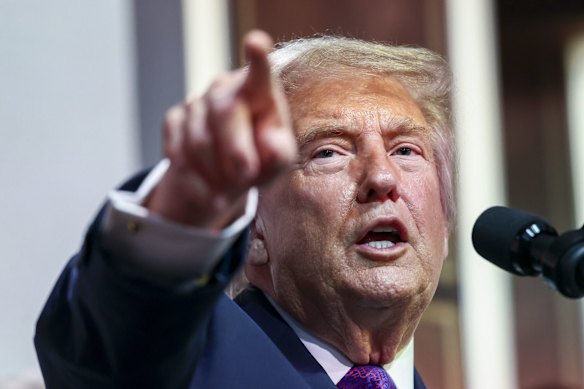

Washington: Donald Trump said he was holding off on a planned attack on Iran at the request of US Gulf allies, and talked up the prospects of an imminent deal to end the war, saying it was different to previous stalled peace efforts.
The US president also signalled a much larger role, even a leading one, for Saudi Arabia, Qatar and the United Arab Emirates in the negotiations. “They think that they are getting very close to making a deal,” he said. “If they’re satisfied, we will be probably satisfied also.”
He said he had been preparing to launch a “very major attack” against the Iranian regime on Tuesday (Washington time), which would have marked a return to hostilities after a ceasefire was declared on April 8.
Trump had not previously disclosed the planned attack, although various media reports suggested that he was weighing his options, and several Republicans were urging him to resume strikes in the hope of forcing Iran to make more concessions.
But Trump said he had suspended the plans for at least the next two to three days at the behest of the Saudi, Qatari and Emirati leaders.
“I’ve put it off for a little while – hopefully, maybe, forever, but possibly for a little while. We’ve had very big discussions with Iran, and we’ll see what they amount to,” he told reporters.
“There seems to be a very good chance that they can work something out. If we can do that without bombing the hell out of them, I would be very happy.”
A full-scale military attack on Iran was still possible at a moment’s notice, Trump warned, if an acceptable agreement was not reached.
His backdown from a threat that he had not publicly made was unusual even for a president who has made a habit of issuing deadlines and warnings – including one that foreshadowed the death of an entire civilisation – before retreating and allowing more time.
He has also routinely cited requests from Gulf allies or Pakistan as the reason for his about-face on threats.
In the past week, Trump said the ceasefire with Iran was “on massive life support” after he deemed the Iranian response to a US proposal so unsatisfactory that he did not finish reading the document.
Iran, through state media, claimed it revised its proposal to the US through Pakistani mediators, but that there remained significant gaps between the two sides’ positions.
At his weekly news conference, Iran’s Foreign Ministry spokesperson, Esmaeil Baghaei, said Tehran’s views had been communicated to the American side, but provided no details.
In an apparent softening of Washington’s stance, a senior Iranian source told Reuters on Monday that the US had agreed to release a quarter of Iran’s frozen funds, totalling tens of billions of dollars, held in foreign banks. Iran wants all the assets released.
The Iranian source also said Washington had shown more flexibility in agreeing to let Iran continue some peaceful nuclear activity under the supervision of the International Atomic Energy Agency.
The US has not confirmed that it has agreed to anything in the talks.
In comments that also hinted at progress towards a deal, Iranian President Masoud Pezeshkian said on X that engaging in dialogue did not mean surrender.
“The Islamic Republic of Iran enters into dialogue with dignity, authority and the preservation of the nation’s rights, and under no circumstances will it retreat from the legal rights of the people and the country,” he said.
Meanwhile, Iran’s Supreme National Security Council announced the launch of the Persian Gulf Strait Authority, which purported to be “the legal entity and representative authority of the Islamic Republic of Iran for managing the passage and transit through the Strait of Hormuz”.
Travel through the strait, which was free and open before the war, was “contingent upon full co-ordination with these entities, and passage without permission will be considered illegal”, the entity said on X.
Iran’s de facto closure of the waterway, through which more than a fifth of the world’s oil usually transits, has been a major feature of the war and a key contributor to rising global oil prices.
Brent crude oil futures remained at around $US110 a barrel on Monday (New York time) despite Trump calling off the plans to resume strikes.
With Reuters
Get a note directly from our foreign correspondents on what’s making headlines around the world. Sign up for our weekly What in the World newsletter.
 Michael Koziol is the North America correspondent for The Age and Sydney Morning Herald. He is a former Sydney editor, Sun-Herald deputy editor and a federal political reporter in Canberra.Connect via X or email.
From our partners
Disclaimer : This story is auto aggregated by a computer programme and has not been created or edited by DOWNTHENEWS. Publisher: www.smh.com.au