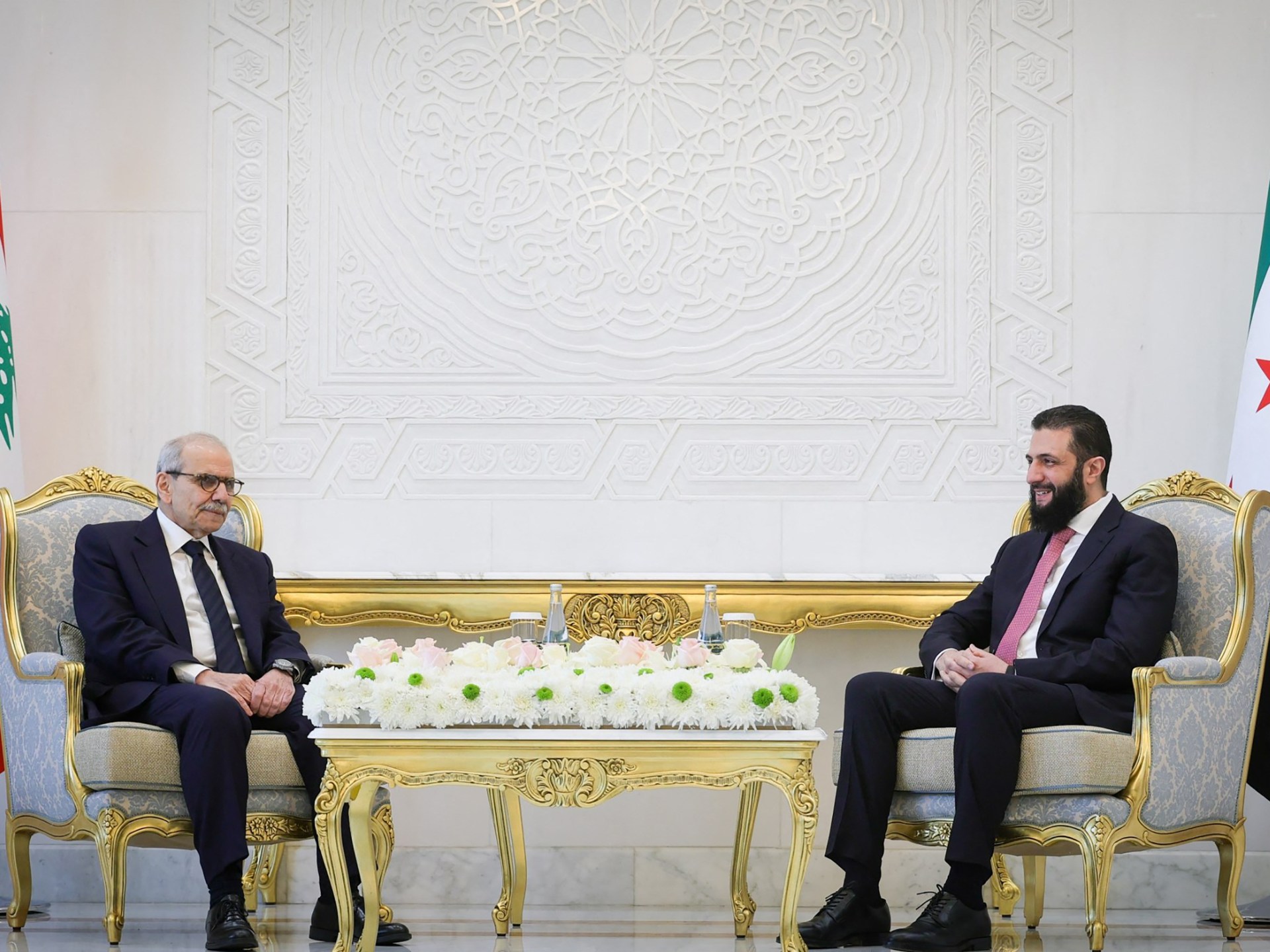
Beirut, Lebanon – On May 9, Lebanon’s Prime Minister Nawaf Salam made his second official visit to the Syrian capital Damascus since the fall of the al-Assad regime in 2024. The trip came as both Lebanon and Syria suffer ongoing Israeli attacks and occupation of their territories.
It also marks the continuation of a ‘new framework’ for relations between the two countries, analysts told Al Jazeera. That followed years of Syria exerting its political and security influence over Lebanon, and the Lebanese group Hezbollah’s military support for President Bashar al-Assad during Syria’s civil war.
Recommended Stories
list of 3 itemsend of list
“Damascus is framing the relationship as one between two sovereign and equal states, and it has matched the rhetoric with institutional moves like suspending [in October] the [Lebanese-Syrian] Higher Council that symbolised Syrian tutelage [and] operating embassies on both sides,” Nanar Hawach, International Crisis Group’s Senior Analyst for Syria, told Al Jazeera.
New priorities
In December 2024, Syrian opposition groups launched an operation to take government-controlled areas, including Damascus, from the grip of the al-Assad regime. In the early hours of December 8, Bashar al-Assad fled the country, bringing an end to five decades of dynastic family rule in Syria.
Al-Assad left the country in tatters. A 2011 uprising against him was violently suppressed by the regime and the war that followed destroyed vast areas of the country. Syria under al-Assad was isolated from the international community and suffered from repeated and compounding international sanctions.
Advertisement
The fall of al-Assad changed the dynamic with Lebanon, Mounir Rabih, a Lebanese political analyst, told Al Jazeera.
“No one in Lebanon thought al-Assad would fall and no one expected [Ahmed] al-Sharaa to come to power,” he said, referring to the current Syrian president, who led the military offensive that toppled his predecessor.
The complicated relationship between Lebanon and Syria dates back to their foundation as modern nations. While Mount Lebanon as a region had a degree of local autonomy under the Ottoman Empire pre-1918, Lebanon as a modern state was established under the post-Ottoman French mandate, separating it from Greater Syria.
The implementation of borders changed societal, economic and political realities for many, in both Syria and Lebanon. In 1971, President Hafez al-Assad came to power in Syria and a few years later, Lebanon’s civil war broke out.
In 1976, Syria under al-Assad invaded Lebanon and would occupy parts of it, retaining significant political and security influence, until 2005, when popular protests expelled the Syrian presence from Lebanon. Hafez al-Assad died in 2000 and was succeeded by his son, Bashar.
Even after Syrian troops left Lebanese territory, Syria retained influence through the regime’s local allies. That influence began to wane in 2011 as the Syrian uprising turned the state’s focus to its own internal dynamics, but al-Assad’s ousting still marks a significant shift in Lebanon.
The fall of the al-Assad regime cut off Hezbollah’s land route to receive funding and weapons from its benefactor Iran. Both al-Assad and Hezbollah were seen as part of Iran’s ‘Axis of Resistance’, and Hezbollah had also played a crucial role suppressing opposition to al-Assad in Syria.
Syria’s new government, led by al-Sharaa, was adamantly opposed to Hezbollah. It also aimed to return the country to the international fold, remove Assad-era sanctions, and play an important economic role in the region.
As for Lebanon, Syria stated its intention to treat its neighbour as an equal, rather than as a territory to control or an arena to play out its battles. With this new relationship came a new series of priorities
“Damascus’s top priorities on the Lebanon file are border control and demarcation, the transfer of Syrian detainees held in Lebanese prisons, refugee returns on terms Damascus can manage, and the Assad-era figures who fled into Lebanon,” Hawach said. “Recovering Syrian deposits trapped in Lebanese banks sits behind these, and the economic files like gas, electricity and transit rank lower despite generating most of the public rhetoric.”
A new page
One of the issues that has dominated headlines has been the more than 2,000 Syrians in Lebanese prisons. In March, 130 Syrian prisoners were transferred from Lebanon to Syria where they will serve the remainder of their sentences, but hundreds remain.
Advertisement
The issue is contentious in Lebanon, where some are held on “terrorism” charges and others have been held for attacks on the Lebanese Army. Still, most have never been tried, despite spending years in jail, because of political gridlock, judicial strikes and political indifference.
After his latest visit, Salam said the prisoner issue had been discussed, as had strengthening cooperation between the two countries.
“We discussed continuing efforts to address the issue of detained Syrians [in Lebanon] and to uncover the fate of the missing and forcibly detained in both countries,” Salam said after meeting al-Sharaa.
But there are also two major issues that touch both countries that have not been spoken about as priorities: how each side wants to handle Hezbollah, and Israeli encroachments on their respective territories.
When Hezbollah attacked Israel on March 2 in retaliation for the killing of Iran’s Supreme Leader Ayatollah Ali Khamenei, rumours started to spread in Lebanon over possible Syrian intervention. The Reuters news agency, citing sources briefed on the topic, reported that al-Sharaa had rejected the idea of deploying troops to Lebanon to help disarm Hezbollah.
“What Damascus is already doing is probably the ceiling of what it will do: sealing its side of the border, breaking up smuggling networks, and signalling support, at least rhetorically, for the Lebanese state’s effort to bring all weapons [including Hezbollah’s] under its control,” Hawach said. “Beirut and Damascus have kept Hezbollah off the formal bilateral agenda, and both seem to find that arrangement useful.”
No agreement on Israel
As for Israel, the two countries do not appear to be discussing any kind of bilateral action or agreement at the moment, with both countries instead focused on internal stability first.
“Beirut and Damascus share a genuine common interest in pushing back against Israeli territorial expansion and the risk of being pressured into one-sided agreements, but there appears to be no structured coordination between them on the Israel file,” Hawach said. “Each is negotiating separately under US mediation, and the most that exists for now is leadership-level consultation.”
Israel’s attacks in Lebanon have killed almost 3,000 people since March 2 as Israeli forces push into the south, causing widespread destruction, demolition of homes and displacing more than 1.2 million people. A ceasefire was announced by Donald Trump on April 16. Since then, only one strike has hit Beirut’s suburbs, but Israeli attacks and displacement orders in southern Lebanon have not ceased. Nor has Hezbollah retaliation.
But Syria has also not escaped Israeli attack. In the year after the fall of al-Assad, Israel struck Syria more than 600 times. On May 17, Fadel Abdulghany of the Syrian Network for Human Rights accused Israel of “gradually annexing” southern Syria. The day after al-Assad fell, Israel seized more land in the occupied Golan Heights.
The Syrian state has avoided attacking Israel and has tried to use its renewed global standing to strengthen itself instead. In November 2025, al-Sharaa became the first Syrian leader to visit the White House, marking a blossoming relationship with Trump.
Advertisement
Still, the Israelis attacked Syrian military posts as recently as March, and continue to set up checkpoints on Syrian territory, according to Syrian media.
“Israel is taking part of Lebanon and part of Syria,” Rabih said, adding that it is trying to create discord between the two states. However, Rabih added that a new alliance is forming in the region.
“Turkiye and Saudi Arabia want Lebanon and Syria to coordinate,” he said. He added that Syria and Lebanon would seek protection that way from a wider alliance that could convince the US to pressure Israel to stop its aggression and land grabs.
But that file, analysts said, will be part of a wider regional framework. For the time being, Lebanon and Syria seem to be operating on equal footing, despite a history of Syrian hegemony over its smaller neighbour. But each country’s priority – and particularly Syria’s – are their own domestic matters.
“Lebanon is not a priority file in Damascus right now,” Hawach said. “The new government is consumed with stabilising Syria, managing Israel and securing reconstruction money, and it has neither the appetite nor the bandwidth to pursue a more ambitious agenda in Lebanon even if it wanted to.”
Disclaimer : This story is auto aggregated by a computer programme and has not been created or edited by DOWNTHENEWS. Publisher: aljazeera.com