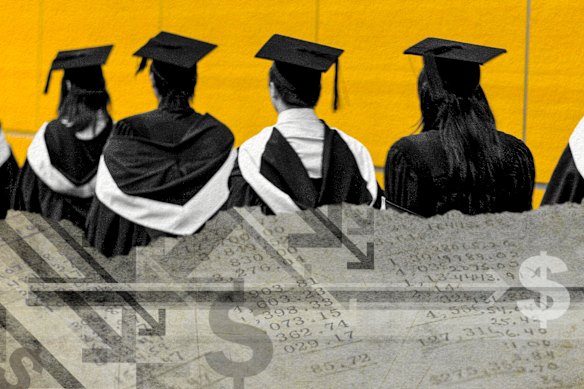

The federal government has spent more than $1 billion of taxpayer money compensating universities for students who never attended under an offset scheme which resulted in some institutions receiving $100 million.
Designed to address under-enrolment – when the university has fewer students accept spots in a course than it has places available – the scheme was created to provide stability during the pandemic. It was anticipated that domestic students would leave higher education in droves, leading to mass sackings of staff who would later have to be rehired.
Introduced by Scott Morrison’s government in 2020 and continued by Labor until the start of this year, the so-called Higher Education Continuity Guarantee and its predecessor, the Higher Education Relief Program, has spent a total of $1.056 billion on students who weren’t.
“What none of us grasped at the time was that the true crisis was not domestic students – we had expected a lot of people to drop out in 2020, but there was instead then a big surge in demand in 2021,” said higher education expert Andrew Norton, who analysed the data.
James Cook University, the University of Tasmania and the University of the Sunshine Coast all received upwards of $100 million for students who never darkened their doors.
In Sydney, the University of NSW received $23 million, the University of Sydney received $10 million and the University of Western Sydney received $20 million.
In Victoria, the University of Melbourne received $2.3 million, Monash University received $1.2 million and the Royal Melbourne Institute of Technology received $37 million.
Universities Australia CEO Luke Sheehy said the funding was crucial.
“[It] helped keep institutions financially viable during a highly uncertain period, especially regional universities that play a critical role in their local communities,” he said.
A spokesperson for the Department of Education said that the Universities Accord recommended the program continue into 2025 after the pandemic disruptions.
“Under the new arrangements, funds must be invested in additional academic and learning support for underrepresented student cohorts,” they said.
The policy ended at the start of this year with the soft launch of the Albanese government’s strict new cap on domestic student numbers that will begin in earnest from next year.
On top of significant limits on international students, Australian university funding is moving away from the demand-driven system introduced by the Gillard government to a so-called managed growth system that will set a target level of enrolments for each university. Students beyond that target will not be funded by the government.
“Unless funding follows enrolments to universities, we risk students missing out on their preferred courses and possibly not going to university at all,” said Norton.
At the same time as introducing managed growth, the Albanese government has set another target – for 80 per cent of Australians to have a tertiary qualification by 2050.
Federal Education Minister Jason Clare said that forthcoming legislation would assist rural and low-socioeconomic cohorts go to university.
“Talent is everywhere. Opportunity isn’t. This is about changing that,” he said.
Start the day with a summary of the day’s most important and interesting stories, analysis and insights. Sign up for our Morning Edition newsletter.
From our partners
Disclaimer : This story is auto aggregated by a computer programme and has not been created or edited by DOWNTHENEWS. Publisher: www.smh.com.au