You’ve been planning the perfect trip for months: that gorgeous, sun-filled apartment overlooking the Seine on one end and crystal clear views of the Eiffel Tower on the other; a slow breakfast filled with coffee and croissants galore; pre-booked tickets to the Louvre and d’Orsay; and three impossible-to-get reservations at Paris’ finest restaurants.
That sounds like the perfect vacation: if only you could get there in one piece. Unfortunately, your flight was delayed 12 hours; you’re not entitled to a hotel stay nor a paltry $12 airport food voucher; and you’re now paying for an extra day of the apartment and missed your museum and dinner reservations.
If you’re feeling anxious about summer travel plans ahead, you’re not a lone. A new survey of more than 1,000 U.S. travelers, conducted by Hopper Technology Solutions (HTS), found that 89% of travelers planning to fly in the next 12 months are concerned about delays or cancellations affecting their upcoming trips. Nearly one in four describe themselves as “extremely concerned” about their trips, and that sentiment is changing how they approach booking their travel.
Disruptions have become the norm
The findings show travelers no longer see disruptions as a rare inconvenience but a baseline expectation. According to HTS data, more than 58 million seats scheduled to depart from U.S. airports were affected by significant disruptions in 2025, up from 50 million in 2019. The frequency of what HTS calls “significant disruption days” (when more than 10% of all scheduled departing capacity is delayed over two hours or canceled within a single 24-hour period) has roughly doubled since before the pandemic.
“We’ve been seeing over the years not just an increase in overall general disruptions, like a delay here and a delay there, but a significant increase in what I call a significant disruption day,” said Hayley Berg, Lead Economist at HTS. “Those days are increasing every year. We’re up to close to 20 a year across the entire United States.”
These mass disruption events, sometimes caused by severe weather, air traffic control staffing shortages, geopolitical conflict, is often outside any individual airline’s control.
“Airlines themselves have done so much work on operational efficiency, especially because of how bad 2021 and 2022 summers were,” Berg told Fortune. “They’re in a really great space now. But then government shut down, so you couldn’t get through TSA. You couldn’t make your flight. And then there weren’t enough air traffic controllers, so there were these intermittent closures of airports. They can’t control that, and they can’t plan for it.”
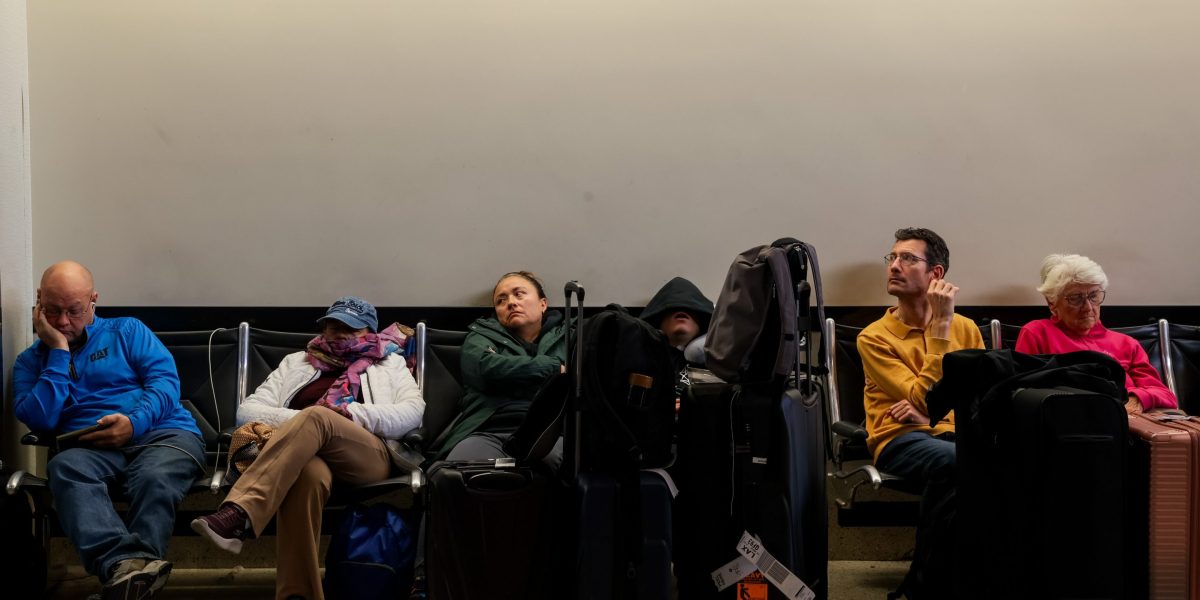
In a year filled with government shutdowns, adverse weather conditions, poor airport staffing and support, and just plain anxiety and delays as understaffing and fatal incidents become all the more recurring, you wouldn’t be faulted for getting anxious at the thought of traveling for your “restful vacation.”
As a result, people have started booking “calmcations,” or closer trips fully intended to relax in spas and get massages. Others have spent an arm and a leg to get to the same place they would have for much cheaper years ago, or are bracing themselves to find alternatives to an ultra-low-fare airline that recently went down. It seems like travel anxiety is now something people are willing to pay extra for to avoid.
When disruption hits, travelers are on their own
The survey paints a stark picture of what actually happens when a flight goes sideways. More than half of travelers who experienced a significant disruption (defined as a delay of two-plus hours or a cancellation) said they were not proactively notified, and instead found out from a gate agent, an airport announcement, or by checking the airline app on their own.
From there, the resolution process is long and frustrating. Only 15% of disrupted travelers resolved their situation in under 30 minutes. Forty-three percent were still trying to figure out their next move more than two hours later, and 7% never reached a resolution at all. When asked to describe the experience, 53% said it was frustrating.
“The timeline to resolution did surprise me a lot,” Berg said. “The fact that half after two hours still don’t have a resolution, and the way we defined resolution to the respondents was, you know, had a plan, knew what was going to happen next.”
The biggest barriers travelers cited: long wait times (48%), limited rebooking options (42%), and simply not knowing what options were available to them (34%).
When resolution was difficult, leisure travelers reported higher difficulty rates than business or mixed-purpose travelers, likely because frequent flyers have more experience navigating the system. But business travelers face their own problem: every disruption carries professional consequences. Over 68% of those flying primarily for business or a mix of business and leisure experienced a significant delay, compared to 33% of pure leisure travelers. One in five disrupted travelers said they missed a major meeting or important event.
“Our poor business travelersm they’re the savviest travelers, they’re in the skies constantly,” Berg said. “Oftentimes they’re unable to rebook on whatever airline they want. They’re stuck taking whatever is in compliance or whatever was booked for them.”
The financial toll is real
The costs add up quickly. Among those who experienced a significant disruption, 42% incurred out-of-pocket expenses—hotel rooms, meals, ground transportation—that were mostly not reimbursed. Sixty percent of those travelers spent $100 or more, with 26% spending over $200.
It’s not just money. Among disrupted travelers, 62% said they lost meaningful time, 50% experienced additional stress or anxiety, 31% lost quality time with family, and one in five missed a scheduled experience or event they’d traveled for.
“Disruption has really turned into a slog for travelers,” Berg said. “It’s something they’re stressed about before the trip. It’s something that really negatively impacts the experience on the trip. And then if they do have a disruption, it’s costing them more money at a time when airfare is so expensive.”
Flexibility has become the price of confidence
The survey found that flexibility is becoming a prerequisite for booking with confidence. Eighty-four percent of travelers said the ability to change or cancel their flight bookings is at least somewhat important for their next trip, with 20% calling it “extremely important.” For hotels, the number is even higher: 87% rate cancellation flexibility as important.
The demand translates directly into purchase intent. Sixty percent of travelers said they’d be likely to add a Cancel for Any Reason (CFAR) option when booking a flight—rising to 74% among mixed business-and-leisure travelers and a remarkable 90% among the most frequent flyers (13-plus trips per year). Sixty-five percent said they’d be more likely to book with a brand that offers CFAR.
“When we’ve been surveying about disruptions for a long time, it’s always something that’s top of mind,” Berg said. “But when we asked similar questions years ago, it was probably more like two thirds of customers. Now it’s 90-10. It ranks every time we ask this question, in any way we ask it, as the number one concern. There’s just fundamentally a shift now, especially after the pandemic years, where people are prepared for it to happen because it’s very likely to happen to them.”
HTS, the B2B technology arm behind the Hopper consumer app, powers travel infrastructure and fintech products for airlines, banks, and travel platforms around the world. Its partners include Air Canada, Frontier Airlines, Azerbaijan Airlines, Porter Airlines, Commonwealth Bank, Nu Bank, and others across more than 180 countries. The company’s two flagship flexibility products, Disruption Assistance and Cancel for Any Reason, are designed to address the exact problems the survey identified.
Disruption Assistance works like this: a traveler adds it to their booking as an ancillary at checkout. If their flight is delayed two or more hours or canceled, HTS detects it in real time using live schedule data and proactively notifies the traveler. They’re then given two options: rebook themselves on any airline or keep the airline’s rebooked itinerary and receive a full refund of the ticket price to their original payment method.
“It’s putting the control and the autonomy to make the decision back in the consumer’s hands,” Berg said. Cancel for Any Reason, meanwhile, lets travelers cancel a flight or hotel booking for any personal reason before departure and receive a refund, regardless of the original fare rules.
Perhaps most telling is that 84% of customers who use an HTS flexibility product and have a claim go on to purchase it again, on the same channel where they originally booked.
“It’s a product that brings customers back in a really exciting way,” Berg said. “Whether it’s a bank or an airline, it’s a loyalty hook. And if you think about it from an airline’s perspective—a total airport meltdown is a really bad day. To be able to offer a product that solves the problem more quickly for their customers and actually gets their customers coming back to book with them again is really, really targeted and specific.”
Airlines across the spectrum are buying in
One of the more notable findings from HTS’s partner ecosystem is that flexibility isn’t a niche product for one type of carrier. The airlines integrating these solutions range from ultra-low-cost carriers to legacy airlines, spanning regions from North America to the Middle East.
“The range of airlines who we work with, who are offering these flexibility solutions, they run the gamut from LCCs to legacy carriers,” Berg said. “Frontier, Porter, Fly a Deal, Air Canada, they’re all trying to address this flexibility problem. That tells us it’s universal. It’s not just one region, one type of consumer, one type of airline. Everyone has this challenge, and everyone’s really eager to solve it.”
For airlines, the business case is compelling on both sides of the ledger. Flexibility products generate high-margin ancillary revenue—HTS reports that fintech products now account for 45% of the company’s total profit—while simultaneously reducing operational strain on disruption days by giving customers a self-serve path to resolution instead of flooding gate agents and phone lines.
What travelers should do this summer
Berg’s advice for summer travelers echoes what the data suggests: build flexibility into your plans from the start.
“Book with flexibility if you have the option to book a refundable fare, consider doing that,” she said. “If you don’t, and something like Cancel for Any Reason is offered where you can pay a little extra to make it refundable, do it. Just give yourself the flexibility to change your plan.”
Disclaimer : This story is auto aggregated by a computer programme and has not been created or edited by DOWNTHENEWS. Publisher: fortune.com