One of my favourite minute details appears in ‘Plating India’ by the Nobel Prize-winning economist Abhijit Banerjee—an edited conversation with four chefs—where tiny typographic ‘ligatures’ subtly connect certain letters. “The term actually comes from medicine,” Monga explains, “where ligatures are literally sutures, tying something together. In typography, ligatures are when two letters are connected.” The ligatures used here aren’t functional, though; they’re used to create a feeling of something “juicy and playful.”
Photographed by Kriti Monga
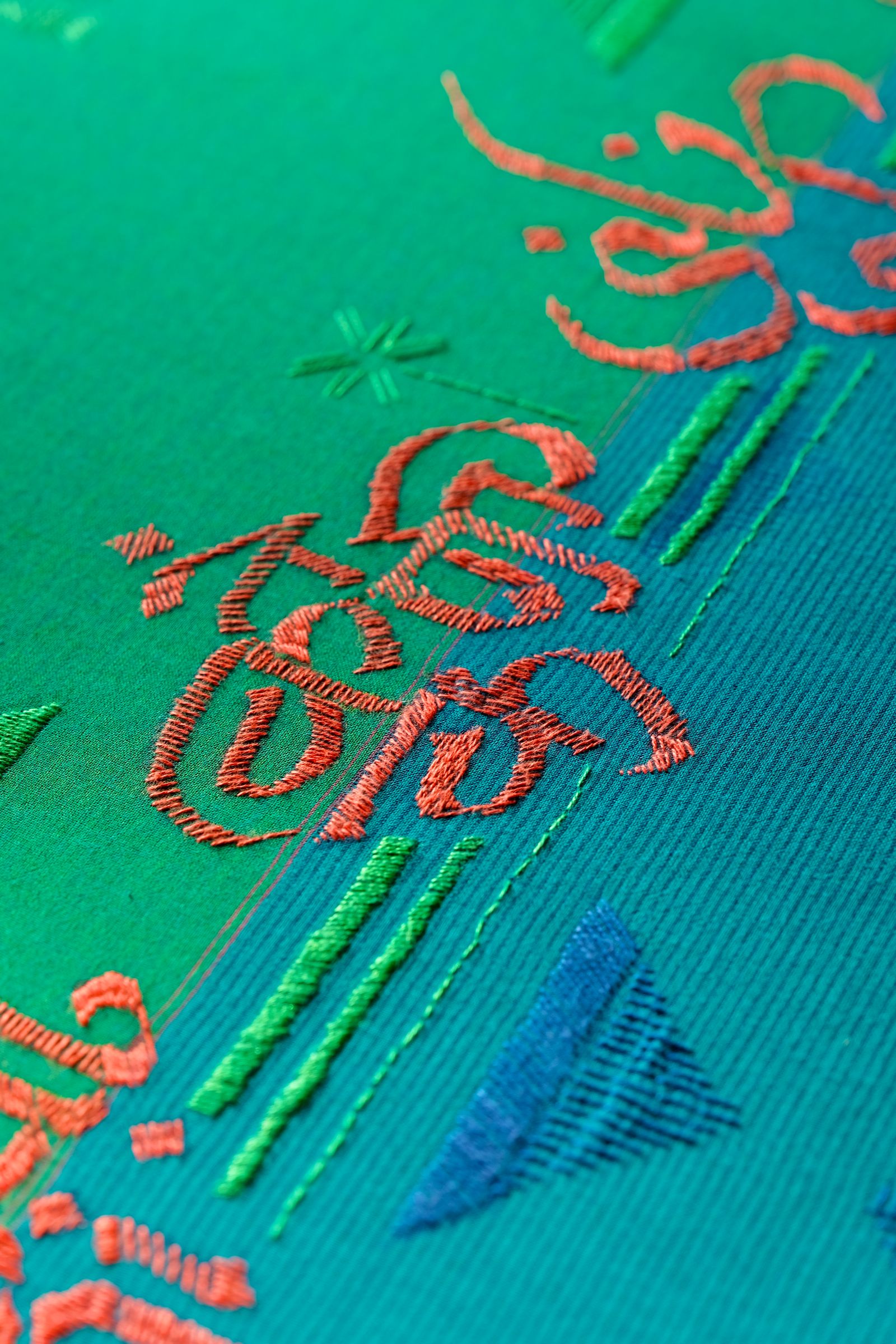
The typeface used across the book is the same, maintaining cohesivity so that every essay has its own visual language while still feeling connected to the larger whole. One of the most striking artworks shows up in ‘Writing in Tongues’ by Vivek Shanbhag and Parul Sehgal, blurring the line between typography and textile art. The piece explores Konkani, the only language in India written in five different scripts, embroidered onto a sari to resemble its pallu. Inspired by Shanbhag’s roots in coastal Karnataka, “the colour palette and embroidery styles of that region informed the artwork. It was hand-embroidered, photographed, colour-corrected and then placed into the book,” the designer adds.
Time + Space spotlights ananas, Madras checks, cummerbund and bandhani, with pineapple being the unlikely starting point for the entire project. “It came from Anirudh Kanisetti’s essay on the fruit,” shares Chaudhry. “Christopher Columbus tastes pineapple in Guadeloupe, and within 100 years, it’s on the walls of the Charminar, in Kalamkari, in Marie Antoinette’s boudoir, used as ornamentation at dinners. Looking at the history of something like that is when I suddenly realised that taste was such a powerful concept.”
Disclaimer : This story is auto aggregated by a computer programme and has not been created or edited by DOWNTHENEWS. Publisher: vogue.in