
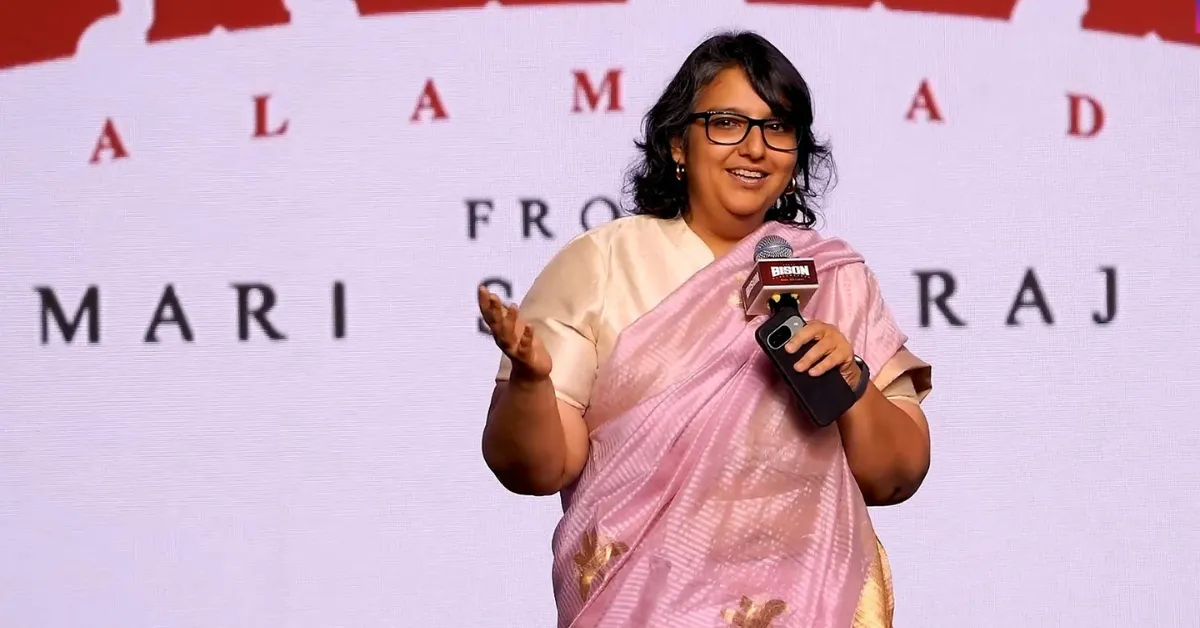
“Family is about finding the people you can build a life with — and discovering there are no rules to how that life should look,” Aditi Anand tells The Better India.
It’s a thought that feels both simple and quietly radical — especially in a world where families are so often defined for us before we can define them for ourselves.
For Aditi Anand (42), an entrepreneur and film producer who has founded two successful media companies, Little Red Car Films and Neelam Studios, and worked on films like Tere Bin Laden, No One Killed Jessica, Paan Singh Tomar, and Chillar Party, this understanding didn’t arrive all at once. It was shaped slowly — through the people she grew up with, the love she found, and the life she chose to build.
Today, as a filmmaker and producer, Aditi has spent years telling stories that challenge norms and expand representation. But beyond the screen, her own life has become a reflection of those very ideas.
Together with her partner, Susan Dias (37) — who has built a life with her for over a decade, co-founded the venture Native Brews, and stood alongside her in petitioning the Supreme Court of India for marriage equality and legal recognition of same-sex parents, Aditi has created a family that moves beyond conventional labels.
As a queer couple in India, their journey has unfolded both in deeply personal ways and in the public eye. They are among those who have not only imagined a different kind of family but also worked to make space for it — legally, socially, and emotionally.
And yet, what they have built feels strikingly simple.
It is a family shaped by choice as much as by love. One that holds space for grandparents and friends, for tradition and reinvention, for both inherited bonds and chosen ones.
And at its heart is a quiet but powerful belief: that family isn’t something you fit into, it’s something you build, together.
A childhood that expanded the idea of belonging
Long before she began redefining family, Aditi had already experienced a version of it that felt unusually expansive.
“I grew up very lucky,” she says. “With both sets of my grandparents and all of their siblings.”
What she describes fondly as a ‘herd of elephants’ wasn’t just a large family — it was a deeply interconnected one. Grandparents, their siblings, and extended relatives all form a web of care, memory, and belonging.
It’s only in hindsight, she reflects, that she realised how rare that kind of upbringing was.
But what truly shaped her was not just the number of people around her, it was who they were.
All four of her grandparents had lived through India’s independence movement and the Partition. They carried within them stories of both immense hope and unimaginable loss, the “highest of highs and the lowest of lows”, as she puts it.
From them, Aditi inherited more than family history. She inherited a way of engaging with the world.
“They had this sense that the nation is not something far away,” she says. “It’s something you participate in and something you build.”
That idea — of building, of participating, of shaping what exists — quietly became a throughline in her life. It shows up in the kind of cinema she engages with, the stories she is drawn to, and the life she has chosen to live.
When the future felt out of reach
And yet, like many queer people growing up in India, there was a time when the idea of building a family of her own felt almost impossible.
“When we come out to our parents,” Aditi says, “we’re not just telling them that we’re gay. We’re telling them we’ll never be married, never have children and the the life they imagined for us.”
It’s a layered kind of loss, not just of acceptance, but of imagined futures.
“You’re not allowed to imagine that life, and it is hard to think of a life that you can live alone,” she adds.
For a long time, that uncertainty lingered.
Until she met Susan.
A love that changed everything
Aditi and Susan met in 2012 — a moment that, in many ways, divided her life into two distinct chapters. “There’s life before Susan and there’s life after,” she says.
It wasn’t just about finding love but about finding possibility.
“I was only able to imagine a life of adulthood and hope after I met her,” Aditi shares.
“I only came out to my parents because I met her, because it didn’t feel acceptable anymore to not share this person with my family.”
/filters:format(webp)/english-betterindia/media/media_files/2026/05/19/aditi-anand-2026-05-19-13-39-31.png)
For Susan Dias, their journey has been just as transformative.
“We’ve seen each other through the most formative years of our adult lives,” she says. “Through very happy times and some hard ones, we navigated it all and somehow grew up together.”
Over nearly 14 years, their relationship has evolved through shared experiences – careers, cities, and challenges – but what has anchored them most deeply are their shared values.
“Beyond the love that brought and kept us together,” Susan says, “we’ve been able to start a family because we share the same values.”
Choosing parenthood, together
When it came to building a family, their journey wasn’t marked by one grand decision but by a series of smaller, deeply personal ones.
Aditi laughs as she admits, “Every big decision in our lives has come from Susan.”
From adopting their dog to eventually adopting their son, Susan often took the lead. But what made those decisions possible was the trust between them — the ability to hold space for each other’s desires.
“I always wanted to adopt,” Aditi explains. “Susan was very clear she wanted to start a family. So we supported each other in what we individually believed in.”
For Susan, the decision to become parents was thoughtful and intentional.
“We waited until we were ready — financially and emotionally,” she says. “It meant reflecting on what we needed to change in our lives and also looking at the society around us.”
There were questions, of course. About acceptance, safety and whether a same-sex family could truly belong.
But their lived experience has been reassuring.
“We’ve only received love and acceptance from people around us,” Susan shares. “And that, to us, is a sign that society is changing.”
Raising a child in a world without labels
When their son entered their lives, something shifted — not just in their home, but in the way they understood family itself.
Aditi describes it with a smile: “When we met, we were like a gritty noir. And then suddenly, we had a child, and we found ourselves in a Sooraj Barjatya film.”
It’s a striking contrast, from independence to interdependence, from solitude to a life filled with many voices.
Their son, like Aditi once did, is growing up surrounded by a ‘herd of elephants’.
Grandparents, great-grandparents, close friends, godparents — a blend of natal and chosen family that forms a rich, supportive ecosystem around him.
“Family is our core,” Susan says. “It’s the people, natal and chosen, who make up the essential structures of our lives.”
/filters:format(webp)/english-betterindia/media/media_files/2026/05/19/aditi-anand-2026-05-19-13-40-14.png)
There’s a moment Aditi shares that captures this beautifully.
One day, their son decided he wanted to “run away from home”. When she asked him where he’d go, he named one of their closest friends.
It’s a small, almost playful anecdote, but it reveals something profound. For him, family isn’t confined to a single space; it exists wherever love does.
The lessons they didn’t expect
If there’s one thing both Aditi and Susan agree on, it’s that parenthood reshapes you in ways you cannot anticipate.
“Parenthood is all about unexpected challenges, for which nobody is prepared” Aditi says.
For her, one of the biggest shifts has been internal.
“I used to think you’re either good at something or bad at something,” she reflects. “And if you’re not good, you just quit.”
/filters:format(webp)/english-betterindia/media/media_files/2026/05/19/aditi-anand-2026-05-19-13-41-02.png)
But watching Susan parent — patiently and intentionally, that thought has been changed.
“I’ve learned that I don’t have to be a brick wall,” she says. “I can express fear and I can process difficult emotions.”
Their son, in many ways, has become a teacher — bringing curiosity, wonder, and a new way of engaging with the world.
Through him, Aditi finds herself exploring things she never imagined — deep sea creatures, outer space, and the joy of asking questions without needing immediate answers.
For Susan, too, the transformation has been profound.
“Parenting has made me calmer,” she says. “It changes how you view your own life and makes you more aware of your child’s future.”
It has also deepened their relationship.
“We’re kinder and more patient with each other now,” she adds. “There’s a deeper level of understanding and respect.”
A quiet shift, a powerful message
In many ways, Aditi’s and Susan’s story is not just about one family — it’s about a broader shift in how we understand family itself.
“There is hope,” Aditi says. Hope that queer families in India are no longer invisible and that this idea of family can stretch, evolve, and include.
But she also believes that change comes from something as simple and as powerful as language.
If queerness is to feel rooted, she says, it must be spoken about in ways that feel familiar, that carry history, that belong.
For Susan, the shift is already visible. “I do think people’s perceptions of family are changing,” she says. “Even in traditional spaces, in gender roles, in parenting, in how we raise children.”
/filters:format(webp)/english-betterindia/media/media_files/2026/05/19/aditi-anand-2026-05-19-13-42-26.png)
In the end, Aditi resists giving a grand, definitive answer to what family is. Instead, she returns to something simpler and lived.
“I don’t think there are rules,” she says again. Family, as she sees it, is not something fixed. It is not something you inherit in a single form.
It is something you build — slowly, intentionally, imperfectly.
It is the people who stand beside you, the ones who raise you, choose you, and teach you.
ones you grow with.
And sometimes, it is the courage to imagine a life that once felt impossible, and then,steadily, to build it anyway.
All images courtesy Aditi Anand.
Disclaimer : This story is auto aggregated by a computer programme and has not been created or edited by DOWNTHENEWS. Publisher: thebetterindia.com



