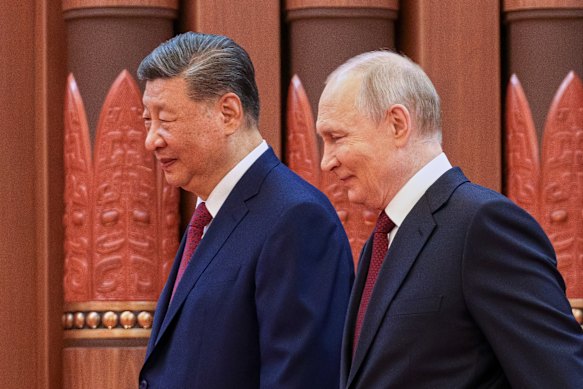

Beijing: Five days after the great optics bonanza that was the Trump-Xi summit, Vladimir Putin’s caravan has rolled into Beijing.
Chinese leader Xi Jinping greeted his “old friend” with a red carpet welcome ceremony at Tiananmen Square on Wednesday, replete with a military honour guard, a 21-gun salute and children waving the two countries’ flags.
The pageantry of Putin’s state visit mirrors the fanfare that welcomed Donald Trump last week.
Like Trump, Putin will also have tea with Xi at Zhongnanhai, the exclusive Communist Party headquarters.
For Xi, the swivel between hosting the two big power rivals – which flank China in global standings – is a coup of timing, and one that boosts Beijing’s narrative that it is the epicentre of world diplomacy.
“It demonstrates to the world, and to Trump as well, that China is a global player and has options. It has multiple relationships, and it has a very independent and self-centered foreign policy,” says Philipp Ivanov, a China-Russia specialist who runs advisory firm Geopolitical Risks and Strategy Practice.
Despite all the bonhomie between Trump and Xi last week, the relationship between Putin and his Chinese counterpart runs much deeper. Whether entirely genuine or a great show, the two men have spent years projecting a bromance in their public appearances as the basis for the “no limits” partnership between their nations.
Ties between Russia and China were at an “unprecedentedly high level,” Putin told Xi as they sat down for talks in the Great Hall of the People, evoking a Chinese proverb that “if friends have not seen each other for one day, it feels as though three autumns have passed”.
The reality is the rare back-to-back summits have aided in cementing Putin’s Russia as a distant third in the global superpower stakes, with Moscow’s relationship with Beijing increasingly lopsided.
Putin arrived in Beijing weakened by the stalemate in the Ukraine war, which has dragged his economy into the doldrums and made it even more reliant on Beijing’s lifeline as the biggest buyer of its fossil fuels. China, in turn, is a major supplier of electronic goods to Russia as well as dual-use technologies and equipment that has aided its war efforts.
The Iran war has handed the Russian leader a window to boost sales of energy supplies to China, which is looking to further diversify away from the troubled Middle East and Strait of Hormuz chokehold. Putin wants to progress talks on the proposed Power of Siberia 2 pipeline, a massive 2,600 kilometre project that would send natural gas to China via Mongolia and which has stalled due to disagreements over gas prices.
The project has become more critical to Russia’s economy as western sanctions have cut off its access to European markets.
The summit also gives Putin and Xi the chance to debrief on the talks with Trump last week, something the Kremlin has been surprisingly frank about.
The trip would give Moscow “a good opportunity to share opinions on the contacts that the Chinese had with the Americans,” Kremlin spokesperson Dmitry Peskov told reporters last week.
This visit is Putin’s 25th to China in his more than two decades as leader. Last year in Beijing, he took centre stage alongside Xi and North Korean leader Kim Jong Un at a military parade honouring the end of World War II, projecting an image of anti-western defiance.
Xi’s embrace of Putin should be a reminder “that Beijing’s closest international partners are connected by their shared emphasis on resistance to the United States,” China expert Julian Gewirtz, a Biden-era National Security Council official, wrote in a recent analysis.
During their talks, the two men were expected to adopt a manifesto endorsing their vision of a multipolar world, which is their proposed alternative to the US-led international order. But while Xi and Putin appear as thick as thieves, the US-China relationship is more consequential to Beijing in status and power.
As the world’s two biggest economies, Beijing and Washington are entwined in a furious rivalry for supremacy across tech, artificial intelligence, military prowess, and geopolitical influence. Xi walked away from the Trump summit with something Putin couldn’t give him – affirmation that China and the US are peers on the global stage.
“In a subtle way, Xi has demonstrated that in the multipolar world that he seeks to build, this multipolarity coexists with a bipolar world in which China and the US are equal,” says Ivanov.
“And that message is well understood in Russia.”
Get a note directly from our foreign correspondents on what’s making headlines around the world. Sign up for our weekly What in the World newsletter.
 Lisa Visentin is the North Asia correspondent for The Sydney Morning Herald and The Age based in Beijing. She was previously a federal political correspondent based in Canberra.Connect via X or email.
From our partners
Disclaimer : This story is auto aggregated by a computer programme and has not been created or edited by DOWNTHENEWS. Publisher: www.smh.com.au