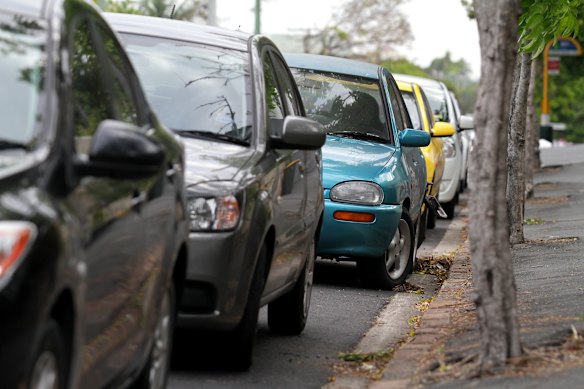

In some Brisbane suburbs, there are at least twice as many on-street parking spaces than cars.
The figure is evidence of the city’s “emotional attachment to parking”, one researcher has claimed, in a call for an eventual ban on kerbside parking.
Analysis by the Grattan Institute, released on Tuesday, found rules requiring new housing developments to include off-street parking add about $113,000 to the cost of building a typical two-bedroom apartment in Brisbane.
Restrictions in inner-city suburbs, such as West End, Herston and Taringa, require residents and their visitors to apply for kerbside parking permits, costing $18.10 a year.
The Grattan Institute argues the price of these permits should be increased to manage demand as on-street parking becomes scarce.
And outside Brisbane’s inner suburbs, the overwhelming majority of on-street parking is unrestricted.
Studies from the Netherlands, UK and US show that when free on-street parking is available, many households use their off-street parking spaces for something else, like storage.
“Forcing residents of new homes to pay for a car space they don’t want, even as they park on the street anyway, is the worst of both worlds: fewer, more expensive homes and congested streets,” the Grattan report says.
“Where there is lots of parking, minimum parking requirements (for new housing developments) are unnecessary. Where parking is congested, they don’t help. In all of these areas, they should be abolished.”
Dr Dorina Pojani from the University of Queensland has done research on how turning high streets’ kerbside car parks into bike lanes affects liveability and the economic viability of small business.
She said Brisbane needed to completely rethink how road space was allocated.
“In Brisbane, there seems to be an emotional attachment to parking, and cars generally,” she said.
Pojani said there were tensions between drivers and micromobility users – including bikes and e-scooters – which were exacerbated by parking policies.
“The proliferation of micromobility vehicles necessitates the creation of wide segregated paths accommodating all of these diverse modes,” she said.
“In denser areas, like the inner-city, making room for micromobility will entail strategic trade-offs with cars – and even buses.
“This will likely involve repurposing existing traffic lanes or parking lanes.”
Describing on-street parking as an eyesore, Pojani said she would personally like to see a ban on kerbside parking, saying cars could go into existing or new purpose-built off-street parking.
“Rather than lining our streets, cars would be concentrated in fewer, managed locations,” she said.
Minimum car park rules also apply to commercial and recreational developments.
For example, a newly built tennis facility in Brisbane must include six parking spaces per court. That’s still more car parking than needed for a game of doubles with a referee.
Nightclubs must provide six spaces for every 100 square metres of floor space – meaning they are forced to have more space for parking than the dance floor.
“The results of requiring more parking are fewer things to do, businesses that never open, and forcing those that are built to be surrounded by an ocean of asphalt,” the Grattan Institute’s report says.
Last year, Brisbane City Council included more parts of the inner city in rules that slash car park requirements.
In the “city core” area, new high-density developments have a maximum of 0.5 car spaces per one-bedroom, one per two-bedroom, 1.5 per three-bedroom, and two for four or more bedroom units.
The council is reviewing parking in “low-medium density areas” close to public transport and shops, with a final plan expected to be adopted soon.
Kieran and Jazz, who have been car-free for five years, said they preferred to live within walking distance of shops, services and amenities.
While looking to buy their first home, they were surprised to find apartments minutes from the city, and close to public transport, still had one or more car spaces included.
“We are privileged enough to consider buying a small apartment in West End, but it’s not achievable for everyone – and we are being priced out too,” Kieran said.
“With the ever-increasing congestion we’re seeing on the roads, it only makes sense to give options for the people who don’t want or need a car.
“And with the housing crisis we are currently in, it only makes sense to give people options that are over $100,000 cheaper.”
Travis Jordan, the lead organiser of housing advocacy group Greater Brisbane, said if there was nowhere on the street to park, it did not mean more parking was needed.
“It tells you council isn’t charging enough for the parking it already has,” he said.
“Every car park could be a street tree, outdoor dining, or parking for a dozen bikes or scooters.
“Every street of parking could have a bus lane or pocket park.”
The council’s city planning chair, Adam Allan, said Brisbane was growing fast and all levels of government needed to act decisively to boost housing supply.
“House prices and rents will only stabilise when more homes are built,” he said.
“Our changes are about striking the right balance by relaxing car parking requirements in areas that are already well-serviced by public transport and other services, helping to reduce the cost to build new homes.”
Start the day with a summary of the day’s most important and interesting stories, analysis and insights. Sign up for our Morning Edition newsletter.
From our partners
Disclaimer : This story is auto aggregated by a computer programme and has not been created or edited by DOWNTHENEWS. Publisher: www.smh.com.au