
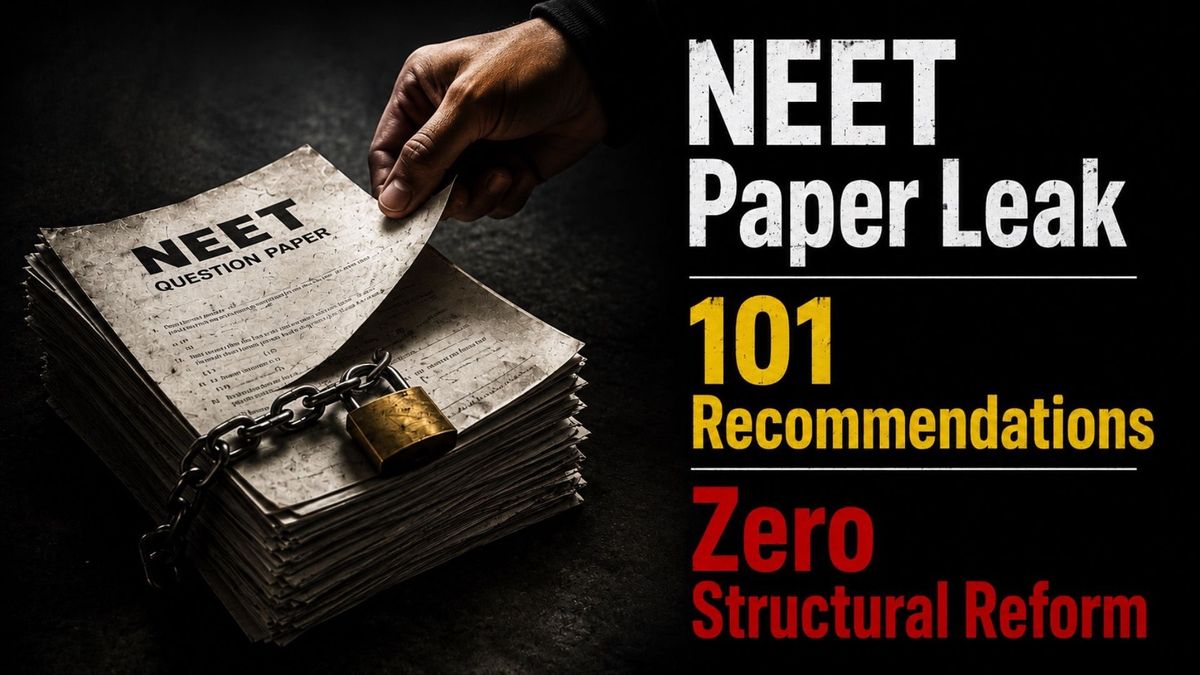
The latest NEET paper leak is not a freak accident; it is the inevitable consequence of a brittle, exam-obsessed ecosystem that refused to learn from its own post-mortems. Drawing on systemic critiques of NEET and India’s medical education maze, this deep dive report traces how a high-stakes, single-shot, pen-and-paper exam moving in physical packets through a leaky logistics chain collided with a governance culture built on outsourcing, under-staffed regulators, and opaque private interests.
The 2024 NEET paper leak—originating in local centres, travelling through brokers and coaching networks, and finally acknowledged by courts and investigators—was supposed to be the wake-up call that fixed the National Testing Agency’s DNA. An expert committee led by K. Radhakrishnan duly prescribed a radical shift to encrypted digital papers, biometric authentication, hybrid computer-assisted testing, and a near-election-grade security protocol. But implementation stalled, and NEET walked into 2026 still wearing the same old vulnerable armour.
Meanwhile, JEE Main—run by the very same NTA—demonstrates that computer-based, multi-shift exams designed from the ground up for digital integrity face fewer recurring breach patterns than pen-and-paper, single-shot models. This report dissects why NEET’s design creates structural vulnerabilities while JEE’s architecture offers comparative advantages, what exactly failed in 2024, how many of the Radhakrishnan panel’s 101 recommendations have actually been translated into practice, and what India can learn from international models that combine high-stakes exams with robust digital and institutional safeguards.
The story closes with a hard-nosed, practical roadmap: treating NEET like a national election, migrating to secure hybrid or full computer-based testing in phases, shackling the coaching-broker nexus, and rebuilding credibility before another batch of aspirants finds itself victims of a system that claims to reward merit while repeatedly rewarding malpractice.
Also Read:NEET 2024: An Educational Catastrophe of Unseen Proportions
How the 2024 NEET Paper Leak Really Happened—And Why It Wasn’t a One-Off
The official story of NEET-UG 2024 reads like a crime thriller with a depressingly familiar plot. Hours after lakhs of aspirants walked out of centres, whispers began picking up on Telegram channels and in coaching-city hostels: screenshots of the paper had allegedly been circulating before the exam, particularly in Bihar and Jharkhand. As complaints piled up, the government and the NTA initially insisted there was no systemic breach, only localised “irregularities.”
Investigators then followed the trail backwards. The CBI and state police unearthed a classic old-school leak chain. Sealed question paper packets, printed days in advance and stored in custody at local nodal schools, were reportedly opened ahead of time at a school in Hazaribagh, Jharkhand. Paper images were clicked, relayed through phones and messaging apps, and fed to aspirants in exchange for hefty payments. In some centres, dummy candidates and impersonators, using the leaked paper, produced suspiciously clustered high scores and perfect marks, triggering petitions across multiple high courts and finally in the Supreme Court.
By late 2024, the Supreme Court recorded that a leak had indeed occurred, yet stopped short of declaring the entire exam invalid, holding that the data did not show a nationwide, systemic paper collapse and refusing to order a full retest. Instead, individual admissions were cancelled where direct complicity was proven: dozens of candidates lost seats, some were debarred, and criminal cases rolled on in Bihar, Jharkhand and other states. What never really came, however, was a structural reboot of how NEET is conceived and delivered. The exam’s vulnerabilities—a single national paper, printed in bulk, trucked to thousands of centres, guarded by a thin administrative line—were left fundamentally intact.
When NEET-UG 2026 burst into another leak storm, it was not lightning striking twice. It was the same dry forest catching fire again because nobody bothered to remove the tinder.
The Anatomy of Failure: Where NEET’s System Broke Down
To understand why NEET paper leak keeps happening, we have to trace the full bloodstream of NEET—from policy design to printing press to the last classroom in a small-town school. Each layer carried its own fault lines, many already diagnosed in analyses of NEET’s broader ecosystem.
First, NEET is a single-day, single-shot, pen-and-paper exam for more than two million aspirants, with one national paper set per language stream. That design is a gift to criminals: if even
Disclaimer : This story is auto aggregated by a computer programme and has not been created or edited by DOWNTHENEWS. Publisher: theprobe.in



