
Karl Bartos first entered Dusseldorf’s Kling Klang studio in October 1974: a sign mounted above the open door that read Elektro Muller. Inside was a single rectangular room with six-metre-high ceilings. “It was like walking into Andy Warhol’s Factory,” the German musician and composer recalls from his Hamburg home studio. “Everything was white.”
There, Bartos met Ralf Hutter and Florian Schneider, the two musicians who co-founded Kraftwerk in 1970. The German word Kraftwerk means power station, a fitting name for a pop-synth group that produced electronic music that sounded industrial and modern. That first audition went smoothly, and soon Bartos was learning the band’s back catalogue music, which then included Kraftwerk (1970), Kraftwerk 2 (1972) and Ralf & Florian (1973).
Bartos joined as drummer just before they released their fourth album, Autobahn, in 1974. The opening title track spans almost 23 minutes and is considered a landmark moment in modern electronic music. In German, Schneider sang about driving on a motorway, his vocals delivered via a vocoder, which maps speech from a synthesiser into several frequency bands.
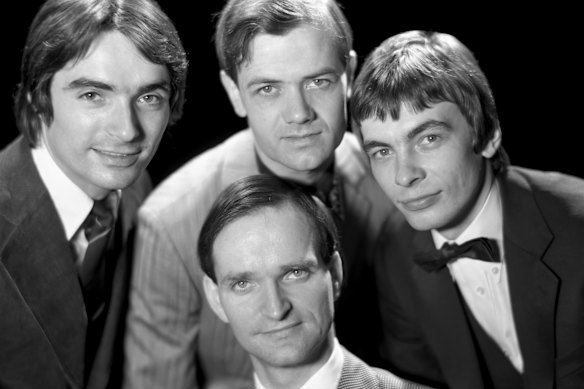
Bartos, now 73, elaborates on their cultural significance in his memoir The Sound of The Machine: My Life in Kraftwerk. “From Autobahn on, electronically created synthetic language became a fixed element of the Kraftwerk sound,” he writes. “Its effect is like an absurd Lewis Carroll story in which animals, plants or objects possess human qualities and can suddenly speak.”
The book documents Bartos’ 16 years as a Kraftwerk member. Initially hired as a session percussionist, he gradually became a prominent creative force within the classic line-up, alongside fellow percussionist Wolfgang Flur. “Nobody was making pop music that sounded anything like Kraftwerk at this time,” says Bartos. “We were the first group to make logical produced music that sounded automated and machine-like. But we could play our instruments too.”
Bartos was asked to join Kraftwerk because they were looking for a classically trained percussionist; he had studied at Dusseldorf’s Robert Schumann Conservatory. Watching Steve Reich in Dusseldorf in 1973 was another important stage in his musical development; he was mesmerised by Reich’s ability to take familiar-sounding musical material and subject it to constant repetition, a technique Kraftwerk would gradually master: “With minimal music you don’t open the door, you enter into another room.”
Bartos spent most of 1975 on the road with Kraftwerk, touring Europe, Canada and the United States. That November, the group released Radioactivity (1975). It was the last Kraftwerk album to feature straightforward voice recordings. Afterwards, the group’s vocals were all recorded as sampled fragments.
The album was released more than a decade before the Chernobyl nuclear disaster. The promotional photographs featured the group wearing white lab coats, standing in a Dutch nuclear power plant. The album’s title is ambiguous, referring to the sending and receiving of sound through radio waves. But there are also references to the emission of radioactive substances.
The album was a hit in France, which was then building a nationwide nuclear program. But globally it flopped. “When we made Radioactivity, we believed in nuclear power,” says Bartos. “A year later, though, an anti-nuclear movement began, which didn’t help the album.”
In early October 1976 Kraftwerk wound down an extensive period of touring, and then didn’t play live for another five years. Creatively, though, it was their most fruitful period. Bartos refers to 1977’s Trans-Europe Express as a series of “acoustic road movies”. The album’s opening track, Europe Endless, was written when the Iron Curtain still divided Europe and a concrete-and-barbed-wire wall divided Berlin. The lyrics envision a utopian alternative: a borderless continent of opulent decadence and endless possibilities.
Trans Europe Express recreates the sound of trains in motion. “In Kraftwerk we were always interested in progress. Trains were part of that,” says Bartos, momentarily digressing into a conversation about Italian Futurism, which also argued humanity’s future was inextricably linked to the machine, an idea Kraftwerk fully endorsed on The Man-Machine (1978).
The phrase, borrowed from Fritz Lang’s expressionist silent film Metropolis (1927), had already been used on posters promoting Kraftwerk’s live shows in America. Set in a megacity in 2027, the dystopian narrative concerns a group of workers toiling over machines deep below ground. One of the film’s main characters, Rotwang, constructs a metallic robot shaped like a woman.
“The whole concept of Kraftwerk is taken from that film. But we never really questioned the oscillating process between man and machine,” says Bartos. “At that time, naively perhaps, we believed that digitalisation would bring a positive effect to humanity.”
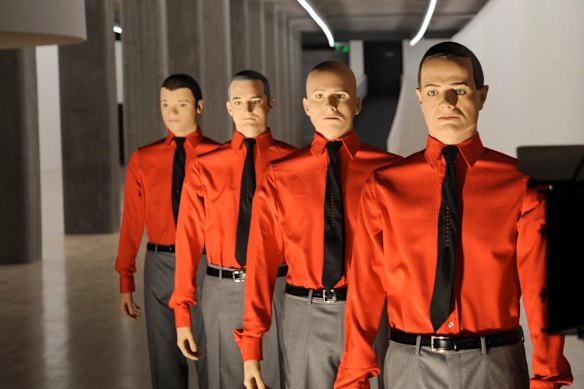
In March 1978 Kraftwerk appeared on West Germany’s Rock Pop TV show, as half-human, half-machine. Special plastic mannequins were designed, as the group replicated their respective silicone selves while performing The Robots, the opening track from The Man-Machine. It was the first Kraftwerk album to feature Bartos as a songwriter, but his earnings were less than he’d made as a part-time musician. Still, he hoped the financial issues would be resolved.
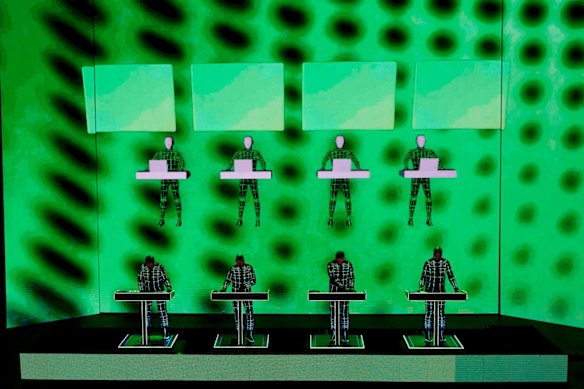
The timing of Kraftwerk’s next album, Computer World (1981), was not a coincidence; it was released the same year IBM launched a personal home computer. Bartos remembers the collaboration process during this time as “a permanent conversation”, where all group members translated their thoughts into music. “That album was fantastic and really the pinnacle moment for the group,” he says. “We had it all.”
But the collective dynamic gradually splintered – and technology is part of the story. Kraftwerk had always used the latest technology to influence their futuristic sound. But they mostly used microprocessor-controlled appliances. Computer terminals were not yet a permanent fixture in the Kling Klang studio.
“All of the music Kraftwerk made up until that point was produced by getting into the studio and exchanging ideas. But in the early 1980s, when the personal computer came in, we spent most of our energy trying to figure out how this technology worked,” says Bartos. “But in the process, we forgot about the music.
“The computer made it possible, in theory, for one person to produce a record,” he says. “This is not very productive. Maybe economically it might be. Eventually, though, machines can erase people’s creativity.”
As more computers arrived in the Kling Klang studio, so did more engineers to maintain them. And they had to be paid, Bartos explains: “Sadly, money then became the main focus within Kraftwerk.”
Hutter and Schneider took care of Kraftwerk’s accounting. Bartos claims “they wore the trousers” and he had to practically beg for his share of everything, including writing credits, a share of licensing fees, and advances.
Doubts crept in, trust broke down, and Bartos left the band in 1990. There was no major drama when he departed, and he continued to make music elsewhere, later forming Elektric Music, with whom he released two albums. He also established commercially successful musical partnerships with high-profile British musicians including Bernard Sumner, Johnny Marr and Andy McCluskey. Two years ago, Bartos released The Cabinet of Dr Caligari, a sound design made for Robert Wiene’s 1920 film of the same title.
Meanwhile, Kraftwerk continues. The group is now in its 56th year of performing, but Hutter is the only remaining member from the classic line-up. Flur left in 1987, a year after Kraftwerk released Electric Cafe. Florian Schneider died of cancer, aged 73, in May 2020. “Florian was like a Jackson Pollock of electronic music,” says Bartos. “He could go over to a new synthesiser and in five minutes construct a new universe of strange electronic sounds.”
Bartos still has ongoing “legal problems” with Kraftwerk. Specifically, these relate to copyright issues. “Kraftwerk are completely anonymous” today, says Bartos: “What remains is a nostalgia of the music.”
“Art is communication, an ongoing dialogue with the world. You can stop the dialogue if you want and continue to play the same music over and over again,” Bartos concludes. “But this music that Kraftwerk continues to play live is a mere reproduction. That is what AI does.”
The Sound of the Machine: My Life in Kraftwerk and Beyond by Karl Bartos (Omnibus Press) is out now.
The Booklist is a weekly newsletter for book lovers from Jason Steger. Get it delivered every Friday.
Disclaimer : This story is auto aggregated by a computer programme and has not been created or edited by DOWNTHENEWS. Publisher: www.smh.com.au