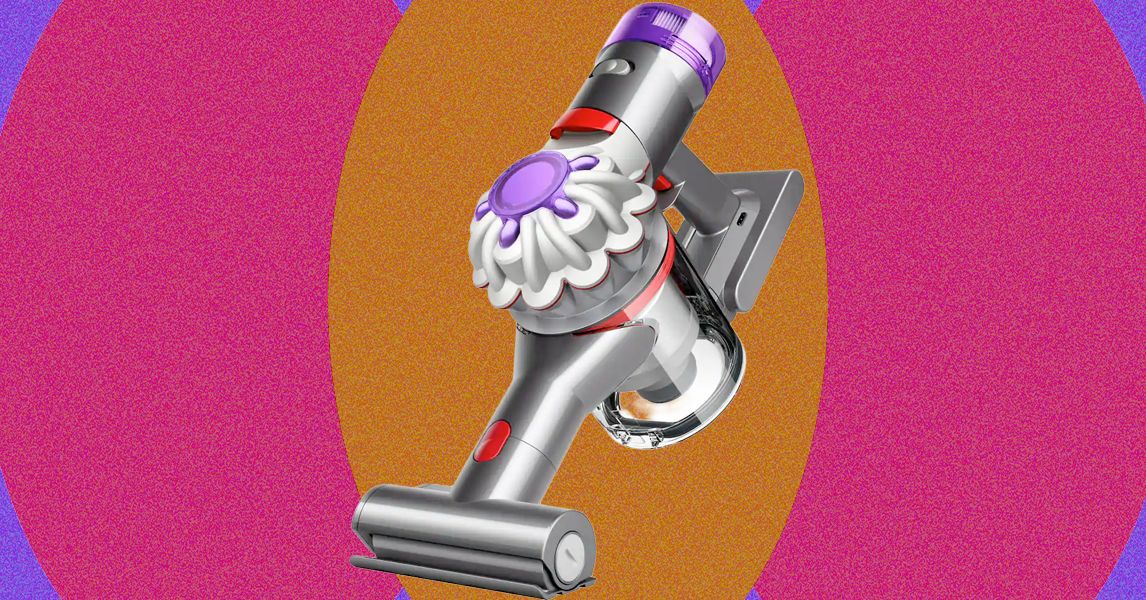
Comparing Our Favorite Dyson Vacuums
What’s Still to Come from Dyson in 2026
Dyson announced in September 2025 that its lineup of vacuums has been totally refreshed for 2026. A few vacuums have already come out, including the PencilVac and new robot vacuum, while a couple are yet to come. Here’s what we’re still waiting to see this year:
- The Dyson V8 Cyclone. This is an update to Dyson’s popular V8 vacuum, with 30 percent more suction power—150 air watts—and twice the run time, giving it over an hour over the original V8’s 30 minutes. It’ll have a triggerless power button and a self-emptying docking station, which is the addition I’m most excited about.
- The Dyson V16 Piston Animal. This is a new cordless stick vacuum with the latest motor, a cleaner head that can sense the floor type, and a wet roller head option, like the Dyson V15’s Submarine variant (aptly named Submarine 2.0). It promises 315 air watts of power and a 70-minute run time, and will have a wipe-clean mechanism that helps get stubborn dust and long hairs out of the vacuum’s bin. There will be a compatible self-emptying docking station available for purchase separately.
Other Good Dyson Vacs
We’ve tested a variety of Dyson vacuums, both corded and cordless. The vacs below are still worth buying, as long as you don’t pay full price.
Dyson Ball Animal 3 for $430: If you really, really, want an upright vacuum instead of a cordless stick vacuum from Dyson, the Dyson Ball Animal 3 is the way to go. We’ve tested the Ball Animal 3 Extra, which has more attachments, but the regular is just as powerful. Former WIRED reviewer Jaina Grey found it performed well against the rabbit hair in her home. The downside is that it’s loud and heavy.
Dyson Clean+Wash Hygiene Wet and Dry Floor Cleaner for $400: This wet-dry cleaner’s claim to fame is its lack of an “unhygienic” filter, and WIRED reviewer Kat Merck found no off smells in her month of use. The device is similar to the previous Wash G1, with a self-propelled design that’s easy to push. It has a screen to show battery life and mode and a dock for self-cleaning. Dyson’s new probiotic floor cleaner ($24) is also a nice product on its own that’s odorless and did a good job on Merck’s Coretec LVP floors. It’s not great for detritus like hair and leaves, though, since it has no suction and just a microfiber roller. She found it best for spot-cleaning stains and spills, but at that point, you might prefer to get a cheaper wet mop with more suction power.
Dyson V11 for $499: This is a solid alternative to the Cyclone V10. When WIRED reviewer Adrienne So reviewed the V11, she called it the “dream vac.” However, that was in 2019, and many updated models have come out since then. The improvements the V11 offered versus the V10 were incremental. If you can find a V11 for under $350, it’s worth it; otherwise, I recommend going with a later (or cheaper) model. If you’re looking into the latest V11 Dyson offers, it’s important to note it doesn’t come with Dynamic Load Sensor technology (a feature that allows it to automatically adjust suction across different floor types).
Dyson V12 Detect Slim for $513: Dyson’s V12 Detect Slim is excellent for small spaces like a studio or a one-bedroom apartment since it’s compact, lightweight, and a great size for hard-to-reach spots and minimal storage. There’s an LCD screen, a run time of up to 60 minutes, and a charging time of up to 4.5 hours.
Other Dyson Vacuums We’ve Tried
There are a lot of Dyson models out there, even if they’re on the older side.
Dyson 360 Nav Vis for $369: The 360 Vis Nav isn’t Dyson’s previous robot vacuum that had a powerful spin speed, but it can only vacuum and needs some work on its navigation. WIRED reviewer Chris Haslam found that it struggled around chair legs and on rugs, something similar vacuums didn’t have a problem with. It doesn’t have a base station, either, but it is pretty cheap now that it’s an older Dyson model.
Dyson Big Ball Multi Floor Vacuum for $359: This was originally one of our top picks for tight spaces. But Dyson no longer sells it, and it’s often out of stock at third-party retailers—unless you’re OK with purchasing a used model (however, you shouldn’t spend more than $250 to $300 on it). It’s a good option if you’re looking for more maneuverability than a stick can offer. You only have to wield a thin suction tube, as long as you don’t mind periodically repositioning the canister. Dyson’s Cinetic technology means there are no filters to wash or replace, and it still has HEPA-grade filtration for capturing allergens and most particulates. If you find a new model, I suggest waiting until it’s on sale between $300 and $400.
Dyson WashG1 for $399: The WashG1 is Dyson’s first dedicated wet floor cleaner. It comes equipped with two very absorbent microfiber rollers that rotate counter to each other and a pump that distributes water evenly from a 27-ounce tank via 26 pulse-modulated water outlets. It’s fantastic for cleaning floors, but the tray is gross and messy to clean, and mine grew mold at one point. I’d recommend checking out the newer Clean+Wash Hygiene, above, if you want a cleaner like this.
FAQs and How-Tos
Power up with unlimited access to WIRED. Get best-in-class reporting and exclusive subscriber content that’s too important to ignore. Subscribe Today.
Disclaimer : This story is auto aggregated by a computer programme and has not been created or edited by DOWNTHENEWS. Publisher: wired.com