For decades, Paradise has occupied a singular place in Hyderabad’s culinary identity. It is one of those rare food brands that long outgrew the definition of a restaurant and became shorthand for the city itself. But what happens when a legacy brand built on heritage begins preparing for aggressive scale?
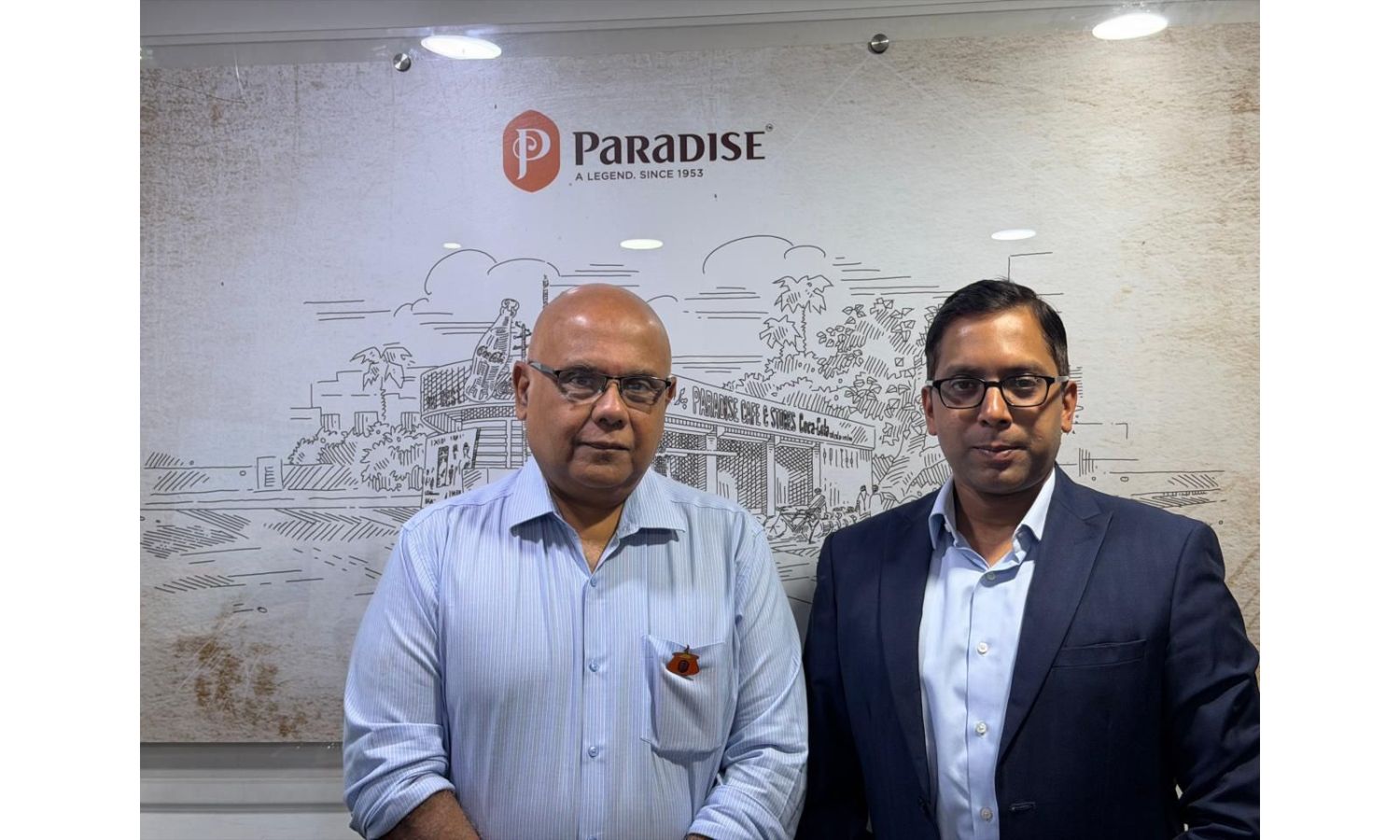
That question sits at the centre of Paradise’s next phase of growth, shaped jointly by the long-term investment thesis of Nilay Pratik, Director, Samara Capital and the operational roadmap being executed by Abhik Mitra, MD and CEO, Paradise Food Court Pvt. Ltd.
For Samara Capital, the bet on Paradise began with a larger thesis around India’s food services market. “We realised that to scale up, there are certain success factors any category needs to have, and biryani is, in our view, the best-positioned category for scale-up,” says Nilay Pratik. The reasoning, he explains, is rooted in both culture and consumer behaviour. Rice and protein form a deeply familiar combination across Indian diets, biryani travels well for delivery, and unlike several other cuisines, it remains difficult to replicate consistently at home.
India’s biryani market today is estimated at nearly ₹38,000 crore, but only a small fraction of it is organised. “Almost 90 percent of the market is unorganised,” he says. “That is where the huge headroom for growth comes in.”
The attraction of Paradise, according to him, lay not just in its scale or brand recall, but in the nature of the product itself. “Paradise stands for authentic dum Hyderabadi biryani,” he says. “You go anywhere in India and you will definitely find Hyderabadi biryani on the menu.”
Yet heritage alone does not automatically translate into scalability. In fact, the Indian restaurant industry is filled with examples of beloved regional brands that struggled to expand beyond their home markets. The challenge, as both executives repeatedly emphasise, lies in consistency.
“The holy grail is whether you can cook the same food repeatedly in so many restaurants,” says Abhik Mitra. “Inconsistent food is the worst thing to have.”
Paradise’s current strategy is built around solving exactly that problem. Unlike franchise-driven restaurant chains, all Paradise outlets continue to remain company-owned and company-operated. Every store cooks biryani fresh in-house rather than relying on centrally prepared products. While this adds operational complexity, the company believes it is essential to preserving authenticity.
To manage scale without compromising quality, the organisation has invested heavily in technology-led monitoring systems. Raw material temperatures, kitchen processes, oven performance and delivery timelines are digitally tracked across stores. “All the ovens are Wi-Fi enabled,” says Mitra. “We know in real time what is happening.”
That data-driven approach extends beyond operations into customer insights as well. Paradise studies feedback patterns across delivery platforms, Google reviews and internal research to understand how tastes differ across demographics. “Food is a dynamic product,” Mitra says. “Unless you stay current with changing consumers, you are missing something.”
At the same time, the company appears careful not to dilute the identity that made Paradise successful in the first place. Mitra insists that authenticity begins with the cooking process itself. “If you don’t make biryani in the dum style, where is the authenticity?” he asks.
Over the past year, Paradise has quietly begun laying the foundation for expansion outside Hyderabad. Around 14 to 15 stores have already been seeded across Bengaluru and Chennai, markets the company considers strategically important because of their high biryani consumption. According to Nilay Pratik, those stores are already outperforming expectations. “These stores are doing phenomenally well,” he says.
The next phase could include markets such as Mumbai, Delhi and Pune, followed eventually by international expansion in regions with large Indian diaspora populations. But unlike older large-format restaurants associated with Paradise, the expansion model is changing. The company is now focusing on smaller omni-channel stores with roughly 30 to 40 seats combined with strong delivery infrastructure.
“If half your sales are coming from delivery, you don’t need 200-seater restaurants,” says Nilay.
That shift reflects larger structural changes within India’s food business, where digital ordering and home consumption increasingly drive growth. Paradise today sees delivery as one of its strongest growth engines, with kitchen efficiency, rider turnaround time and preparation speed becoming as important as the food itself.
For Samara Capital, Paradise represents something larger than a restaurant chain. It is an attempt to build one of India’s few nationally scalable food brands rooted in regional cuisine. Nilay points out that while India has built massive chains in pizza, burgers and coffee, very few local cuisines have managed to achieve comparable scale.
“Why not biryani?” he asks.
The answer, he believes, lies in combining product strength with the right store format, supply chain, management talent and technology backbone. Paradise now appears convinced it has assembled those pieces.
For Hyderabad, Paradise will likely continue to remain an emotional brand first. But increasingly, it is also becoming a case study in how regional Indian food businesses are learning to think nationally, technologically and globally without losing the essence of what made them iconic to begin with.
Disclaimer : This story is auto aggregated by a computer programme and has not been created or edited by DOWNTHENEWS. Publisher: deccanchronicle.com