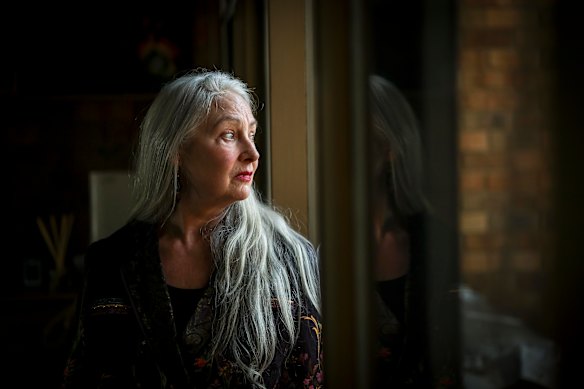

In 2008, Carmel Bell was on top of the world. She was a 47-year-old mother of five healthy kids, ran a successful medical diagnostic business and lived in a beautiful home in Melbourne’s leafy east.
Then one night, she suffered a cardiac arrest in her sleep. It was the moment that marked the beginning of the collapse of her life.
“I was dead for close to an hour … and I have been left with a severe brain injury,” Bell, now 64, recalls.
Despite having life insurance, her company refused to pay. “I also had a brain or pituitary tumour, which caused Cushing’s disease, which is one of those rare and usually terminal diseases, and they covered everything except the pituitary,” Bell says.
Unable to work and support her family (she was the primary breadwinner) Bell and her husband, who quit his job to look after her, were forced to take out a reverse mortgage to make ends meet.
“When I got the brain injury, my business folded, [which] was making at the time in excess of $300,000 a year,” Bell says. “We could actually afford to clothe, educate the kids and pay the mortgage, and suddenly that all went away.”
When the children moved out the couple sold their house, but after paying off their mortgage and reverse mortgage they had nothing left. Her husband has found another job and they are trying to save a house deposit; Bell says it’s not enough.
“My husband is 70, I’m 64 and we’re living in a rental property with very, very little income, very little in the way of anything,” she says. “I have no superannuation, and while my husband did that all got chewed up while I was in recovery.”
For Bell and her husband, the outlook is grim. Treasurer Jim Chalmers used last week’s federal budget to shift wealth from Baby Boomers to younger wage earners by overhauling negative gearing, capital gains tax and trusts, and pledging to help an additional 75,000 Australians buy their first homes.
For the less wealthy Boomers, experts say there was little on offer.
While Bell’s generation, aged between 60 and 79, is the wealthiest in the nation with an average net worth of $2.46 million, most of this is predicated on owning one’s home outright in retirement.
Wendy Stone, Professor of Housing and Social Policy at Swinburne University of Technology, says while housing tax reform is overdue, “it’s absolutely critical that we also realise that not all older people or people approaching retirement are equal”.
“Older people who were never able to own a home, or perhaps they had previously owned a home, but they’ve been divorced, or ill and lost their house … means they weren’t able to … build up the benefit of the equity growth that [those] who own their home in retirement have,” she says.
While Stone welcomed increased investment in residential aged care, she says the budget offers “very minimal support for older people” who are not home owners.
“Our retirement system pensions are built on the assumption that by the time people living in Australia reach retirement age, they do own their home,” she says. “So, the pensions are set very low, and currently it’s absolutely impossible for people to live above the poverty line without that housing security.
“People in later life and retirement years are falling between the cracks, and this budget doesn’t address their issues. We need more targeted intervention into social housing options, collaborative housing options or affordable housing in the private rental sector.”
A 2025 report by Council on the Ageing (COTA) Australia found one in four older Australians lives in poverty.
Chief economist at Downsizer.com Michael Blythe, formerly of Commonwealth Bank and the Reserve Bank, says while older Australians as a group may be wealthier, there were nuances. “This is true in total – half the Boomers who bought a house more than 20 years ago are sitting on a large pocket of money … many are also asset rich but cash poor”.
Blythe questioned the focus on first home buyer polices without considering last home buyer polices.
“We spend all this time getting first home buyers in, but all we do is push up prices,” he says, pointing to the federal government’s 5% deposit scheme.
“Maybe we need to rethink this … and be helping last time buyers instead. They are already in the market and providing one unit of supply – why not make it easier for them to move, freeing up larger properties for families or redevelopment?”
University of Sydney sociologist Associate Professor Myra Hamilton, who researches ageing population issues, says while some budget measures will begin to address intergenerational inequality, it would be more helpful to tackle overall wealth inequity.
“Not all Baby Boomers are cashed up – we know that one in six don’t own their own home,” Hamilton says.
“Women over 55 are one of the fastest growing groups of homeless people, and women over 65 have high rates of economic insecurity, so talking about Baby Boomers as this one cashed up mass … makes those groups invisible.”
Hamilton says renters are the cohort most likely to be living in poverty in older age.
“As growing numbers of people reach older age without owning their own home, the levels of insecurity and poverty among our older citizens is going to increase. If we’re wanting to improve equity in the housing market … we need to address the wealth divide within all generations,” she adds.
Bell doesn’t understand all the talk about wealthy Boomers. She is one of six, and says only her childless brother owns two houses and an apartment.
“I just get a disability pension depending on what my husband earns, who is 70 and still working because we can’t afford him not to work,” she says. “We don’t have enough to go into a retirement village – we will literally end up living in a caravan park.”
Property listings
From our partners
Disclaimer : This story is auto aggregated by a computer programme and has not been created or edited by DOWNTHENEWS. Publisher: www.smh.com.au