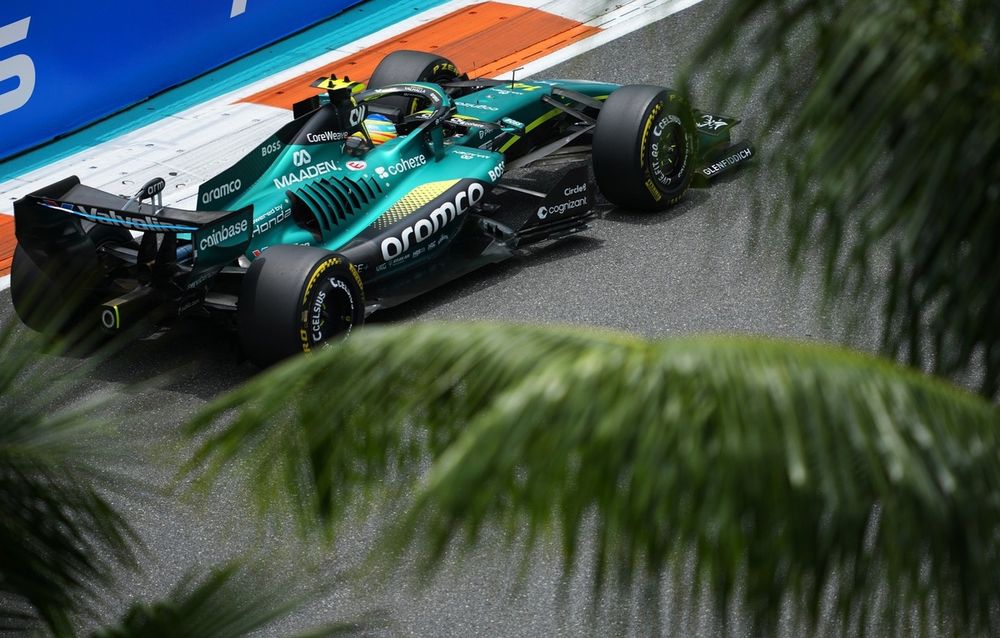
Aston Martin and its engine partner Honda insist it is drilling down into the problems that have beset the AMR26 since its introduction – but the car remains at least two seconds off the pace in qualifying.
Reliability was an early bugbear, delaying work in understanding the car and debugging various other problematic elements of the powertrain, including vibrations through the chassis, and abrupt gearshifting and engine braking. After a fraught Miami Grand Prix, Fernando Alonso declared these latter elements the “number one” priority fix required for Canada, given the point-and-squirt nature of the Circuit Gilles Villeneuve’s layout.
But, speaking on the eve of the race in Canada, Alonso also warned that resolving these issues would not recoup all the laptime deficit to the frontrunners.
“No, I don’t think the performance will change,” he told media including Motorsport.com.
“We need to change both the reliability, because we had some issues that stopped us sometimes in free practice to run properly and to optimise the track time, but also we need to improve the driveability, and have a little bit of smoother downshifts, upshifts, engine braking, all these things that can give you a little bit more confidence to attack the corners.
“But on that confidence, maybe there is half a tenth. It’s not the two or three seconds we are missing, so I don’t think it will change much the performance.”
This season, Aston Martin has built its gearbox in-house for the first time since the late 2000s. In its previous incarnation as Force India it began buying in its engine and gearbox as a package from McLaren and Mercedes in 2009, latterly shifting to an exclusively Mercedes arrangement.
Alonso said fixing driveability issues was the next most important task after fraught Miami GP weekend
Photo by: Sona Maleterova / Getty Images
But driveability and shift quality is closely interlinked with engine performance, given the integration between these and the actions of the electrical motor, which harvests and deploys battery power. Essentially, Aston Martin is having to do its learning ‘in the field’ because the car was finished late and then suffered battery and vibration-related issues that severely curtailed testing mileage.
“In Miami, we had a good step on battery reliability, and the battery issue is now gone. Then we now focus to improve energy management, also driveability,” said Honda chief engineer Shintaro Orihara.
“We have a good understanding what is the problem or what is causing the driveability issue. The unique point is this year [the] regulation is changing.
“Then in, let’s say, partial throttle region, last year partial is definitely partial [load] on engine. But this year, partial or even engine brake phase, engine operation load is high.
“So, quite a big difference from an operation point comparing with last year. And then we see some unique behaviour in that phase – we are trying to improve our controllability in that [partial throttle and engine braking].”
Many of the complications the team is facing stem from the aggressive packaging of the AMR26’s rear end. That design choice – made by engineering guru Adrian Newey after he joined Aston Martin last season – aimed to benefit aerodynamic performance in what remains a crucial area of the car around the diffuser.
Facilitating this required a number of unusual solutions, including the ‘double deck’ battery format, and a different location for the electrical motor relative to the other cars on the grid. So far, the team has been unable to realise – or even evaluate the effectiveness – of these theoretical benefits because of the knock-on effects of the design compromises on reliability.
“The whole subject of driveability, including the shifting up or down, is a step more complicated than it used to be, for various reasons,” said chief trackside officer Mike Krack.
“The regulations have changed quite a lot on the downshifting. We are recuperating much, much, more [electrical energy].
“And we are new to that party as well, we must not forget. So it is a complex topic that I think we’re getting our head more and more around.
“A lot of issues that we had, that prevented us from running, are now solved. And you see then new topics pop up.
“So I think the whole gearbox topic is challenging. It will remain challenging.
“We see also across the field there are a lot of drivers complaining about shifting – and I think it is partly related to the situation [with higher demands on the powertrain in unusual places]. But also I think we have some work to do.”
To find Alonso’s “two or three seconds we are missing”, though, will require more than drivetrain finesse. It’s been known since the beginning of the season that the engine is short of the benchmark Mercedes unit in terms of both horsepower and electrical deployment.
We want your opinion!
What would you like to see on Motorsport.com?
– The Motorsport.com Team
Disclaimer : This story is auto aggregated by a computer programme and has not been created or edited by DOWNTHENEWS. Publisher: motorsport.com