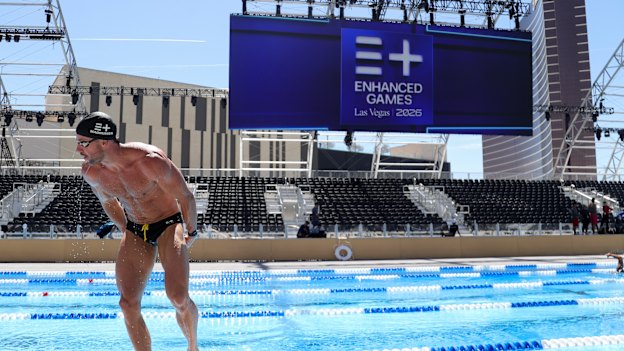
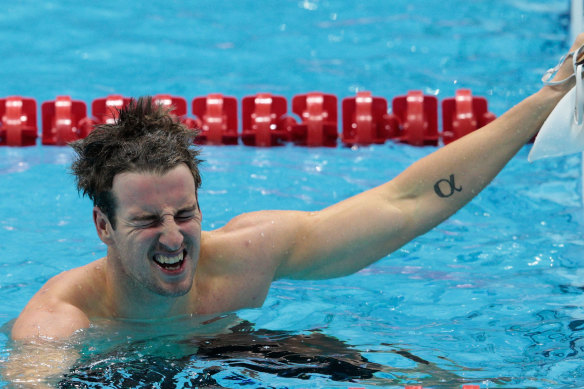
James Magnussen is sitting shirtless beside a luxury Las Vegas hotel pool, veins protruding from his forearms, soaking in the Nevada sun and completely comfortable that he has made the right call.
“History will prove me right,” Magnussen says behind oversized black sunglasses. “I’m very confident in that. People will look back and go, ‘oh, it was ahead of the curve’.
“I’ve pushed in all my chips.”
Two years after declaring he would “juice to the gills” and join the world’s most controversial new sporting venture, the former Australian swimming star is days away from competing at the inaugural Enhanced Games – a billionaire-backed event hoping to one day become, quite literally, the Olympics on steroids.
Las Vegas is an appropriate setting for someone who has gone all in. Magnussen, a former world champion, is relaxation personified ahead of Sunday’s event (Monday morning AEST) that the World Anti-Doping Agency has labelled a “dangerous and irresponsible concept”.
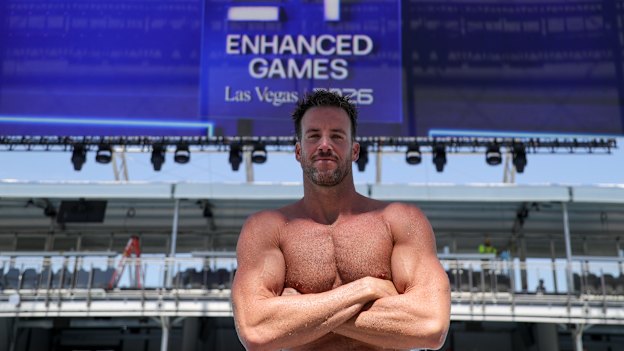
“Promoting performance-enhancing substances and methods sends a dangerous message – especially to current and future generations of athletes,” read a joint statement from WADA and the International Olympic Committee. “Such substances can lead to serious long-term health consequences – even death – and encouraging athletes to use them is utterly irresponsible and immoral. No level of sporting success is worth such a cost.”
Not that the criticism bothers Magnussen, who now boasts a resting heart rate of 28 beats per minute. An athlete typically has a resting heart rate of between 40-50 bpm, according to the Victor Chang Institute. Magnussen is also mentally preparing for his belated bucks party, which begins on Monday, with mates who have flown from Australia.
“I may as well find a pool party because this body is not going to last forever,” Magnussen says with a grin. “As is the case with most 35-year-old men in Australia, half of them are enhanced anyway, so [my mates] are all on board with this movement.”
A Resorts World sun bed is a far cry from the regimented routine of Magnussen’s London 2012 and Rio 2016 Olympic campaigns. Documentary crews roam around the hotel chasing content, while athletes from swimming, sprinting and weightlifting mingle in branded apparel ahead of one of the most divisive sporting events in years.
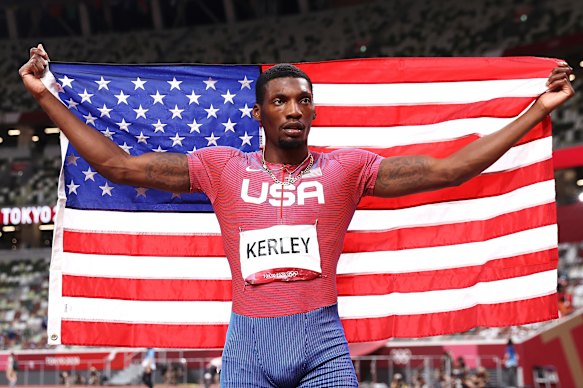
American sprint star Fred Kerley – “he is a cool cat” – is staying in the room next door.
Enhanced Games chief executive Max Martin briefly appears poolside, impeccably dressed and with an eye-catching (enhanced) jawline, to check in on Magnussen and his new wife Rose.
“I know where my bread is buttered now,” Magnussen says. “Enhanced have looked after me extremely well. I’ve become great friends with the powers that be.”
The Australian, who has spent 12 of the past 18 months overseas training, will race the 50m and 100m freestyle, with a $US1 million ($1.4 million) bonus on offer if he can go under Cam McEvoy’s world record (20.88 seconds) in the shorter event. None of the records achieved in Las Vegas will be officially recognised.
Magnussen has taken performance-enhancing drugs on and off for the past two years after first throwing down the gauntlet on the Hello Sport Podcast, where he famously declared he would “juice to the gills”. He regrets the phrasing, but not the decision.
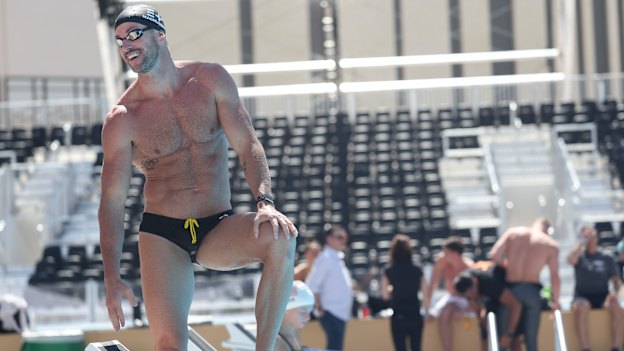
“This is squarely where my allegiance lies,” Magnussen says. “I don’t need to be doing anything else.
“The biggest misconception is that I’m doing this purely for the $1 million. It would be great, but a lifetime of opportunities in this space is worth far more.”
There are two main questions Magnussen has been repeatedly asked during this pursuit with the Enhanced Games.
What about his legacy? And what about the children watching?
“I did spend time in that [Olympic] world, and I loved it, but I’m also 35 now. I can’t be doing swim clinics for the rest of my life,” Magnussen says. “Once people see these first Games, I really think they will be able to differentiate between the two worlds.
“You can say, ‘I wouldn’t do something like this because it affects my legacy’. Once you’re 50, you can tell your kid how good you were back in the day. Or they can wake up in a house that shows you provided for them.
“If I have a kid and he or she wants to swim, I will still tell them the pinnacle is the Olympic Games. This is a separate option.”
Magnussen argues the conversation around performance-enhancing drugs is often hypocritical.

“These things are on the black market anyway, which is concerning,” he says. “Say we brought these products to Australia. These things are not available for kids. It’s not marketed at kids. In Australia, we have the most rampant gambling and alcohol advertising in the world. You can’t go into a store as a kid and buy alcohol. You can’t go into a TAB as a kid and place a bet. Exactly the same as this industry.”
Magnussen is happy to cop some bullets in a bid to change perceptions that the use of such drugs can have positive health impacts. Medical professionals would beg to differ.
“Some of the risks cannot be protected against by having a medical professional there,” Dr Naomi Speers, the director of research at Sport Integrity Australia, told this masthead last year.
Magnussen says his biological age has come down from an already low 25 last year, to 23 now, and declares he is “doing a Benjamin Button”. He claims he has more energy than ever and says his libido has increased.
His 197-centimetre physique is certainly more rugby league than swimming, although not as exaggerated as this time last year, when footage of Magnussen’s first “protocol” body – involving peptides and testosterone injections – went viral online.
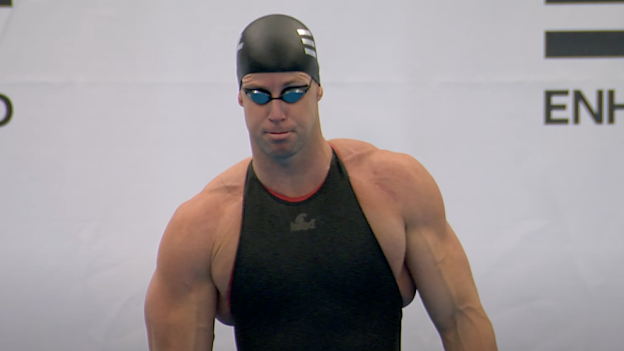
“I look at a weight, and my biceps start growing,” Magnussen jokes when asked about the power of the substances. “I smell lead, and my quad gets bigger.”
Unlike last year, Magnussen has deliberately tried to slim down because he got too big the first time.
He is 17 kilograms lighter, dropping from 114kg to 97kg, after a year living in a calorie deficit, predominantly because he is focusing on the longer 100m freestyle event.
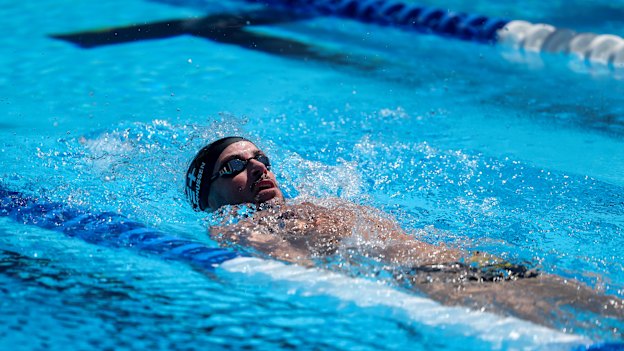
During training camps in Abu Dhabi, Magnussen would swim up to 40 kilometres a week and has barely touched weights over the past six months.
“This time I’ve been really cautious,” he says.
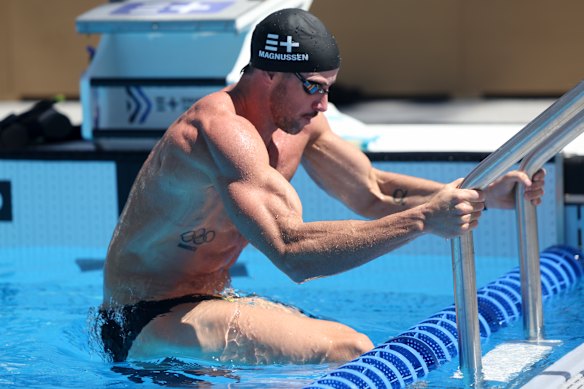
Magnussen says Enhanced athletes are monitored closely by doctors and scoffs at suggestions that the drug-taking is reckless or uncontrolled.
“We go through the most in-depth medical I have ever done,” he says. “If we have any underlying issue, we’re not allowed to even begin a protocol or think about competing. I’m talking heart, lungs, kidneys, liver, pituitary gland, hormone levels, eyesight, hearing, cognitive function, you name it.
“My heart function has improved. I’m getting better sleep. All the metrics for health and longevity have improved, which flies in the face of most of the stigma and innuendo around what we’re doing. I would love to bring those same opportunities to Australia.
Like a personal ‘Maggie stack’ of drugs to sell online?
“Hell yeah,” Magnussen says. “In terms of bringing Enhanced to Australia, that is front and centre in my mind.”
Will Magnussen break a world record? Probably not.
But even if he comes last in both events, he will pocket $US100,000 ($140,000), on top of already lucrative appearance fees.
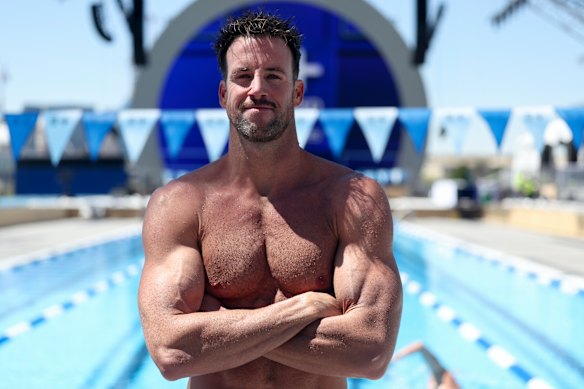
“It’s crazy and a bit of a pinch yourself moment,” Magnussen says. “Australians do have a reputation for taking a chance and breaking a norm. I’m kind of proud that it was an Australian athlete who was first to take the step and say, ‘yeah, I’ll do it’. More will follow in the future. I’m pretty confident of that.
“This is more Super Bowl than Olympic Games.”
A day later, Magnussen is slicing through the water at the competition venue, as dozens of journalists from around the world are given a first look at the three-sport-in-one arena. Just five metres from the pool is a 100m running track and a weightlifting area, the latter of which is still being built by workers around the clock.
Magnussen hauls himself out of the water, his muscles and six-pack there for all the cameras to see, and stops for a chat. The topic quickly shifts away from swimming to South Sydney rugby league player Jai Arrow, who announced his retirement this week after being diagnosed with motor neurone disease.
Amid the spectacle of the week in Vegas, reality still cuts through to the Canterbury Bulldogs supporter.
“I couldn’t sleep last night when I saw his interview,” Magnussen says. “I was bawling my eyes out.”
Since experiencing the effects of the drugs firsthand – “like putting yourself in an 18-year-old body”, as he describes it – Magnussen says he has become even more staunch on wanting traditional sport to remain clean, despite the irony of saying so while walking around in Enhanced Games-branded swimwear.
“Given the stories I’ve heard, I was so naive as to how rampant this is in normal sport,” Magnussen says. “The names of other athletes that I’ve been told, some that I’ve raced over the years, some of the most famous names in the world, who have seen doctors or been to clinics or gone through protocols, blew my mind and opened my eyes to what’s really going on. I think in Australia, we’re so innocent and so naive.
“I’d never been offered anything in Australia. Then you start to travel … and you go, ‘oh, wow, we’re playing by a different rule book to the rest of the world’. It is already such an unlevel playing field.”
Anti-doping agencies would argue otherwise. Hunter Armstrong, an American swimmer competing at the Games without taking drugs, has been subjected to more than half a dozen drug tests since arriving in Las Vegas. His bid to compete at future Olympics remains alive, although legal battles loom.
“It makes no sense why he’s not allowed to compete at the normal Olympics if he’s passing tests,” Magnussen says.
“We’re now in a position in Australia where, for the first time in my lifetime, swimming is facing serious competition from athletics for eyeballs, sponsors, relevance and stars. We need to look outside the box. We’ve got a bunch of billionaires here who are willing to do just that. What an awesome opportunity.”
After fleeing escalating conflict in the Middle East and scrambling onto a business-class flight back to Sydney for his wedding earlier this year – courtesy of Enhanced, of course – the ‘Missile’ is ready to race.
Aside from a few tequila sodas on his wedding night at Icebergs in Bondi, it has been all business.
The Games will not be for everyone, and there will be more criticism around the concept. Magnussen is prepared for that.
“I can’t wait to swim in front of a crowd. That’s the one thing I miss in life,” Magnussen says. “This feels like the culmination of two years of work for me.
“There’s stigma and there are opinions … but we’re going to shine a light on it.
“Australians love us and hate us. But you’re going to watch us.”
Disclaimer : This story is auto aggregated by a computer programme and has not been created or edited by DOWNTHENEWS. Publisher: www.smh.com.au