
The Trump administration’s portfolio of strategic technology companies has expanded across the Pacific, with the US government taking equity stakes in two Australian-founded quantum computing pioneers as part of a $US2 billion ($2.8 billion) funding round.
Sydney-founded Diraq, a 2022 spin-out of the University of New South Wales, signed a letter of intent overnight with the US Department of Commerce for up to $US38 million in federal funding from the CHIPS Research and Development Office. Palo Alto-based PsiQuantum – co-founded in 2016 by a group of Australian and British physicists, and the recipient of close to $940 million in federal and Queensland government backing for its Brisbane facility – separately received a letter of intent for $US100 million.
IBM was by far the largest beneficiary of the package at $US1 billion, followed by chipmaker GlobalFoundries at $US375 million.
In return for the funding, the US government will take a minority equity stake in each of the nine recipients, according to multiple US media reports, although the Commerce Department has not disclosed the size of the stakes.
The deal extends a run of state-driven deal-making by the second Trump administration, which has already taken a 10 per cent stake in Intel, formed a “golden share” partnership with US Steel and Nippon Steel, and acquired equity in critical minerals players including MP Materials, Trilogy Metals and Lithium Americas.
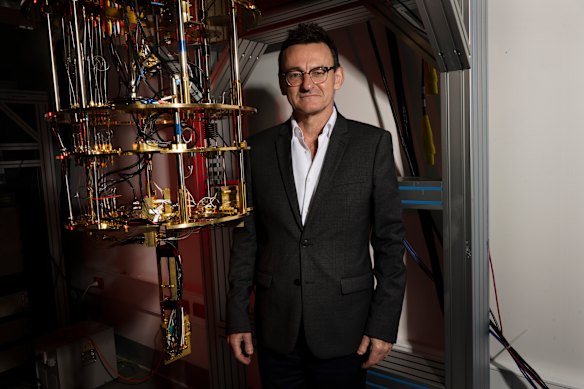
Diraq chief executive Andrew Dzurak, who landed back in Sydney on Friday morning after several weeks of negotiations in the United States, said the process had been “just under six months in the making” after the Department of Commerce issued a broad agency announcement late last year inviting proposals from semiconductor industry players.
“This is a huge validation of Australian technology,” Dzurak told this masthead.
“We are the smallest of the companies, we’ve kind of moved from start-up, we’re now in the scale-up phase. The fact that technology developed here in Sydney is now recognised by the US government as one of nine companies, and the only one outside the United States to be selected for this investment, is a very significant validation.”
The executive said that despite the deal, Diraq would remain an Australian company. “We don’t see it as a migration, it’s an expansion,” he said. “We’ll continue to expand our headcount, footprint, manufacturing here in Australia, but we’ll obviously be very significantly expanding all of those things in the United States as well.”
Diraq employs about 70 staff across hubs in Sydney, Melbourne, Palo Alto, Boston and Chicago, and earlier this year received $20 million from the Australian government’s National Reconstruction Fund as part of a $75 million Series A round backed by Hostplus, NGS Super and UniSuper alongside Main Sequence Ventures, Taronga Ventures and ICM. Dzurak said in February the company was valued at less than $US1 billion.
Quantum computers – still largely theoretical, with no system yet performing useful tasks beyond the reach of conventional supercomputers – represent a fundamentally different model of computation. Where today’s machines store information in binary bits that hold either a one or a zero, quantum systems use “qubits” that can occupy both states simultaneously, exploiting the strange properties of subatomic particles to attack problems that would take classical supercomputers years, decades or even centuries to crunch.
The technology’s most-discussed applications include drug discovery, materials science, battery design, financial modelling and energy grid optimisation. McKinsey estimates the industry could generate up to $US2 trillion annually once commercialised.
Dzurak said Diraq was working with biotech start-up PendingAI on new medicines, with the Australian Energy Market Operator on smart grid efficiency, and was targeting its first commercial product – a quantum computer that slots into a standard data-centre rack – for 2029.
PsiQuantum was co-founded by Australian physicist Jeremy O’Brien, who is now executive chairman, alongside Terry Rudolph, Pete Shadbolt and Mark Thompson – all previously academics at Bristol University and Imperial College London – before the team relocated to California. Veteran chip executive Victor Peng, the former AMD president, was installed as interim chief executive in February. The company was valued at $US7 billion in a capital raising last September.
A PsiQuantum spokeswoman said the deal underscored the company’s standing on both sides of the Pacific.
“This announcement is the latest evidence of PsiQuantum’s leading role as a trusted partner for Washington and Canberra alike,” she said.
“The investment from the US government will accelerate the development of key technologies, including advanced silicon photonics, that underpin the company’s utility-scale quantum computing systems, including PsiQuantum’s first utility-scale quantum computer to be built in Queensland.”
The Australian and Queensland governments tipped nearly $1 billion into PsiQuantum in 2024, a deal that was controversial because public money flowed to a US-headquartered company, and was repeatedly defended by the Albanese government on the basis that it would anchor sovereign capability in Australia.
“With today’s CHIPS research and development investments in quantum computing, the Trump administration is leading the world into a new era of American innovation,” US Commerce Secretary Howard Lutnick said in a statement.
Shares in publicly listed US quantum names including IonQ, D-Wave Quantum and Rigetti Computing surged on Wall Street after the announcement.
Australia hosts the world’s fifth-largest quantum workforce despite representing just 0.3 per cent of global population, according to figures presented at this year’s Quantum Australia Conference.
Get news and reviews on technology, gadgets and gaming in our Technology newsletter every Friday. Sign up here.
 David Swan is the technology editor for The Age and The Sydney Morning Herald. He was previously technology editor for The Australian newspaper.Connect via X or email.
From our partners
Disclaimer : This story is auto aggregated by a computer programme and has not been created or edited by DOWNTHENEWS. Publisher: www.smh.com.au