Donald Trump’s nominee for surgeon general sells an herbal supplement that contains an ingredient prohibited by the US military and which health experts have warned can cause liver damage.
Dr Nicole Saphier’s record of selling dietary supplements, which are only loosely regulated in the US, has raised concern among doctors and consumer advocates, some of whom allege she sells “snake oil”.
Amazon said it has opened an investigation into the products after the Guardian inquired whether they were in compliance with the company’s policies on supplement sales.
“Nobody who prides themselves as rigorous about science is in the supplement business,” said Dr Peter Lurie of the Center for Science in the Public Interest, a food and health watchdog organization. Lurie has been an outspoken critic of what he called wellness industry “grifters” inside health secretary Robert F Kennedy Jr’s Make America Healthy Again (Maha) movement, who he said sold consumers poorly regulated supplements with unsupported claims.
The surgeon general is considered America’s doctor, responsible for communicating the best scientific information to Americans about how to improve their health. Previous surgeon generals have issued influential warnings on tobacco use and educated the public about Aids.
Saphier specializes in breast cancer as a radiologist at Memorial Sloan Kettering Cancer Center in New Jersey and is a former contributor to Fox News. She is Trump’s third pick for the job after his first two failed to advance in the Senate.
Saphier and her company, Drop RX, did not respond to several emails seeking comment.
“Dr Nicole Saphier is an accomplished physician who has practiced radiology at Memorial Sloan-Kettering and has been an outspoken voice on breast cancer prevention, intrusive COVID-19 mandates, the politicization of science, and the federal government’s role in America’s chronic disease epidemic,” White House spokesperson Kush Desai wrote in an email. “She will be a powerful asset for President Trump and work tirelessly to deliver on every facet of his Maha agenda.”
Richard Carpiano, a public health scientist and professor of public policy at UC Riverside, said it was concerning that the nominee for a job that depends so much on trust had been selling “pseudoscientific” products for a profit.
“The US surgeon general should be a highly trusted position as America’s health communicator, bringing to bear the best science, the scientific knowhow,” said Carpiano, who has worked on surgeon general reports in the past. “If she’s willing to push these kinds of wellness products, what else might she push along the way?”
Promoting products
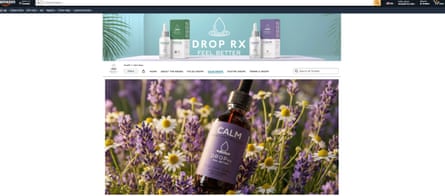
Saphier has been selling the products under the brand name Drop RX since at least 2024, according to a Guardian review. The Guardian found the brand has offered at least nine formulations, with names including Allure, Boost, Relief, Sleep and Intimacy. The labels describe Drop RX as being “physician formulated”, and suggest benefits people might see if they use the products. The labels say Focus is “designed to support overall brain health”, while Calm is “designed to support a balanced mind and body”.
The Drop RX website links directly to Amazon, where two formulations, Calm and Focus, were available for sale until recently in a Drop RX storefront. The Guardian bought both products for $24.99 each soon after Saphier was announced as Trump’s pick. The liquid comes in a 2oz glass bottle with a dropper, with a label that suggests using “1-2 dropper fulls daily under tongue or diluted in a beverage”.
On Wednesday, the Guardian inquired about Drop RX’s listings to Amazon and Saphier. By Thursday, several of the listings had been removed, and those that remained were listed as “currently unavailable” and were not purchasable. Amazon said in an email: “We are investigating the compliance of the products in question and will take appropriate remediation actions.”
In the past, Saphier promoted the products on her Instagram account. In a video posted in June 2025, she asked: “Did you see a new study that came out this week? The more rosemary and sage you have in your diet it actually lessens your risk of Alzheimer’s disease. Good news! Drop RX’s Focus already has liquid rosemary and sage in it to promote your brain health. So we’re already ahead of that trend.”
In another video in August 2025, Saphier said her morning routine included making tea from her Boost and Intimacy products.
“Intimacy. I know how it sounds,” she said with a smile as she showed the box to the camera. She called it an incredible combination that is “a natural aphrodisiac”. “And it’s actually great for hormonal support. So if you’re like my age, men, women, we could all, kind of, use this.”
Unlike with Saphier’s other products, the Guardian could not find Intimacy listed on Amazon.
In another post that surfaced in a Google search but which is no longer available on her Instagram account, Saphier said she was putting a “care package” of DropRX liquid herbs together for Trump “as he continues to heal from his gunshot wound”.
Saphier’s employer, the Memorial Sloan Kettering Cancer Center (MSKCC), one of the most renowned research hospitals in the world, has a conflict-of-interest policy that prohibits “endorsement of products or commercial ventures.” The MSKCC did not respond to multiple messages seeking comment on whether Saphier is in compliance with the hospital’s policies.
A concerning ingredient
The first ingredient listed in Drop RX’s “Calm” formulation is kava kava root. Also called kava, the ingredient was added to the US Department of Defense list of prohibited dietary supplement ingredients in April 2024, “based on the possibility of impairment and subsequent threat to military readiness”, according to a spokesperson for the department’s health system.
The spokesperson added that the US Food and Drug Administration, which regulates food and drug safety, first issued a consumer advisory in 2002 expressing concerns about liver damage associated with kava use. The FDA in 2020 published a 29-page review of the scientific literature and highlighted safety concerns about kava.
Kava can be legally sold in the US, but it has been banned or restricted in some countries, including the UK, France and Switzerland, due to concerns about liver toxicity.
The rules in the US can vary depending on whether it is mixed with anything and where it is sold. For example, kava is sometimes sold as a tea, but New York state does not allow food establishments to serve it because it is considered an adulterant. However, New York does not restrict the sale of kava on its own as a nutritional supplement product, according to a state health department spokesperson.
Consumer advocates raised additional concerns about Drop RX.
ConsumerLab.com independently tests health and nutrition products, and has reviewed thousands of dietary supplements. It publishes a list of “red flags” to watch out for when buying dietary supplements.
After reviewing Amazon listings for two of Drop RX’s products at the request of the Guardian, its president, Tod Cooperman, said they exhibited the number one red flag his group warns about: labels that don’t tell you how much you’re getting. The two products the Guardian purchased listed ingredients including organic ginkgo biloba extract, organic Bacopa monnieri and organic lavender, but did not say how much of each was in the bottle or in a dose.
“We prefer that consumers buy products where you know what’s actually being provided,” Cooperman said. “Most supplements will tell you, will break out how much of each ingredient.”
Though the labels said the products were made in the US and used good manufacturing practices, they did not specify where they were made or provide any indication that a third party had verified those manufacturing practices, Cooperman said.
A growing market
Supplements are a growing but controversial segment of the wellness market. Leading figures in the Maha movement have courted the industry, which is estimated to have reached $72.9bn in sales in the US in 2025.
But unlike drugs and pharmaceuticals that are subject to rigorous testing, dietary supplements do not have to be proven safe and effective before they are marketed, Lurie, of the Center for Science in the Public Interest, said. That means many supplements don’t work, he said, don’t have the ingredients they say they do, contain ingredients that could cause health problems, or all of the above.
Unlike drugs, dietary supplements are not allowed to make health claims, such as that they treat a certain disease. But they can make what’s called structure or function claims that their ingredients can affect some structure or function of the body, such as that they provide “immune support” or that “calcium builds strong bones”.
Lurie said a reason many dietary supplements were in that category was because no one had proved that they are effective and provide a health benefit.
“If it were, somebody might take it and try to make it into a drug, right? Because then there’s good money to be made. Even better money to be made,” he said.
Saphier, he said, was just the latest Trump pick to back such products, which he believed “tells you something about the quality of science that they are likely to implement”.
Disclaimer : This story is auto aggregated by a computer programme and has not been created or edited by DOWNTHENEWS. Publisher: theguardian.com