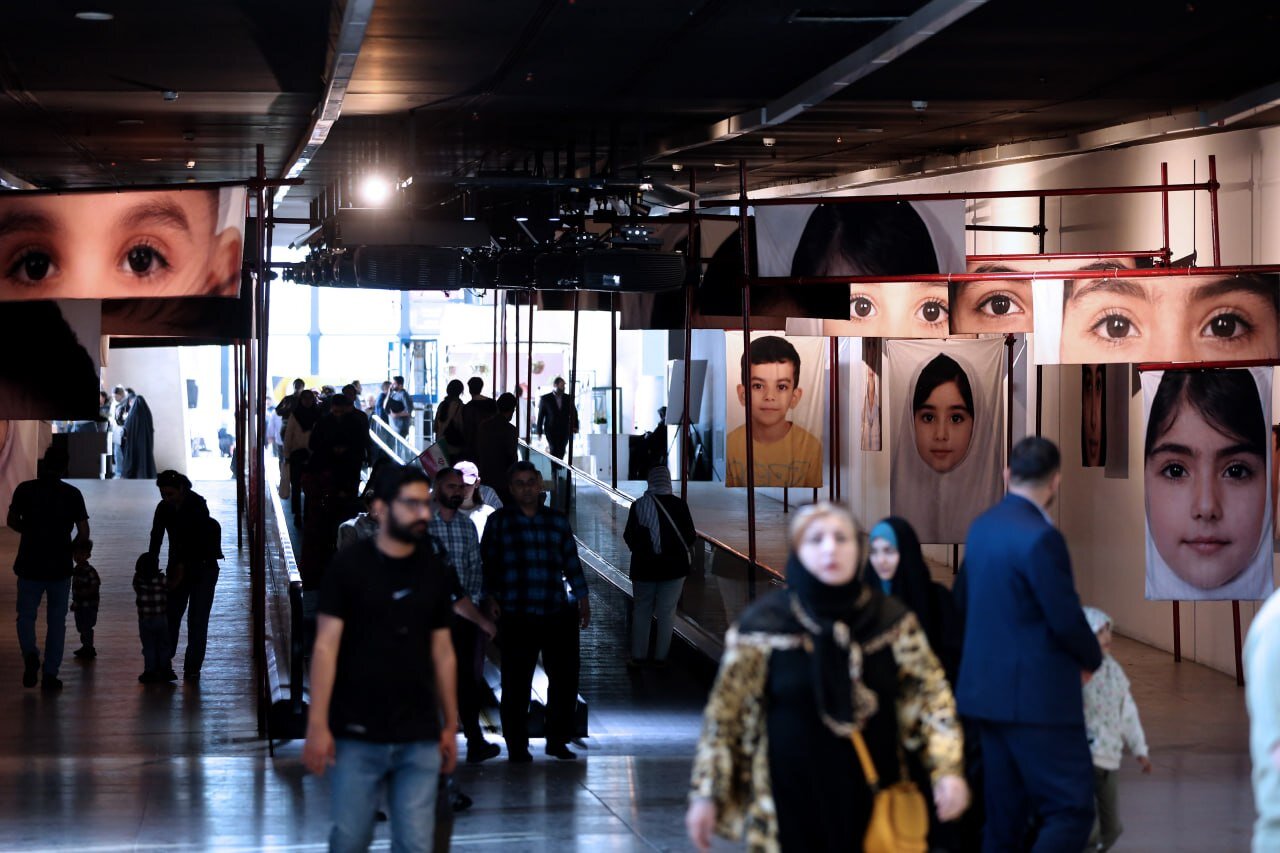
TEHRAN- Following its initial display at Tajrish Square, the art installation titled “Eyes of Minab” has been relocated to the Khialestan walkway of the Tehran Book Garden, drawing public attention once again to the tragic martyrdom of schoolchildren in southern Iran.
The art project serves as a somber tribute to the 168 students and staff of the Shajareh Tayyebeh Elementary School in Minab, who were martyred during the recent US-Zionist aggressions.
By displaying large-scale images of the eyes and parts of the faces of the martyred children, the installation seeks to remind the international community of the human cost of these crimes and the innocence of the victims.
Commissioned by the Tehran Municipality Beautification Organization and produced by the Soore-ye Omid Institute Arts and Media Institute, the project was executed by architectural designer Reza Golpayegani.
The relocation of the installation to the Book Garden, a major cultural hub in the capital, ensures that a wider audience, particularly families and youth, can engage with this visual narrative of resistance and remembrance.
Earlier in April, in an exclusive interview with the Tehran Times, artist Reza Golpayegani provided an extensive look into the conceptual framework and the emotional weight of the work.
Inspired by the haunting power of children’s gaze, Golpayegani focused specifically on the eyes of the students martyred during the US-Zionist coalition airstrikes to symbolize their enduring souls and the fragmented futures of their families. Despite the heavy subject matter, the artist noted that the public has been drawn to the purity and beauty of the images rather than being repelled.
Golpayegani viewed this project as a form of spiritual resistance and a traveling memorial intended to visit other affected cities, ensuring the narrative of victims like Makan Nasiri—whose remains are still missing—is never lost to history. By capturing these gazes, the artist aims to educate future generations on the immense cost of national sovereignty and the profound innocence sacrificed during the conflict.
On February 28, the Shajareh Tayyebeh girls’ elementary school in Minab, Hormozgan province, became the site of a devastating massacre as the United States and Israel initiated their strikes against Iran.
While dozens of girls and boys aged between 7 and 12 were beginning their lessons, the school was targeted by a missile strike that caused the building to collapse, trapping children and teachers beneath the rubble. Iranian authorities confirmed a final death toll of 168 people, with at least 95 others wounded, marking one of the most harrowing incidents of the conflict’s opening day.
Despite attempts by US and Israeli authorities to distance themselves from the carnage as images of the tragedy spread across social media, detailed forensic and digital investigations have painted a starkly different picture.
An analysis by Al Jazeera’s digital investigations unit, utilizing over a decade of satellite imagery and recent video clips, revealed that the school was a clearly distinct civilian facility, separated from any adjacent military sites for at least ten years. Furthermore, witness accounts and satellite-based analyses confirmed that the school was triple tapped by three separate, deliberate strikes, leaving no doubt about the nature of the attack.
The international community has faced mounting evidence regarding the responsibility for this atrocity, with investigations from major global outlets including The New York Times, BBC Verify, CBC, and NPR all concluding that the United States was responsible for the strike.
These findings have raised fundamental questions about the intelligence used to justify the bombing, as the patterns of the strike suggest a direct targeting of a civilian educational institution. The Minab school tragedy now stands as a somber testament to the immense human cost of the aggression and a focal point for those demanding international accountability.
SAB/
Disclaimer : This story is auto aggregated by a computer programme and has not been created or edited by DOWNTHENEWS. Publisher: tehrantimes.com