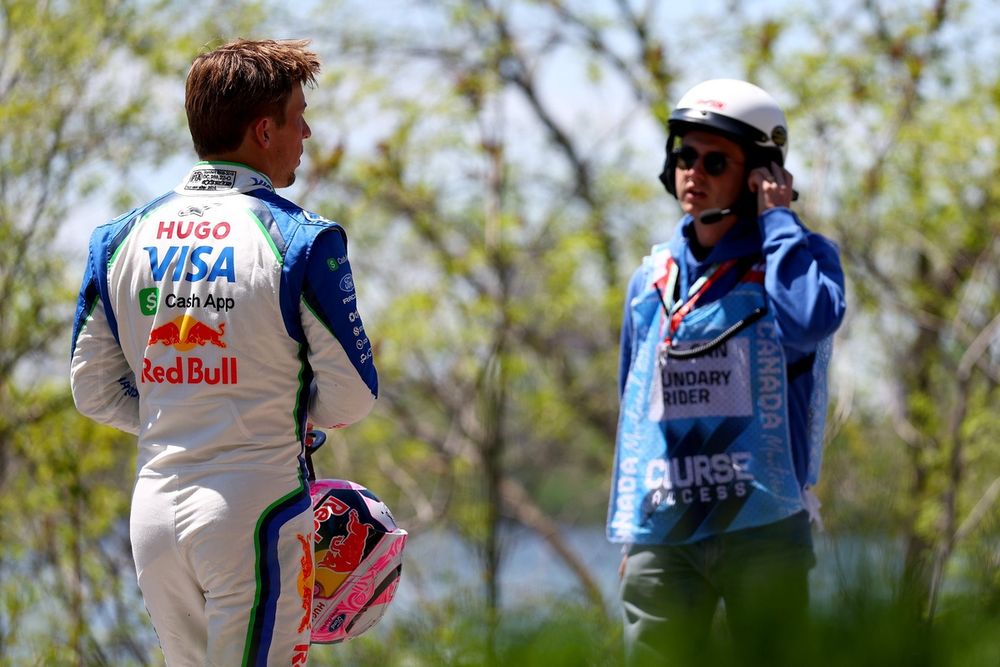
The phrasing of official communications from the FIA’s stewards tends to be deliberately dry and factual, but a note of schoolmasterish anger was manifest in the document announcing and explaining a €30,000 fine for Racing Bulls after Liam Lawson’s breakdown forced Formula 1 practice to be red-flagged in Canada.
Lawson’s car halted with a hydraulic problem within 10 minutes of the sole practice session for this sprint weekend getting under way, but the marshals were unable to move it.
That in itself presents a problem at the Circuit Gilles Villeneuve, an older venue that doesn’t have the space to accommodate the perimeter roads expected of newer tracks, complicating the task of removing stricken cars.
Even so, since all cars must be fitted with a so-called Clutch Disengagement System (CDS), which acts even if the onboard hydraulics and electrics have failed, it should have been possible for the marshals to push the VCARB 03 into one of the gaps in the barriers while covered by a virtual safety car (VSC) deployment. Instead, the session had to be red-flagged, and race control added five minutes to the end of the session to compensate.
For breaching Article C9.3 of the FIA F1 Regulations, Racing Bulls was fined €30,000, €20,000 of which was suspended for 12 months “subject to no further breach of this regulation by the competitor, for either of their cars”. This brings an element of peril for the team, since it has emerged that FIA technical delegate Jo Bauer has previously warned Racing Bulls about its CDS design, which is unusual in that it also services the car’s anti-stall system.
Article C9.3 states: “All cars must be fitted with a means of disengaging the clutch for a minimum of 15 minutes in the event of the car coming to rest with the engine stopped. This system must be in working order throughout the competition even if the main hydraulic, pneumatic or electrical systems on the car have failed.”
Liam Lawson stopped on track in the sole practice session for the Canadian GP
Photo by: Andy Hone/ LAT Images via Getty Images
The system is activated by a button that must be clearly marked, and located facing upwards on the monocoque so it can be reached and activated within five seconds by the driver or marshals. As reported in the stewards’ findings, in this case the marshal who initially tried to activate the CDS was trying to press a button in the wrong place.
But this had no bearing on the outcome, because the system had failed anyway – and this is what clearly annoyed the stewards. Not only did the dual function design prevent the car from being moved, disrupting the business on track, it created a further safety hazard in that the CDS is also supposed to shut off the car’s electrical energy recovery system.
“It was noted that the system on this car performs two roles,” said the stewards’ statement.
“The one for which is it primarily intended, namely to release the clutch when the car is stopped and the engine is not working, and the other relates to the anti-stall system. In this case, a ruptured joint caused a hydraulic leak, which caused the car to stop.
“The CDS, when activated by the marshal, then failed to release the clutch and hence the car could not be moved.

Liam Lawson, Racing Bulls
Photo by: Alex Bierens de Haan / Getty Images
“This is a serious matter. It resulted in the session being red-flagged.
“Had the system worked as intended by the regulations, the incident could have been dealt with swiftly via deployment of the virtual safety car.
“The stewards note the concern of the FIA technical delegate, over the dual purpose of the CDS on this car. The technical delegate advised that the team had, in 2025, been warned about the CDS system design for its cars.”
Making a single component perform more than one role is a solid engineering principle but in this case, it resulted in an expensive fine and a verbal slap on the wrist from the stewards. The wording of the regulations doesn’t explicitly forbid the CDS being used for more than one purpose, but it’s understood the technical delegate’s concern related to the additional complication making failures more likely.
The choice facing the team now is whether to redesign the system – if possible, given its integration into the anti-stall mechanism – or take the risk of it happening again.
We want your opinion!
What would you like to see on Motorsport.com?
– The Motorsport.com Team
Disclaimer : This story is auto aggregated by a computer programme and has not been created or edited by DOWNTHENEWS. Publisher: motorsport.com