
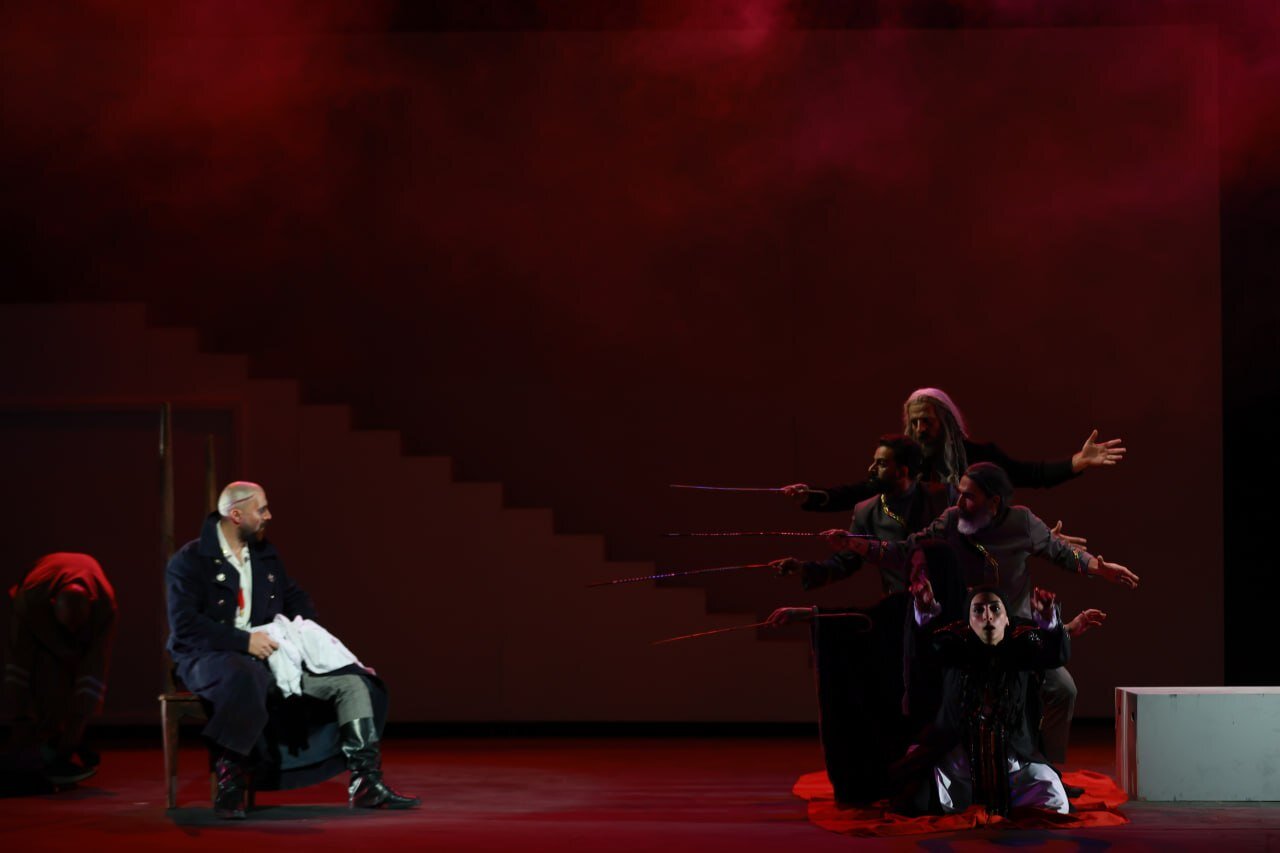
TEHRAN- The main hall of Tehran’s City Theater Complex hosted the opening ceremony of the play “Particles of Chaos” on Friday evening. The event was marked by a tribute to the martyrs and brave survivors of the Iranian Navy’s Frigate Dena.
The ceremony, attended by high-ranking cultural and military officials, began with a performance by the Islamic Republic of Iran Navy band in the theater’s courtyard. Notable attendees included Mehdi Shafiei, Deputy Minister of Culture for Artistic Affairs; Kourosh Soleimani, Director of the City Theater; Amir-Hossein Shafiei, Director of the Soore Theater Club; and Ruhollah Sadeqi, Deputy Head of Public Relations for the Navy.
During the event, honors were presented to the families of martyrs Rasul Esfandiari, Sadra Bahmani-Moqaddam, Mohammad Hossein Qahramanvand, Mohammad Amin Mahdavi-Ara, and Hossein Naeini. Three survivors of the Frigate Dena—Amir Zangeneh, Meysam Chari-Rad, and Hamed Sarani—were also recognized for their courage.
Addressing the audience, Mehdi Shafiei emphasized the artist’s role in documenting contemporary sacrifice. “It is the duty of artists to recreate our collective memory—a memory that empowers us to resist aggression throughout different eras, from the liberation of Khorramshahr during the Sacred Defense to the recent war,” he stated. He added that the presence of the martyrs’ families serves as a “living embodiment of resistance” that must be recorded for history.
The play’s director, Ebrahim Poshte Kouhi, expressed the difficulty of speaking in the presence of such sacrifice. “The most valuable asset a human possesses is their life. Those who give theirs for their homeland are revered figures worldwide,” he said. Poshte Kouhi explained that “Particles of Chaos” tells the story of the crimson soil of Hormuz Island, ensuring that future travelers never forget the blood shed to keep that land free.
Kourosh Soleimani, head of the City Theater, also paid his respects, noting that while no words can fully ease the pain of the grieving families, “the memory of these young men, who perished in ultimate oppression and solitude, will never be forgotten in the history of this land.”
Representing the Navy, Ruhollah Sadeqi assured the audience that the nation’s maritime authority and peace are rooted in the sacrifices of the Dena and Jamaran crews. “We promise that we will never allow any enemy to cast an aggressive eye toward this country,” he declared.
The ceremony concluded with a performance of “Particles of Chaos,” a narrative of the Southern Iranian people’s resistance against foreign invasion.
Written and directed by Ebrahim Poshte Kouhi and produced by the Soore Theater Club, the play offers a powerful narrative of steadfastness in the Persian Gulf.
The production is described as an epic chronicling the liberation of Hormuz Island from Portuguese occupation. This stirring narrative delves deep into the heroic triumph of the Persian Gulf’s inhabitants as they stood defiant to safeguard their motherland’s sovereignty, effectively dismantling the shackles of long-standing occupation and colonial ambition. It is a profound saga of a maritime uprising, where the resilient seafaring communities rose like the tide against foreign intrusion. Set against a visceral backdrop of passionate love and the heavy price of blood, the play masterfully captures the frenzy and magic inherent to Iran’s southern coast—a region where myth and reality blur.
The atmosphere is further heightened by evocative live musical performances that utilize traditional instruments and rhythmic chants, echoing the heartbeat of the coastal people. This artistic fusion does not merely recount a revolt; it explores the psychological and spiritual depth of a community that found its ultimate strength in unity. By intertwining the raw beauty of Southern folklore with the harsh realities of maritime warfare, the performance creates an immersive sensory experience that honors the ancestral courage of those who transformed the shores of Hormuz into a permanent bastion of freedom and national dignity.
The work is more than just a retelling of a historical event; it is a vivid, musical portrayal of the Iranian spirit of resistance, nurtured and defined within the embrace of the Persian Gulf. By highlighting the strategic and cultural significance of the region, “Particles of Chaos” depicts the grandeur of the Iranian soul and its resilience against colonial powers.
The production serves as a reminder that the Persian Gulf is not merely a name, but the very fountainhead of Iranian identity, resistance, and historical pride—a place where freedom resonates within the waves and history breathes along its shores.
SAB/
Disclaimer : This story is auto aggregated by a computer programme and has not been created or edited by DOWNTHENEWS. Publisher: tehrantimes.com



