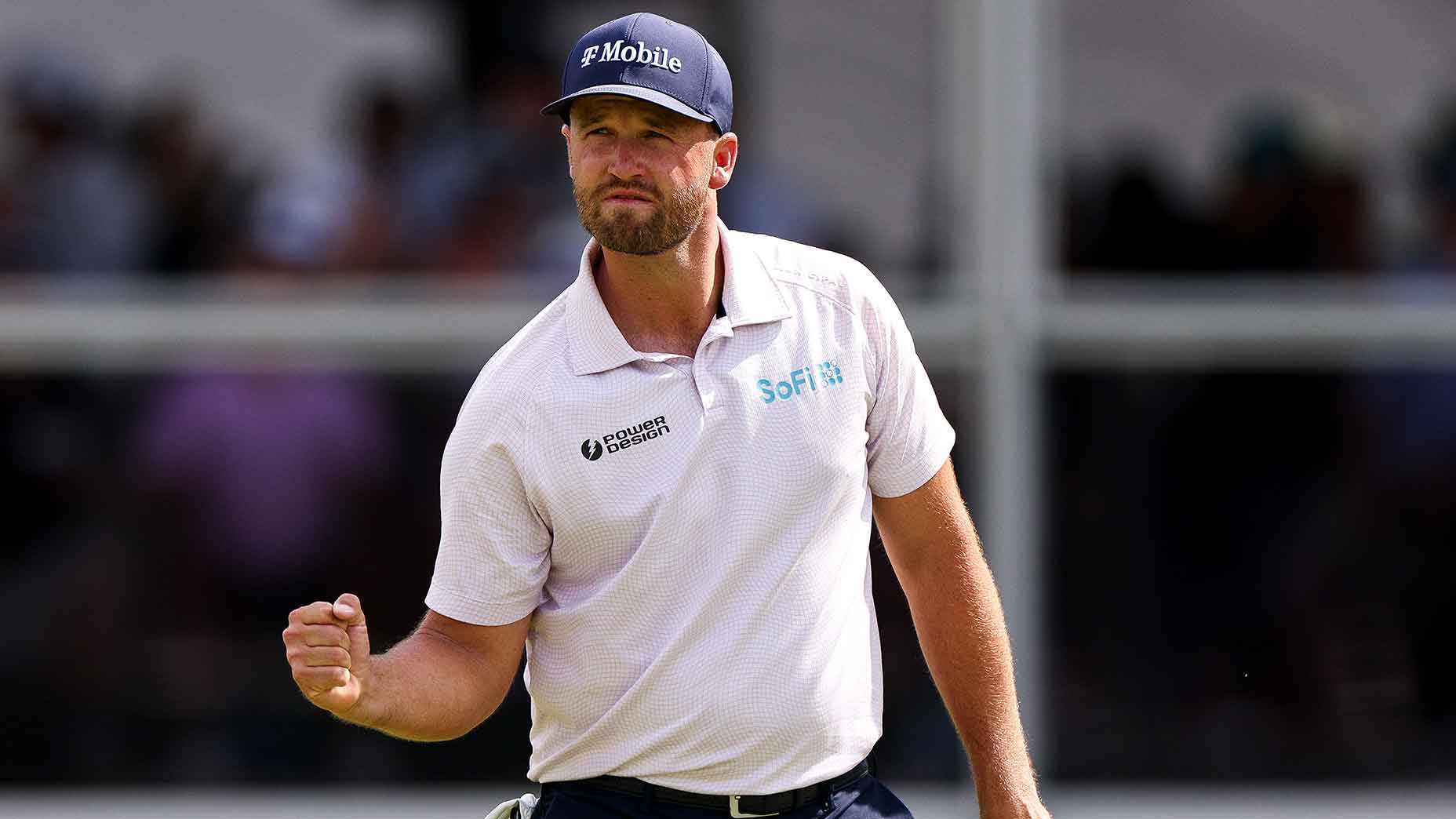
Post-round interviews on Sundays are often short but can be extremely telling. Sometimes it’s through tears or choked up answers. Other times it’s just a big exhale and a scattered brain as the reality rushes over them. For Wyndham Clark on Sunday, it was a curious answer about one of his darkest moments: the situation between him and Oakmont Country Club after he damaged a locker at last year’s U.S. Open.
“I have to first thank a lot of people,” Clark said after winning the CJ Cup Byron Nelson, “because what happened at Oakmont wasn’t the greatest thing.”
He then thanked each of his sponsors by name for sticking with him through a trying time. “I’m very thankful for that,” he continued, adding, “You know, the greatest thing about having a downfall like that is the comeback. Today feels really special after having a tough year and grinding it out.”
Not everything was made clear by that answer, but the fact that it was volunteered so immediately and acknowledged publicly says something. Perhaps Clark will add more as the weeks and months move forward, having summited the Tour mountain once again. Sunday’s immediate response was telling, in part, because Clark hadn’t spoken much about Oakmont period.
Last June, in the waning minutes of the U.S. Open, Clark severely damaged one of the lockers in that club’s ancient locker room. In the weeks that followed, whatever happened — or didn’t — led to the club banning Clark from Oakmont property. In a letter addressed to Oakmont membership, club president John Lynch said, “Reinstatement would be contingent upon Mr. Clark fulfilling a number of specific conditions, including full repayment for damages, a meaningful contribution to a charity of the Board’s choosing, and the successful completion of counseling and/or anger management sessions.”
As with plenty of things in pro golf and involving a famously exclusive golf club, not much else was said publicly. A month later, at the Open Championship, Clark said he wanted to do “anything” he could to show Oakmont, “what happened there was not a reflection of who I am and won’t happen again.” He apologized again, but made it clear he intended to right his wrongs.
Until this week, that was the last we’d heard of it. Right until the opening answer of Clark’s post-win interview.
Perhaps it is most fitting for this kind of statement from Clark, whose journey to the top of the pro game has often aligned with a discussion about mental health. He admitted to Amanda Balionis that there were times in 2025 that he was concerned he may never get back in the winner’s circle. On Saturday, as part of a tournament initiative that allows players to decide what name or phrase is velcro’d to their caddie’s back, Clark included the term “Unlok”, the name of a mental health app he hopes to launch in the coming year.
His career triumph, at the 2023 U.S. Open, was a story of mental health, and not always a positive one. It was during his championship press conference that he admitted to “three or four” moments of mental anguish in his career through which he stayed the course. Those moments included, by his own admission, screaming in his car, punching things, etc. It pushed him to PGA Tour sports psychologist Julie Elion, who Clark thanked to no end in the months that followed. Their work together unlocked his true potential, helping him rise as high as No. 3 in the world.
But when his good golf began to fade, that mental battle continued to show itself. It showed when he whipped his club into tournament signage at the 2025 PGA, and it showed in how he responded during a disappointing weekend at Oakmont. The journey of pro golf and the journey of mental health is rarely linear. He finished 2025 outside the top 40 in the world and dropped further this spring. Then, almost all of a sudden, he led the field in Strokes Gained: Putting on Saturday and Sunday, making over 250 feet of putts and boat-racing the field to a score of 30 under.
Asked afterward about how he did it, Clark said he was in a zone, but a different one than in his past victories. He called it a “calm zone” and admitted it was a bit weird. But that’s the same word he used numerous times at the Masters last month: calm. Calmness with life off the golf course. Calmness arriving for the first round and the final round. Calm enough to just go out, hit golf shots, and maybe make everything.
“Here it just almost felt like I was playing at home,” Clark said, “and every hole was a new hole. I didn’t worry that I just made six birdies or that I needed to make more. I just was like, all right, I have this 20-footer. I see it left edge, and I’d hit it, and it would go in.”
Disclaimer : This story is auto aggregated by a computer programme and has not been created or edited by DOWNTHENEWS. Publisher: golf.com