
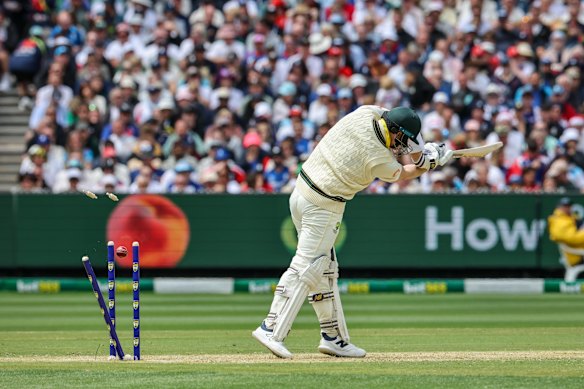

Australian cricket will hold a summit this winter to question whether the nursery for the Test team has become too difficult for batters, too friendly for medium pace seam bowlers and too grassy for spinners.
Cricket Australia and state teams have been discussing worrying trends in the Sheffield Shield since the season’s conclusion, with low aggregate totals for batters and a glut of wickets for seamers on the agenda alongside a steady decline in the number of overs bowled by spinners.
CA has pencilled in plans for a national meeting of coaches to discuss the recent struggles for batting in particular, while curators from all major venues around the country will hold their annual meeting in July.
By their own admission, state teams have become accustomed to playing Shield games on “result” pitches with plenty of grass to help ensure an outright win, rather than more even surfaces that might end in a thrilling draw where neither side takes maximum points.
Ahead of a summer where Australia will play five Tests in India, the struggles of the likes of Todd Murphy and Matt Kuhnemann to play a central role in matches has also come under the microscope, with state coaches and national team mentor Andrew McDonald in agreement that the style of cricket prevalent in the Shield will have to shift.
While players called up from domestic ranks have served Australia well in recent summers – not least the likes of Beau Webster and Michael Neser – there are concerns about the environment being created to develop the generation that will follow that of Pat Cummins, Travis Head and spinner Nathan Lyon.
“I think there’s an admission across the board that batting has struggled on the current surfaces that are being played on in Shield cricket,” McDonald told this masthead. “I still believe the best players are at the top of the averages, it’s just that they’ve slid. Instead of averaging 50 for a season, the averages are down to high 30s, and then the bowling averages equally have come down.
“Now is that something that will produce cricketers for the next level? That’s a question mark and there is a lag between now and when those players are exposed at international level.
“There is a conversation around what type of cricketer that produces. Does it produce a cricketer, especially the batters, that are ultra-aggressive, trying to hit bowlers off their line and length. Are you getting rewarded for investing in your innings in the first 50-odd balls, or does the wicket keep seaming for the rest of the game. I know the state coaches have an appetite to spark this conversation up, and then it’s really how you go about it.”
Victoria’s coach Chris Rogers, who guided his team to the top of the Shield table after 10 rounds before they lost the final to South Australia, said he was conscious that too many games played out in a similar fashion: a lot of pace overs, difficult batting conditions and a marked advantage for bowling first.
“We want to make sure we’re not just playing one style of cricket all the time, and that’s a conversation with Cricket Australia,” he said. “I think we’ve got to be a little bit mindful of not falling into the trap of trying to get a result every game that means the best bowlers in the competition are around 130km/h and making sure we’re still making it hard for bowlers to get wickets.
“But I’m not taking away from the fact the first-class game is bloody hard in Australia and we’ve still got some fantastic cricketers. I’m just saying we can make sure we’re producing the right kinds of cricketers who are then going to go on and make sure the Australian cricket side is strong.”
Lyon, for one, has been worried about the style of cricket being played in the Shield for some time in terms of the lack of opportunities it provided for spin bowlers to influence the outcome of a game.
“I do care about spin bowling and I’m not saying this because I’m concerned about my position in the team,” Lyon said last year. “I know my role, I know how important spin bowling is, but there is a degree of me that’s concerned about spin bowling around the world, not just Australia, with the wickets we’re playing on.
“If you look at spin bowling and your younger spin bowlers around the country whether they’re not getting the overs or the opportunities to bowl on day-three, day-four wickets, or spinning wickets, or even green seamers because the fast bowlers are dominating.”
In the final round of the regular season, Victoria met South Australia on a well-prepared pitch at Junction Oval that provided something for all: runs for batters and wickets for both pace and spin.
The game petered out to a draw largely because both sides had already qualified for the final. When the decider was played a week later, the surface was much grassier, leaving Murphy with little to do and SACA wrist spinner Lloyd Pope carrying the drinks.
English county cricket has a system where the ECB has the ability to dock points from teams that prepare pitches rated “below average” or “poor”.
“A game that goes for four days and one team is nine down at the end of play, it’s a fantastic game, but you don’t get many points out of the game,” Rogers said. “Whereas a game can finish in two days and be a bit of a poor pitch, but you get maximum points for the result.”
News, results and expert analysis from the weekend of sport sent every Monday. Sign up for our Sport newsletter.
 Daniel Brettig is The Age’s chief cricket writer and the author of several books on cricket.Connect via X.
From our partners
Disclaimer : This story is auto aggregated by a computer programme and has not been created or edited by DOWNTHENEWS. Publisher: www.smh.com.au


