
Prime Minister Anthony Albanese has admitted his capital gains tax overhaul may hit a wider range of firms beyond new tech start-ups, as he rushes his tax policy package through parliament in a ploy to corner Opposition Leader Angus Taylor into opposing tax relief.
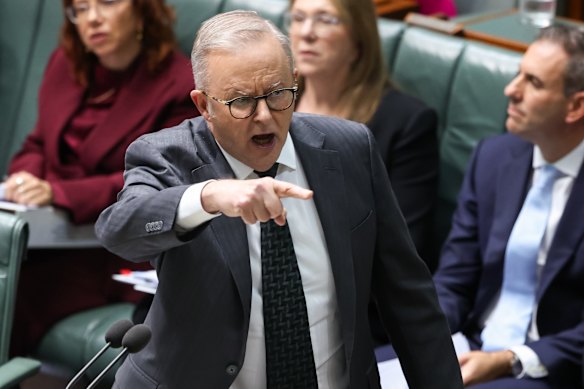
As Labor MPs grumbled about the messy public messaging after this month’s budget, tempers flared in question time. Albanese passionately defended the case for stripping away tax concessions to boost home ownership and warned Taylor that his hard line against Labor’s policies would lead to his replacement by Liberal MP Andrew Hastie.
The government intends to ram through its bill without a normal committee inquiry into the changes, and Albanese said any carve-outs could be put into the legislation at a later date after consultation.
Facing criticism from big business, young entrepreneurs and economists that Labor’s budget would sap productivity, Albanese, Treasurer Jim Chalmers and Industry Minister Tim Ayres said repeatedly last week they would consult tech firms and the “start-up sector” about unintended consequences.
But Albanese, asked about a narrow carve-out for tech start-ups, said “that’s not what we said” on budget night, even though budget documents stated the “tech and start-up sector” would be consulted on the CGT changes.
Albanese softened his tone when talking about his tax agenda on Monday. Instead of castigating critics, Albanese promised to consult a wider group of business groups including the peak small business association, not just the innovators ordinarily understood to fit the definition of a start-up.
“On budget night, we very specifically said that we’d go out there and consult on the details, including the interaction with the rather complex tax system across the board,” Albanese said.
In a move to wedge the opposition, Albanese has rebuffed calls from the opposition and teal independents to set up an inquiry into the decision to replace the 50 per cent CGT discount with an inflation-adjusted model.
Instead, he confirmed he would push the bill through by the end of June. Included in the bill will be new limits on negative gearing, the CGT changes – both opposed by the Coalition – and separate measures to provide a $250 tax offset to workers and a $1000 standard deduction.
Bundling all the tax policies together forces the Coalition to vote on all the measures at once. If the opposition votes against the whole bill, Labor will be able to say – as it did before the last election – that the Coalition is opposed to tax cuts.
Teal MPs Allegra Spender and Zali Steggall teamed up on Monday to highlight the potential economic consequences of Labor’s CGT changes, which they said had ambushed small businesses.
The new inflation-adjusted model for taxing capital gains may unintentionally penalise faster-growing businesses, UNSW economist Richard Holden argued in research released on Sunday, labelling it a “productivity tax”. Holden said run-of-the-mill firms such as industrial cleaners could be hard hit if they grew at above-inflation levels, not just tech firms.
The government says privately that Holden’s analysis is selective. Treasury modelling released by Labor last week claimed the CGT change would only increase from 19.3 per cent to 21.5 per cent over the next decade the tax rate on gains, which it said would not significantly affect investment.
“We need to find a way that rewards innovation and that rewards risk,” said Spender, who said last week that she underestimated the effect of expanding the CGT changes to assets other than investment properties.
“I really urge the government to take a breath. They say that they want to put stuff through, the legislation, this Thursday … I think that is the wrong idea.”
Albanese does not want an inquiry into the tax bill, which the Coalition could use to keep the contentious changes in the headlines. The Coalition would need the Greens to force an inquiry. The minor party has indicated it will vote for the bill, though it has not reached a final decision.
The prime minister suggested on Monday that the government would amend the tax bill after June if the consultations on the CGT changes came up with solutions.
“That’s the normal way that tax policy has been implemented for a long period of time,” he said.
Several Labor MPs who returned to Canberra on Monday said they were not overly panicked by the public furore about the budget but were worried that Labor’s framing on “intergenerational inequality” was being drowned out by criticism and questions on detail.
“Our comms has been no good,” one MP said. Another noted it was unusual for a minister outside the treasury portfolio, assistant minister for the digital economy Andrew Charlton, to seemingly lead the government’s communication on tax measures over the weekend.
Albanese said in question time: “Perhaps [Taylor] might like to speak to the next leader of the Liberal Party, who said this: I feel the anger regularly from young Australians who feel locked out of the housing market, red-hot anger, frustration, also a sense of despair that they can’t get a stake in the country, that they can’t afford a home again.”
“Good advice from [Hastie]. You might like to watch him just behind you.”
Taylor said earlier on Monday that Labor’s policies “don’t need a carve-out, they need an axe”.
“We need to see them gone because they are a war on ambition, a war on aspiration in this country,” he said. “We will fight it all the way through the parliament, and if it gets through the parliament then we will repeal it on winning an election. That is our vow to small business owners.”
Business Council head Bran Black said the CGT changes “make an already uncompetitive tax system less competitive at a time when Australia is fighting hard to attract investment”.
“A proper consultation process, including a parliamentary inquiry, is the right next step, if the government is proceeding,” he said.
Cut through the noise of federal politics with news, views and expert analysis. Subscribers can sign up to our weekly Inside Politics newsletter.
 Paul Sakkal is Chief Political Correspondent. He previously covered Victorian politics and won a Walkley award and the 2025 Press Gallery Journalist of the Year. Contact him securely on Signal @paulsakkal.14.Connect via X or email.
From our partners
Disclaimer : This story is auto aggregated by a computer programme and has not been created or edited by DOWNTHENEWS. Publisher: www.smh.com.au