Jack Ewing
Tesla hasn’t had a blockbuster new product since the Model Y sport utility vehicle went on sale in 2020.
But early reviews of the Tesla Semi, an electric heavy truck, suggest it could be a much-needed hit for the company. And it could shake up the staid business of truck manufacturing in the same way that Tesla’s cars upended the car industry.
After years of delays, Tesla has begun taking orders for the Semi, which is expected to cost about $US290,000 ($400,000) for the version that can travel up to 800 kilometres on a charge, much less expensive than heavy-duty electric trucks sold by Daimler, Volvo and other companies, which usually sell for at least $US400,000, according to estimates by the International Council on Clean Transportation. Tesla has said the Semi will also have a more affordable model that can travel 560 kilometres between charges. Both options would travel farther than trucks from other suppliers.
Cost and range are two of the main reasons many logistics and delivery firms have been reluctant to buy electric trucks, which cost at least twice as much as diesel models and account for only a sliver of heavy truck sales.
“The problem with the technology that’s out there right now is their range is limited. They’re quite heavy, and they’re very expensive,” said Jennie Abarca, owner of King Fio Trucking in Long Beach, California, which has ordered 20 Tesla Semis. “This is something new coming to the market that kind of answers all those problems.”
Demand for the Semi appears strong. California road transport firms have asked the state government for subsidies to help them buy more than 1200 Tesla trucks. That’s more than all the applications for other electric trucks since the state’s incentive program began in 2019.
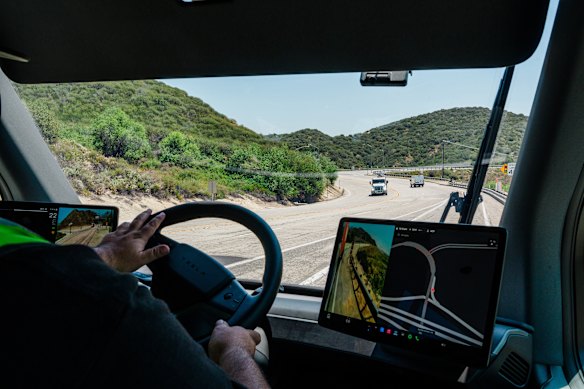
Ivan Torres, a driver for Nevoya, a San Francisco-based transport company, is a big fan of the Semi. He was at the wheel of one last month hauling power tools from the Port of Long Beach to Ontario, California, 100 kilometres away. Nevoya operates only electric trucks.
As the truck climbed a steep hill that separates Ontario from greater Los Angeles, Torres marvelled at its power. “It hauls the load like nothing, just up,” he said from the padded driver’s seat, which sits atop a shock absorber that smooths out the bumps. Screens on either side of the steering wheel provided a view of the traffic around him.
Torres said the Semi was quieter than diesel rigs. And he can run the air conditioning while waiting to drop off a load. That is sometimes not possible with diesel trucks because California limits how long those vehicles can idle in residential areas or near schools and hospitals, to minimise pollution.
If Tesla can push the road transport industry towards battery power, the environmental implications could be significant. Heavy and medium-duty diesel trucks make up a small percentage of all US vehicles but are responsible for 45 per cent of nitrogen oxide emissions from road transport, according to the Union of Concerned Scientists. Nitrogen oxides cause asthma and bronchitis and are the main component of smog.
Tesla’s timing may also be fortuitous. Diesel prices have risen about 50 per cent since the war with Iran began, making battery power more attractive. Electricity is much cheaper per kilometre – even in California, where utility rates are relatively high.
So far, Tesla has produced the Semi in limited numbers for a few customers like Pepsi and Nevoya. But the company said last month that it had started an assembly line in Sparks, Nevada, designed to produce up to 50,000 trucks a year.
If Tesla meets that target, the Semi could bring in tens of billions of dollars in revenue. That is still a modest amount compared with the trillions of dollars that Elon Musk, chief executive of Tesla, expects from self-driving taxis and humanoid robots.
Wall Street investors believe the company will dominate those two futuristic technologies. But Tesla has yet to perfect them or earn much money from them.
The Semi “could be a very nice additive revenue stream”, said Ben Rose, president of Battle Road Research, who closely tracks Tesla. “But it won’t be the kind of blockbuster that some of the products that they’re working on would be.”
Tesla did not respond to a request for comment.
Most electric trucks on the road today in the US are in California, New Jersey, New York and other states that offer incentives for their purchase. Such vehicles tend to carry loads relatively short distances.
Abarca’s firm specialises in hauling containers from the Port of Long Beach around the south-west. Tesla is building chargers powerful enough to add 500 kilometres of range in half an hour, putting cities like Las Vegas within reach, she said.
Whether Semis save money for their owners depends on how they use them.
“The more you drive it, the more you’re going to get those fuel savings from electricity being cheaper than diesel,” said Jacob Richard, trucks project manager at Calstart, a nonprofit group whose members include energy producers, carmakers and other businesses that promote clean energy.
More than a decade ago, Tesla permanently changed the auto industry when it introduced the Model S sedan, proving that electric cars could be practical and fun. Established car companies initially dismissed electric cars as a niche product. But later they spent billions of dollars trying to catch up with Tesla, which still accounts for roughly half of US electric car sales.
“It’s the same movie,” Adam Browning, chief strategy officer of Forum Mobility, which provides charging and other services for electric trucks, said of the Semi’s potential to disrupt the industry.
Still, established truck makers say they’re not worried that the Semi will lure away their customers.
“I don’t think it’s disruptive,” said Peter Voorhoeve, president of Volvo Trucks North America. The Swedish company’s VNR Electric heavy-duty truck has a range of 440 kilometres.
Voorhoeve said Volvo, which owns Mack Trucks, planned to introduce a new model next year that will have a longer range, but he declined to provide details. Volvo, with its years of experience, provides the service and reliability that fleet owners demand, he added.
John O’Leary, president of Daimler Truck North America, which owns Freightliner, said electric trucks were not practical for long trips because there were not enough high-powered chargers. “Infrastructure continues to be a challenge,” he said.
This article originally appeared in The New York Times.
The Business Briefing newsletter delivers major stories, exclusive coverage and expert opinion. Sign up to get it every weekday morning.
From our partners
Disclaimer : This story is auto aggregated by a computer programme and has not been created or edited by DOWNTHENEWS. Publisher: www.smh.com.au