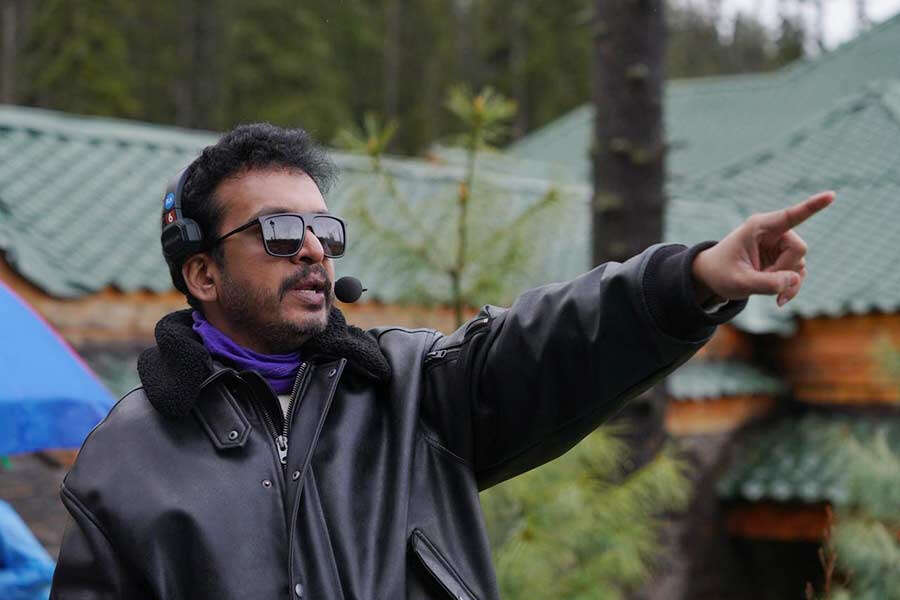
After the critical acclaim of Bhakshak, director Pulkit is back in the spotlight as his latest directorial venture, Kartavya, tracks at the number one spot. Backed by Red Chillies Entertainment and Netflix, the gritty thriller dives straight into the dark, complex realities of the Indian heartland. In an exclusive conversation with Filmfare, Pulkit opens up about his creative process, casting real-life journalist Saurabh Dwivedi as an antagonist, the massive online conversations around the film’s climax, and his experience of working with Saif Ali Khan. He also shares details about his next film, Sundar Poonam, which is currently filming in Rajasthan. Here’s the interview:
After Bhakshak, you seem to have mastered this art of talking about stories of these dark, complex realities of the Indian interiors. What draws you so relentlessly to stories where doing your duty means going against the system?
My draw towards the stories is very simple. I think that I belong to a very small place in India. I have been brought up there. So while growing up, I have seen so many stories up close to my heart. What I want to say is that 99% of India is around the heartland of this country, like 1% or 2% of people are in metros. And I connect with them the most. The way I connect to them, I do not connect to the people in metros. So yeah, that draws me there. And I think if I know something, if I know their story, if I know the culture, I will rather go ahead and tell those stories which I know and am very comfortable with.
That is the first thing. And the second thing is, I do not want to make or tell people to go against the system. Through my stories, through my films, I want to say: Have a voice. You do not need to fight the system or fight the society, you just have to have a voice. We are in a free land, and everyone has the right to put their thing upright on the table.
In Bhakshak, your protagonist was a journalist uncovering a racket. In Kartavya, you open with a twist where a journalist investigating child abuse is assassinated right under a cop’s watch. Is this opening sequence a deliberate nod to a cinematic universe?
(Laughs) No, nothing like that. I think I am too small to create a cinematic universe right now. So I do not think about that.
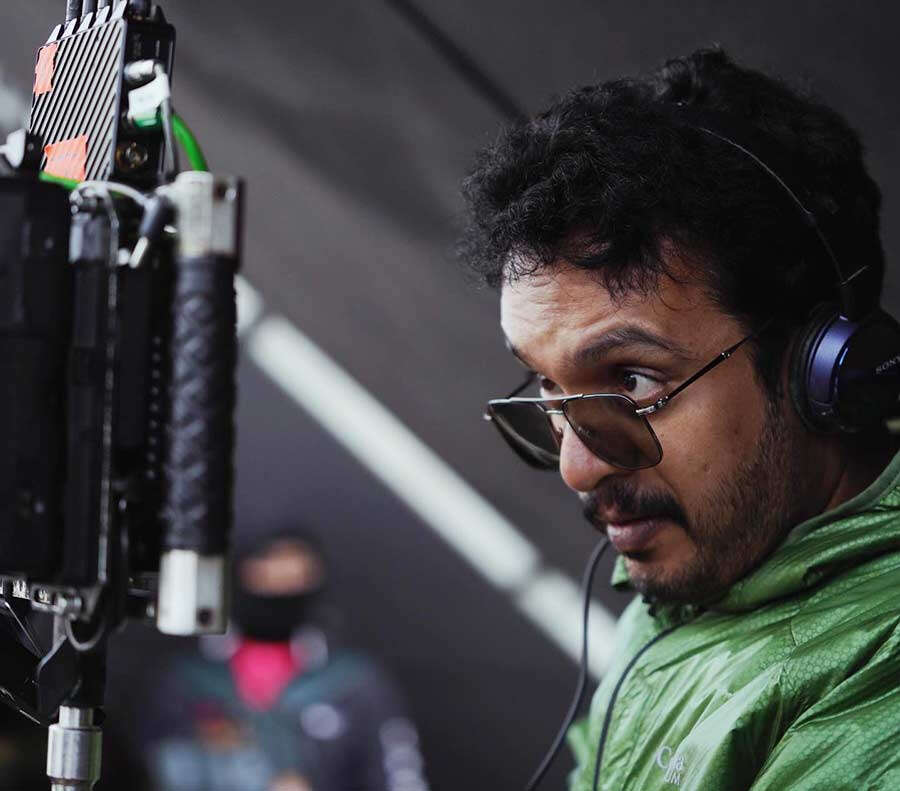
Speaking about Saif Ali Khan, how was the overall journey when you approached him for this role and how did the entire process go?
With him, it was a dream come true because I have always admired his craft and the way he has played so many characters in Dil Chahta Hai, Omkara, and more. While growing up, I have seen him and I have always admired him as an actor. I think he is one of those actors in that age bracket where he is willing to take risks more freely than the others. He is the one who, whether it is Sacred Games or anything, jumps on good content.
That was the thing which excited me to go to Saif, and Saif was my first choice for the film. I got lucky that I narrated it and he said, “Yes, I am doing it.” Working with him was quite an eye-opener because I always thought that he is a Bandra boy, he knows English, he will talk about Greek mythology. (Laughs) But he is so well-read, he can talk to you on anything, and he is emotional, vulnerable, and so emotionally charged. So yeah, it was fun exploring this project with Saif.
When audiences see Saif playing a gritty cop, the mind instantly races to Sacred Games. How did you work with Saif to ensure that Pawan felt fundamentally different from Sartaj Singh?
I never thought like that. We conceived the character very differently. I do not remember any conversation of me or even Saif discussing Sartaj Singh from Sacred Games. We never had a discussion. When you do not discuss, I think then you do unique things. If you discuss and if you want to do something different, then you fall into a wrong bracket. That is what I feel.
Choosing this story from a director’s point of view, what really told you that you had to do this project?
Again, it goes back to my growing up age. I always thought that everyone teaches you about so many things in life—your role in life as a brother, as a son, as a father, as a husband, as a wife, etc. But no one teaches you what your duty is as a human. That was one question which was there in my mind. While growing up in Bihar, studying in Haryana, then UP, I had so many exposures to different states. I thought that the question remains the same, and no one is talking about my duty as a human. So I wanted to explore that side, and then obviously, it began to have a story.
When a story takes place in the interiors of India, the accent and body language come into the picture. How did you ensure the actors sounded authentic without making a caricature out of it?
For that, I think the key thing is good casting. If you get good actors, you cannot expect Sanjay Mishra, Rasika Dugal, and Zakir Hussain to go wrong because the way they have been brought up and the way their conditioning is, it is very different. And again, Saif was so good while picking diction, and he has proved it again and again. So it was not tough actually. Saif’s native place, Pataudi, is in Haryana. So Saif has some kind of understanding of the body language and the language also. It was not very tough, but yeah, we did some readings and we went through some workshops to make sure that everyone is in the same world.
Many critics said they felt Rasika Dugal and Sanjay Mishra left them wanting more screen time. As a writer and director, how do you handle the tightrope of giving these actors enough room to breathe without letting the story lose its pacing?
As a filmmaker, you want to explore more and more, but there is a time duration. If you ask me, I want to make a four-hour film. But there are so many things that you have to cut and understand and make sure of. Nevertheless, they are a brilliant bunch of people. You want to see them more, you want to be with them more. It is a process. Sometimes I feel I have done justice; sometimes I will question myself that okay, I should have done more.
Casting real-life journalist Saurabh Dwivedi as a corrupt cult figure is a much-talked-about thing right now. How did that casting conversation happen?
I wrote something and I felt like this character speaks like how Saurabh speaks. So I thought I will approach him and ask if he wants to do it. There was no other thing to do about it. I approached him and he said, “Yes, if you want me to explore, I am okay to explore.” I am grateful for that. Sportingly, he came on board and he did it. There was no convincing required. Obviously, he said, “I have never done any acting job. How will I pull it off?” and I said, “Okay, I just want you to come as Saurabh Dvivedi and do it.”
This is your second outing with Red Chillies Entertainment and Netflix after Bhakshak. How was the experience of having them back this film ?
It is a good thing to have such a big production house backing your film. It is my second outing with Red Chillies and Netflix. They have backed Bhakshak already, and I am in full gratitude to my stars that the Red Chillies and Netflix combination has happened twice. For many people more talented than me, it is still a dream. So I feel truly blessed that I got a chance to tell stories with a brand like Red Chillies and a brand like Netflix, not once, but twice. It is one of the best experiences a filmmaker can have.
Making films that mirror real-world political and social issues can be tricky when it comes to censorship. Did you face any such issues?
No, luckily, we never thought about it and we never faced it. The idea behind making any film should not be to hurt someone. That is the first thing, because you are making a film for the audience, and if you are going to hurt them, then you should not make it. That is what I feel. Films which have society involved in the storytelling, you should not make them to hurt someone. You should make the film to understand things without hurting someone. We had this conversation internally between Red Chillies, Netflix. During the writing phase itself, we were very clear about what we wanted to take out.
What is next in the pipeline? Are you working on any project right now?
I am currently shooting while we are talking. I am in Rajasthan. I am shooting for my next film called Sundar Poonam, which is for Amazon Prime, with Sanya Malhotra and Aditya Rawal.
Also Read: Toaster Starring Rajkummar Rao And Sanya Malhotra Set For Mid-April Release
Disclaimer : This story is auto aggregated by a computer programme and has not been created or edited by DOWNTHENEWS. Publisher: filmfare.com