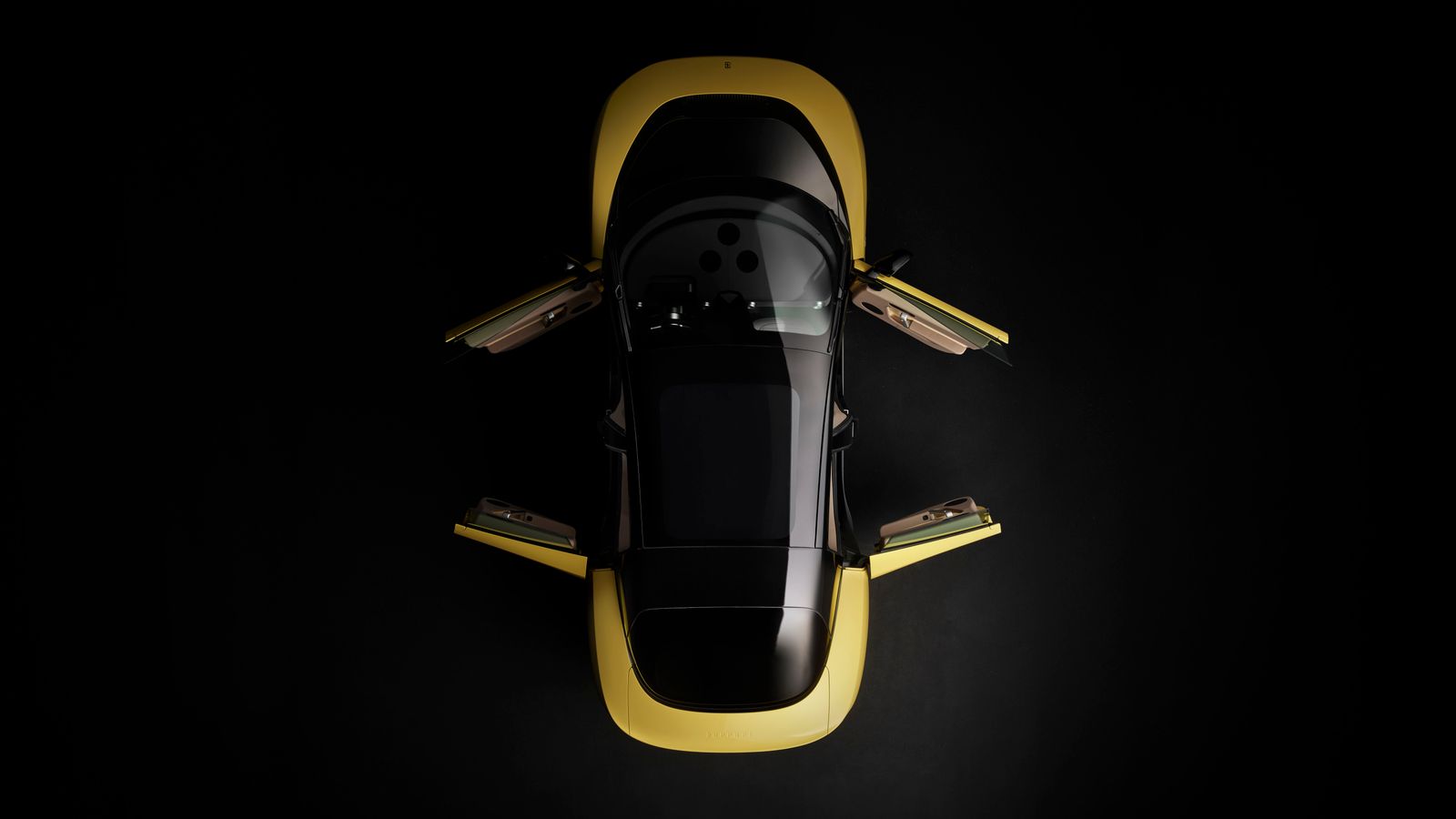
We have been waiting for the Ferrari Luce for eight years.
It was January 2018 when, at the North American International Auto Show in Detroit, former Ferrari chairman and CEO Sergio Marchionne first hinted at a “prancing horse” EV to compete with Tesla.
“If there is an electric supercar to be built, then Ferrari will be the first,” Marchionne said. “People are amazed at what Tesla did with a supercar: I’m not trying to minimize what Elon, did but I think it’s doable by all of us.”
Well, Ferrari has not been the first. But it has certainly taken the award for most anticipated EV launch ever, what with the drip-feed strategy of an initial model “nickname” of Elettrica, then last October’s powertrain reveal, then, in February, the Apple-esque LoveFrom-designed interior spearheaded by Jony Ive and Marc Newson.
Today’s reveal of the exterior in Rome by Ferrari ends the secrecy and completes the process. This is the Luce (Italian for “light”), the most consequential thing Maranello has made in decades.
The numbers are suitably high-end. Four motors, one per wheel, have a combined output of over 1,000 horsepower in Boost mode. The rear axle puts out 832 hp and 7,750 Nm to the wheels. The front axle adds 282 hp and 3,400 Nm. Full power is available in less than a second. Zero to 62 mph is dealt with in 2.5 seconds, then on to a top speed of 192 mph. This is effectively a hypercar in a GT disguise with five seats (a first for Ferrari).
The 122 kWh battery—one of the largest in any production EV—charges at up to 350 kW on an 800-volt system. Ferrari is claiming this battery gives the Luce a range of more than 329 miles per charge. The all-wheel drive and steering are inspired by the Purosangue SUV. Ferrari has confirmed a curb weight of 4,982 pounds, or 2,260 kg, which is only around 200 pounds more than the Purosangue, despite that thumping great battery pack.

For handling, each wheel has its own independently controlled power, braking, suspension, and steering (the rear wheels can be steered up to 2.15 degrees.) And rather than synthesizing a fake engine note, Ferrari has fitted an accelerometer to the rear axle that works like a guitar pickup, sensing vibrations from the motors, filtering out unwanted whine, and feeding the resulting audio into the cabin. Ferrari’s sound quality manager Antonio Palermo has gone as far as calling this system “an instrument.”
Perhaps the most remarkable—and controversial—move by Ferrari is the fact that instead of stewarding the project entirely internally, it sought outsider help. The company signed up LoveFrom, the agency founded by Jony Ive in 2019 upon his exit from Apple, to aesthetically craft Ferrari’s first EV, tasking Ive’s team to work closely with Maranello’s engineers.

Just how much that bold decision was to affect the look of Ferrari’s first EV became obvious at the San Francisco launch of the interior in February. Key members of the team who shaped the iPhone, iMac, and Apple Watch during Ive’s nearly three decades at Apple, have created a cabin with an aesthetic we would have expected to see in the Cupertino company’s canceled car project. Brushed aluminum, glass, leather; rounded corners; a steering wheel that is truly a thing of beauty; physical switchgear; circular OLED displays; a center screen mounted on a ball-and-socket joint so it can pivot to the front passenger; a Corning glass gear-shift knob with 13,000 laser-etched holes; a key fob that looks like a miniature iPhone.

But while we have known for some time that LoveFrom took control of the interior, it’s only recently been confirmed that Ive, Newson, and the rest of the team have also sculpted the exterior of the Luce, which explains why it doesn’t look like any other Ferrari that has come before it.
Ferrari says the Luce’s exterior style is defined by “the glass house, an uncompromised, shell-like form” that extends below the belt line of the EV to the extremes of the car. The windscreen seemingly stretches down to the nose of the Luce, affording the car added aerodynamics as well as a sweeping line not seen in any Ferrari before it. Ferrari says the Luce has attained the goal of achieving “by far the lowest drag coefficient in the history of Maranello’s road cars.”
To achieve this uninterrupted slide of glass down the front of the vehicle, LoveFrom has decided to place the large windscreen wipers not at the bottom of the windscreen but on either side by the A-pillars. Perhaps to give the aesthetic more aggression, the Luce has the largest staggered wheel diameters on a series-production Ferrari road car: 23 inches in the front and 24 at the rear.

The front and rear light panels are transparent and part of the primary surfaces, while the halo tail lights celebrate the 360 Modena and 458 Italia. Suicide rear doors round out an exterior that looks in pictures at least rather like a pleasing hybrid of Tesla, Alfa Romeo, and Ferrari genetics.
Ferrari says in a statement that introducing a team from outside its Ferrari Design Studio led by Flavio Manzoni brought a new perspective, enabling a new design language. The car company insists that LoveFrom was given “the creative freedom needed to define the design direction of the project from the outset, translating this design language into an authentic Ferrari experience.”
It will be interesting to see whether the Luce’s look wins over the Ferrari faithful or repels them. Ive has described the Luce as “still clearly a Ferrari,” but added that it represents “a different manifestation based on some of the beliefs around simplicity.”

Ferrari’s Luce also arrives just as rivals wobble. Lamborghini has pushed its first EV back to 2029. Bentley moved its all-electric deadline from 2030 to 2035. Porsche has at enormous expense remapped its immediate future back to combustion. Ferrari is pressing forward with the Luce, yes, but this is likely because it was too late to cancel. In June 2025, Ferrari announced it was delaying its second EV till 2028, citing weak demand for electric luxury cars.
With a firm eye on not alienating its core customer base, Ferrari CEO Benedetto Vigna has been at pains to point out the Luce—with production set to begin in late 2026, deliveries early 2027, and no confirmed price yet—is an addition to the lineup, not a pivot. The company’s 2030 target calls for just 20 percent of sales to be fully electric, with 40 percent hybrid and 40 percent combustion. Still, in October last year, Ferrari’s shares fell more than 16 percent on disappointment over the brand’s long-term financial targets.
Vigna, Ive, and the whole of Ferrari will be crossing everything that the Luce gets a reception from buyers that matches the EV’s pre-reveal anticipation. Behind the pomp and bluster of the Luce launch, there are more than a few nervous automotive executives.
Disclaimer : This story is auto aggregated by a computer programme and has not been created or edited by DOWNTHENEWS. Publisher: wired.com