Having lunch with Eddie Izzard is a dizzying business. The conversation ricochets from Shakespeare to stand-up, trans politics to tigers, human sacrifice to exploding monarchs, endurance running to her continuing ambitions to enter the British parliament. And more.
The British comedian/actor/runner/political aspirant doesn’t so much answer questions as open doors off them, each leading to another corridor, another yarn, another left-field and often brilliant digression.
However, it always stops short of being self-consciously performative or completely exhausting – she’s too generous for that, as well as being too attuned to her audience. Even an audience of one.
She’s also genuinely interested in other people. Before I even get a proper question out, we have somehow got onto a topic I usually avoid at all costs in interviews: me.
Izzard wants to know about my growing up in the South Yorkshire coalfields during the miners’ strike of the mid-1980s and my decision to move to Australia in my 20s. Then we’re on to that time I was arrested on top of the Harbour Bridge (don’t ask – I was a young backpacker, and it was a VERY big night), before talking about my dad.
“Was he a good father?” Izzard asks, apparently sincerely interested in the answer to the sort of question I’m more used to tackling with my therapist.
At this stage, I’m really not sure who is interviewing whom, and it takes a conscious effort to shift gears and move the encounter back to a more conventional footing.
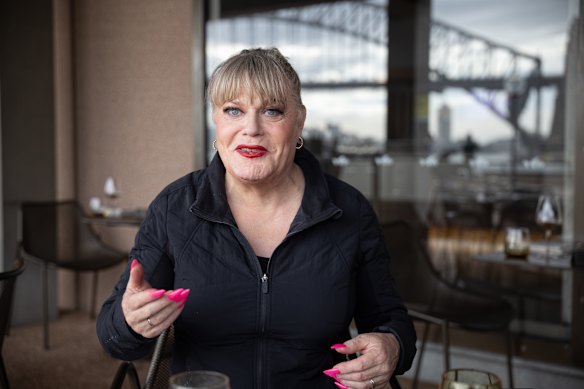
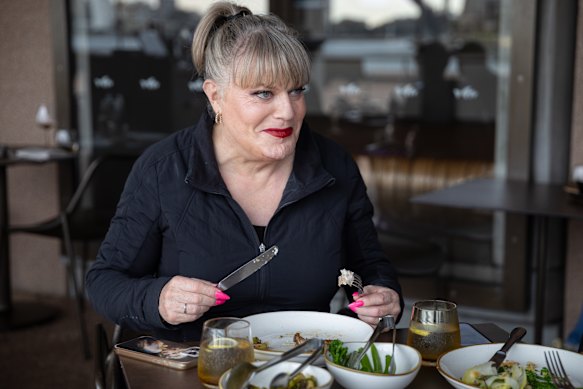
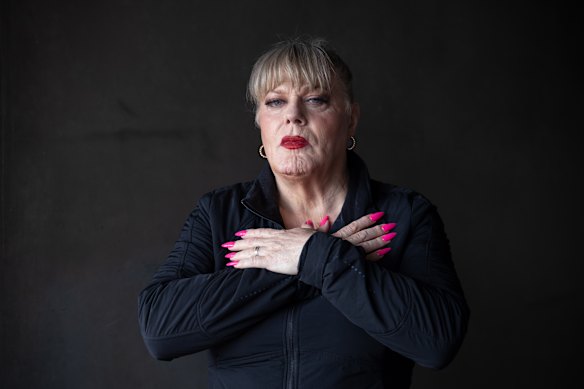
We’ve arranged to meet at Midden on the Western Broadwalk of the Opera House. I’m five minutes late and Izzard is already waiting, seated alone, immaculately made-up and coiffed, and sporting a set of arresting fuchsia-pink talons, which she is very keen to show off.
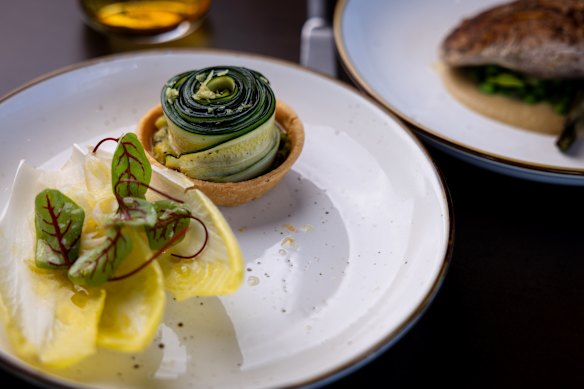
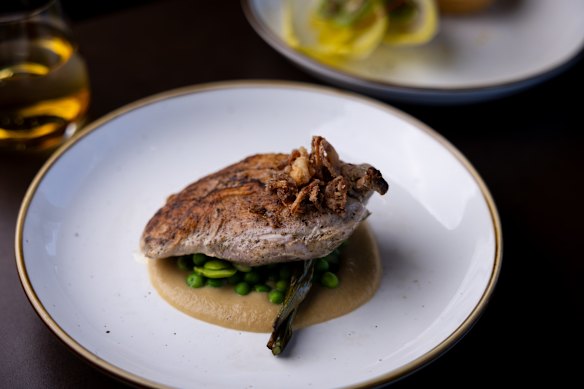
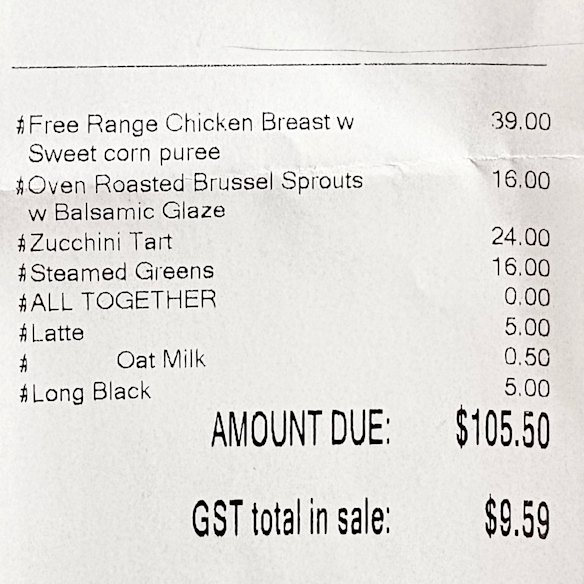
Ordering complete – we plump for the $49 express lunch, chicken breast for Izzard and a zucchini tart for me – we switch focus from my youthful indiscretions to Izzard’s far more interesting story.
As someone who has sold out Wembley Arena for four nights, played Madison Square Garden, and had a role in more than 70 movies, is she recognised by people on the street? “The cooler people do,” she says, somehow managing not to sound up herself.
“You’ve got to be somewhat switched-on to know my thing because I didn’t do sitcom. I didn’t do sketch comedy. I’ve done a number of film roles that I’m very happy with, but no particular one has grabbed necessarily in a big mainstream way.”
If you are one of those who would have walked past the glammed-up 60-something diner sitting alone looking at her phone at Midden rather than squealed excitedly “cake or death” (from one of her best-known bits, a 1998 skit), the short version of Izzard’s extraordinary career goes like this.
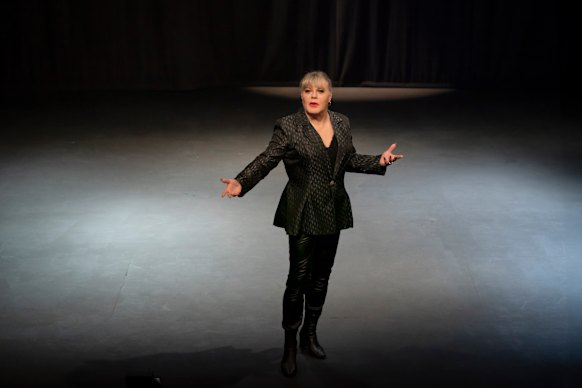
She is one of Britain’s most distinctive comics, with a surrealist stand-up style descended directly from Monty Python. She has also acted alongside, among others, Robin Williams and Judi Dench, and is about to start touring her audacious, one-person Hamlet here. She’s a high-profile activist and an aspiring Labour politician. She is also an endurance athlete who in 2009 ran 43 marathons in 51 days – about 1800 kilometres – after training for just five weeks.
Possibly the least interesting thing about her – although this depends very much on your point of view – is that she is also transgender.
In an era where transgender politics have been injected into the centre of the so-called culture wars as an excuse for real or confected outrage (even Coalition boss Angus Taylor, in the face of the myriad challenges facing his party and country, felt the urge to take a position recently), Izzard has always been remarkably relaxed.
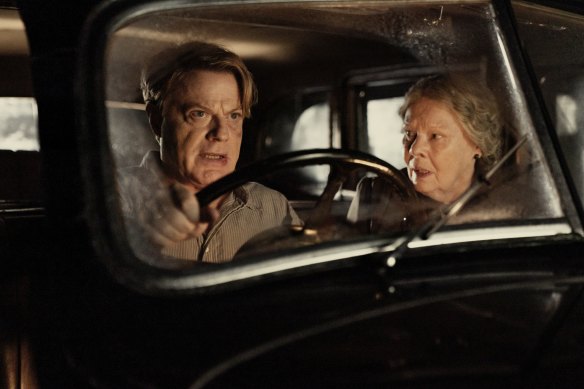
In 1985, she came out as what was labelled at the time as a “transvestite”. Later, she said she identified as gender-fluid. In 2017, she told the Hollywood Reporter she was “trying to have my cake and eat it”.
“I have boy mode and girl mode,” she said. “I have boy genetics and girl genetics.”
She has even accidentally misgendered herself on stage and laughed about it. “Tigers don’t care,” she says, when we, inevitably, get to discussing gender.
Er, what? “If tigers were attacking humans, they would not be going [switching into her version of a tiger voice] ‘Is it a male, female? Long hair. Could be. But they’re tasty. But what sex is it? I don’t know what sex it is … Can’t you check?’
“Then the human’s not going, ‘Hmm. I’m being attacked by a tiger. Is it male or female? I really don’t know. They look the bloody same. If it was a lion … If only it was a lion. That would really help…’
“So, species-wise, we need to get to that place where who cares about male, female things. It’s how you see yourself, whatever in your own world, fine, but why is it impinging on anyone else? Just get on with your life.”
Coming from Izzard, the tiger analogy makes perfectly weird sense. Whether being savaged by a tiger would help clarify Taylor’s thinking remains moot.
Izzard’s award-winning stand-up is built around these absurd musings, often riding atop a serious point. She frequently pushes them almost to breaking point but somehow always makes it home by the skin of her teeth, relying on the speed and breadth of her intellect.
So, how much effort does it take to make it all appear so effortless? Is the writing as “easy” as Hemingway supposedly said: “All you do is sit down at a typewriter and bleed”?
“I chose to make it conversational, so it does feel loose because it is actually loose,” she says. “But I don’t sit down there and open a vein. I actually go on the stage in front of an audience and open my mind.
“It’s like a journey. If you go on a car journey that was two hours long, and you knew the route, but you could just say, ’Oh, I’ve done this thing. Let’s go down this road. Oh, let’s go get back on the main route because this alternative is a bit boggy or marshy or the road’s no good, or I can’t see where I’m going.
“Even if I did the whole thing improvised it would be too much, and maybe I’m too lazy. I’m a lazy person with a huge drive.”
Quite where that drive comes from is hard to nail in one lunch date, but the sudden death of her mother in 1968, when Izzard was just six, had an almost incalculable emotional impact, as did being packed off to boarding school shortly afterwards.
But there is also the simple, mischievous – and rather British – joy with which Izzard raise two fingers whenever she is told she can’t or shouldn’t do something.
Despite desperately wanting to be on stage, at primary school she received the strong message that acting was not for her, due in part to her dyslexia. Now, 50 years on she’s performing Hamlet – solo.
The current project follows a well-reviewed one-person Great Expectations. “As I was developing the solo Great Expectations I thought I could do Shakespeare this way. Which one? Let’s do Hamlet. I just went straight to Hamlet.”
After successful runs across the US, Izzard brought the show to Britain, where London reviewers were less than enthused. Guardian chief theatre critic Arifa Akbar was particularly brutal in a one-star review. “Some of the London critics were sniffy about it, said that I should just f— off,” says Izzard. “We’d already got rave reviews [in the US]. I think they [the London papers] got it wrong. Certain people in London said, ‘Look, we know who you are. We know where you came from. Get back in your box’.”
Izzard has built a career shredding boxes intended to contain her, such as the one declaring it is neither possible nor wise to run 1800 kilometres in a little over seven weeks on the back of almost no training (2009 in Britain). Or another box that says performing stand-up to French audiences in French with only basic French (or German audiences, ditto), really shouldn’t work. It does. She’s proved that wrong in sold-out tours to both countries: “Warum the f— nicht,” as she says.
Now she has a political career in her sights, serving on the Labour Party’s powerful National Executive Committee and twice (unsuccessfully) seeking pre-selection as a parliamentary candidate, first in Sheffield then Brighton.
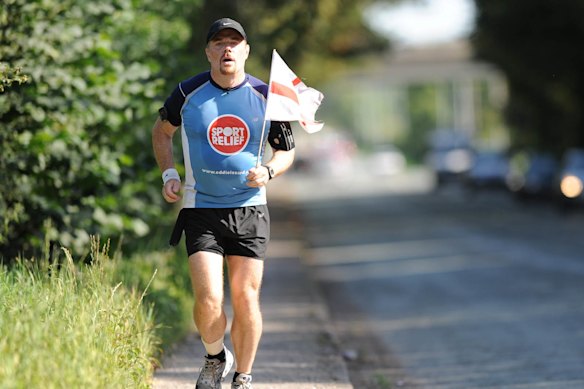
“I might have a determination gene,” she says. “When we were growing up there was always some kid who people said ‘Oh, they could do it. They’ve got the thing’. And then they just gave up, and they didn’t follow it through. But some of us stay with it, and we stay pushing. Blessed are the believers.”
When I venture that she seems very restless, always changing lanes. She says it’s not so much changing lanes as adding them to her astonishing portfolio.
“I’ve got the answer to the meaning of life,” she volunteers as we order coffee. “I don’t think there is a meaning of life, but some people put meaning into life and some people take meaning out of life, and we need to encourage as many people to put meaning into life, to do things, to try and help.
“I run some marathons, I do gigs in different languages, make connections rather than break connections. I try and do things. I’m a trans person who’s touring Hamlet around the world, trying to give out a positive thing and say, ‘Oh, well, maybe I’ll try something, maybe I’ll do this, or I’ll do that’. Try and put meaning into life.
“I’m a glass two-thirds full person. I’m a trans person sitting next to you looking out on beautiful Sydney Harbour. And I’m about to do a surreal comedy tour and go crashing into a dramatic tragedy tour of Hamlet. It’s pretty amazing.”
Izzard: The Tragedy of Hamlet will play at the Sydney Opera House on June 9 – 21, the Brisbane Powerhouse June 24 – 27, the Arts Centre Melbourne June 30 – July 12 and Canberra Theatre Centre July 31 – August 1.
Read more great conversations over lunch
Jacqueline Maley explores loss with Bob Carr: Bob Carr on marriage, grief and finally learning how to do a load of laundry
Stephen Brook asks Michael Rowland about his future: In the space of 14 months, Michael Rowland upended his ABC life. There’s more upheaval to come
Margot Saville laughs with Kathy Lette: Kathy Lette on ageing fabulously … and giving cheek to the King
David Wenham bares his scars to Louise Rugendyke: David Wenham on cancer, getting older and being lusted after
Start the day with a summary of the day’s most important and interesting stories, analysis and insights. Sign up for our Morning Edition newsletter.
Disclaimer : This story is auto aggregated by a computer programme and has not been created or edited by DOWNTHENEWS. Publisher: www.smh.com.au