Sometime in the early 18th century, in the port town of Nagapattinam on the Tamil coast, someone made a decision born of desperation.
The Dutch East India Company had tightened its grip on the Coromandel Coast. Soldiers and administrators moved through the streets, and the old order that had once made this city a crossroads of the Indian Ocean world felt dangerously fragile.
So, whoever was entrusted with safeguarding the most important documents of a vanished empire did the only thing that made sense: they dug into the earth and buried them.
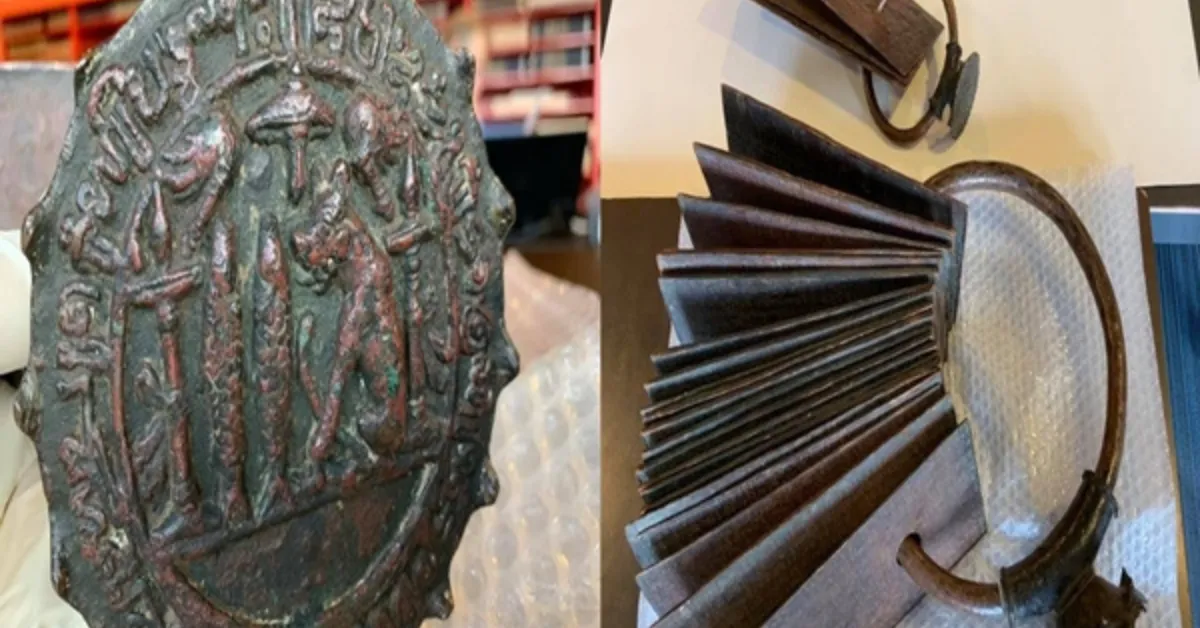
What they buried was a set of 24 copper plates bound by a bronze ring stamped with the royal Chola seal — nearly 30 kilograms of metal dense with inscriptions in Tamil and Sanskrit, recording a transaction between a Hindu king, a Buddhist monastery, and a ruler from the Malay Archipelago.
They were buried to survive. Instead, they vanished.
A Dutch pastor named Florentius Camper brought them to the Netherlands around 1712, and there they remained while the coast they came from forgot they had ever existed.
That forgetting ended on 16 May 2026 in The Hague, where Prime Minister Narendra Modi and Dutch Prime Minister Rob Jetten presided over the plates’ official return to India. A restitution committee at Leiden University concluded that the objects had been removed from Nagapattinam without the consent of their rightful custodians.
What came home was not merely a beautiful artefact — it was one of the most remarkable surviving records of a civilisation that once commanded the seas from the Tamil coast to the shores of Sumatra.
What the inscriptions actually say
The plates are royal charters — the form Chola kings used to permanently record administrative decisions. Issued under Rajaraja Chola I (985–1014 CE) and formalised by his son Rajendra Chola I, they record a land grant: the village of Anaimangalam near Nagapattinam, along with surrounding agricultural lands, was assigned to support a Buddhist monastery called the Chulamanivarma Vihara.
What elevates this beyond a routine grant is the identity of the monastery’s founder. The vihara had been built not by a Tamil king but by Sri Mara Vijayottunggavarman, a ruler of the Srivijaya Empire centred in present-day Sumatra and the Malay Peninsula.
A Hindu emperor was formalising revenue from a Tamil village to sustain a Buddhist institution established by a Southeast Asian ruler. The inscriptions also detail land boundaries, tax exemptions, and irrigation responsibilities — offering a rare window into both the administrative sophistication of the Chola state and the depth of its international reach.
Nagapattinam: the city that connected worlds
To understand why any of this was possible, one must understand Nagapattinam. By the 10th and 11th centuries, this port on the Coromandel Coast had become a meeting point of the Indian Ocean world.
Merchants from Arabia, China, Southeast Asia, and East Africa moved through its docks carrying textiles, spices, pearls, and aromatic woods. The Chola navy protected sea lanes used by Tamil merchant guilds — the Manigramam, the Ayyavole, and the Ainnurruvar — whose commercial networks extended deep into Southeast Asia.
/filters:format(webp)/english-betterindia/media/media_files/2026/05/20/4-2026-05-20-12-30-36.png)
The monsoon winds worked in the Cholas’ favour, allowing their fleets to sail eastward and return with the seasonal reversal, linking the Tamil coast to Srivijaya, the Malay Peninsula, and the ports of southern China.
Revenue from maritime trade is estimated to have contributed more than 30 percent of the empire’s total income at its peak, with Nagapattinam, Kaveripattinam, and Mamallapuram serving as its key commercial centres.
The naval expedition that changed the Bay of Bengal
The Chola relationship with Srivijaya was not always cordial. Even as Rajaraja I had supported the Chulamanivarma Vihara, his son Rajendra launched a massive naval expedition against Srivijaya in 1025 CE.
Historian K. A. Nilakanta Sastri suggested that the trigger may have been Srivijaya’s attempts to restrict Chola access to East Asian trade routes.
Rajendra’s fleet crossed the Bay of Bengal and struck ports controlling the Straits of Malacca, weakening Srivijaya’s grip on China-bound trade and sending an unambiguous message: Chola power could extend thousands of kilometres beyond its heartland.
A civilisation of striking openness
Alongside the military story, the copper plates capture something equally significant — a portrait of cultural confidence.
/filters:format(webp)/english-betterindia/media/media_files/2026/05/20/2-2026-05-20-12-35-19.png)
A dynasty that built the famous Brihadeeswara Temple was simultaneously funding a Buddhist monastery established by a foreign ruler.
The Sanskrit portion traces Chola genealogy through divine lineage, while the Tamil portion records the practical details of the grant with remarkable administrative precision. Both languages, both traditions, coexist on the same document without contradiction.
This was a civilisation secure enough in its identity to engage with Buddhism, Southeast Asian royalty, Chinese traders, and Arab merchants without feeling threatened by any of them.
Coming home after 300 years
India had been pursuing the return of the plates since 2012, with a formal request submitted to Leiden University in 2023. The Colonial Collections Committee recommended restitution, and on 16 May, that recommendation became a ceremony, and the ceremony became a homecoming.
The plates will now return to Tamil Nadu, carrying within their copper folds a story of trade winds and royal charters, of Buddhist monks and Hindu kings, of a port city that once stood at the centre of the ancient world.
After three centuries in a European archive, the Chola Empire’s most well-travelled document has finally found its way back to the coast from which it came.
All images courtesy All India Radio.
Sources:
‘Netherlands Returns Chola Copper Plates to India‘: by ANI, published on 17 May 2026
‘Leiden University to return Chola Plates to India‘: by Leiden University, published on 16 May 2026
‘Chola Maritime Trade: Economic and Cultural Exchanges‘: IJRAR, published December 2023
‘Chola Maritime Expansion: Commerce Driven?‘: Dalvoy/UPSC History, published January 2026
Disclaimer : This story is auto aggregated by a computer programme and has not been created or edited by DOWNTHENEWS. Publisher: thebetterindia.com