
Examine, a free weekly newsletter covering science with a sceptical, evidence-based eye, is sent every Tuesday. You’re reading an excerpt – sign up to get the whole newsletter in your inbox.
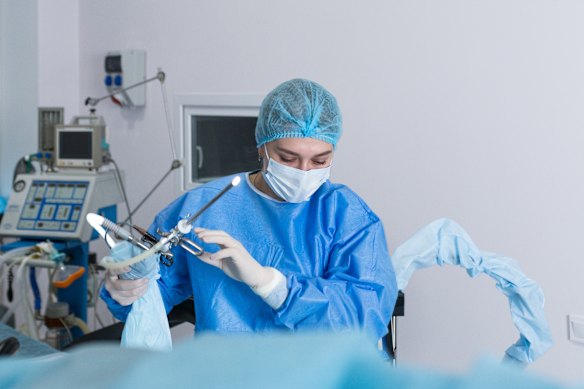
Hysteroscopies are among the most commonly performed medical procedures in the world.
Allowing surgeons to check for causes of abnormal bleeding in the uterus and to operate if needed, some practitioners claim it’s pain-free, while survey data collected by the UK-based Campaign Against Painful Hysteroscopy suggest that for some women, the procedure is more painful than childbirth.
Part of the problem may be that women are being offered the wrong painkillers because of a deeply buried case of scientific misconduct.
“Women are now told if you take a couple of ibuprofen, you are fine with the pain. In reality, that is unlikely to be true,” says Professor Ben Mol, professor of Obstetrics and Gynaecology at Monash University.
“There is untrustworthy or fake data in the system.”
Increasingly, doctors are trying to move the procedure from being done under general anaesthesia to one that can be done more quickly in a doctor’s office.
“Anecdotally, many women ask me: do I have to go to theatre?” says gynaecologist and director of Women’s Health Road, Associate Professor Talat Uppal. “We know women recover faster if they don’t have a general. It’s a more invasive procedure.”
That’s problematic because, in general, clinicians may underestimate pain during gynaecological procedures – and if they assume anaesthesia is unnecessary, they can fail to talk to patients about pain at all.
A study of 804 hysteroscopy patients at a British hospital found a lot of variation in pain: 7.8 per cent found the procedure pain-free, while 17.6 per cent rated the pain as severe or worse.
“Sometimes I hear a doctor say to me it’s about the skill. I beg to differ. I think there is a certain degree of pain with this procedure,” says Uppal, who prefers the term “uteroscopy”, as hysteroscopy sounds like hysteria.
Guidelines issued by the NSW government explicitly warn doctors against underestimating the pain of the procedure.
But it is the tools the guideline gives doctors to manage that pain that worry Mol.
The guideline states the first-line option for pain is a non-steroidal anti-inflammatory drug (like ibuprofen) taken orally an hour before the procedure. This can also be taken after the procedure to help with any lingering pain.
An information pamphlet from the Royal Australian and New Zealand College of Obstetricians and Gynaecologists carries the same advice.
Understanding where that recommendation actually comes from, though, requires a journey deep into the weeds.
NSW’s guidelines explicitly reference the 2024 UK expert hysteroscopy guidelines, which are based on a 2020 meta-analysis of 16 studies of pain management for women undergoing hysteroscopy.
That meta-analysis bases its recommendation for anti-inflammatories on seven studies.
Four of those studies found anti-inflammatories had no statistically significant effect on pain, while three did find an effect; particularly important was a 2019 Egyptian study that found by far the strongest pain-killing effect.
Combining the seven studies, the meta-analysis concluded anti-inflammatories were an effective painkiller.
The problem: earlier this year, the 2019 Egyptian study was retracted.
The retraction notice itself is remarkable, noting three different versions of the study record exist, “with broad and varying inconsistencies”.
The trial was meant to be blinded, but the pills given out to the volunteers were different colours, allowing them to work out which was which.
And crucially, some of the p-values reported in the paper – the metric that tells us if the findings are statistically significant or not – “cannot be reproduced from the published data”.
“Currently it takes years before these papers are taken out of the system. And as a consequence, they end up in guidelines,” says Mol.
Australia’s College of Gynaecologists said anti-inflammatory tablets remained a “sensible and generally low-risk approach” following hysteroscopy. The college said it shared “Professor Mol’s concerns around research integrity and the impact that poor quality research can have on the development of reliable clinical guidance and the provision of high-quality, evidence-based care”.
At her practice, Uppal offers a range of pain-killing options for patients undergoing hysteroscopy, from ibuprofen through to the powerful penthrox green whistle inhaler, a non-opioid analgesic inhaler, on an opt-out basis. Women can also elect to go to hospital for a general anaesthetic.
“I often think: would we ask someone to take out a tooth without giving them local [anaesthetic]? There are certain standards in other industries, and we just say it’s OK in women’s health to not abide by [them],” she says.
“Because women are resilient, we are expected to put up with it. And women have also not spoken up because of the shame, stigma and taboos that engulf women’s procedures. The system has been like: ‘they are fine’. When they are not.”
The Examine newsletter explains and analyses science with a rigorous focus on the evidence. Sign up to get it each week.
 Liam Mannix is an investigative journalist at The Age. Before that, he was national science reporter for The Age and the Sydney Morning Herald.
Contact him via email or Signal (encrypted) liammannix.18
Connect via X, Facebook or email.From our partners
Disclaimer : This story is auto aggregated by a computer programme and has not been created or edited by DOWNTHENEWS. Publisher: www.smh.com.au