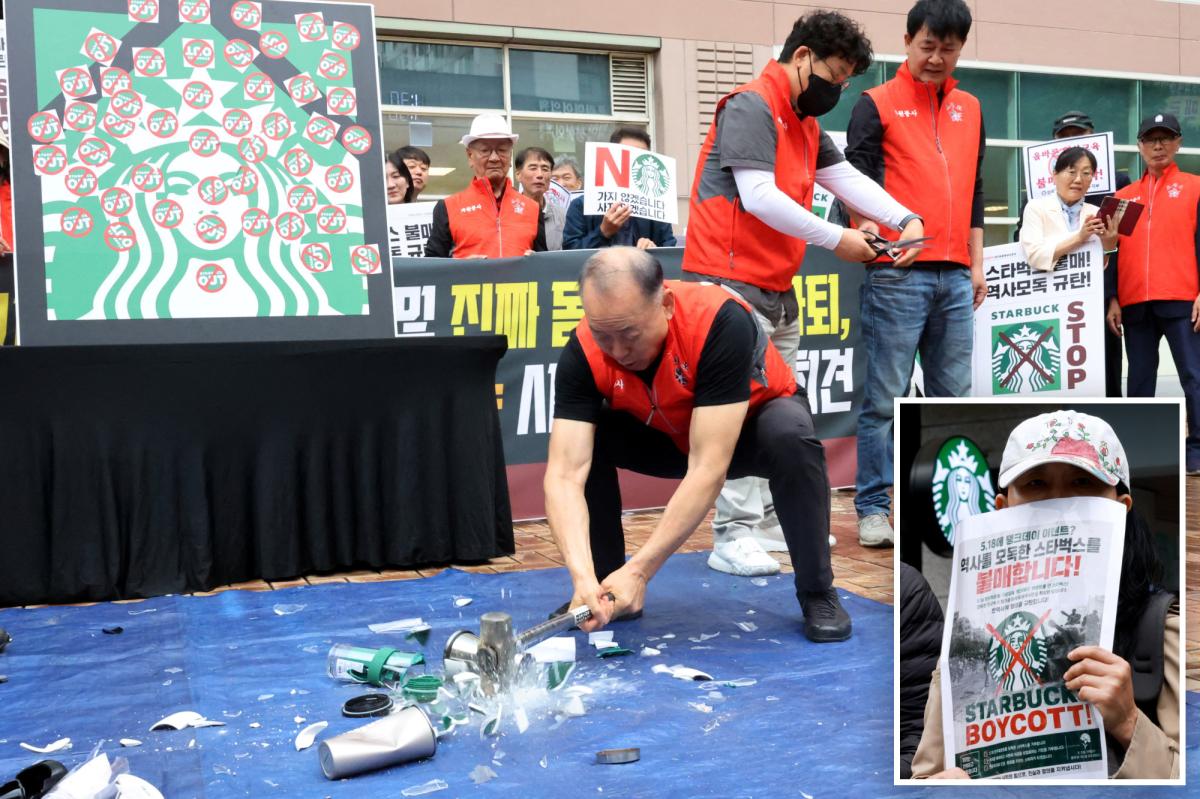
Starbucks is facing a major backlash and “very significant” drop in sales in South Korea after the coffee giant held a promotion that evoked a brutal military crackdown on protesters.
Furious activists smashed Starbucks cups with a hammer in a protest outside a store in Gwangju, the site of a brutal military crackdown where some 2,000 Koreans were killed.
The the chain is accused of “making light” of the 1980 tragedy, which happened during the country’s military dictatorship.
Government officials have called for a boycott of the Seattle-based company, and even President Lee Jae Myung has condemned it.
The global chain planned a “Tank Day” promotion, selling a large drink tumbler, which they called a “tank,” on May 18.
But May 18 is also the anniversary of the violent suppression of pro-democracy protesters by South Korea’s military.
Hundreds of activists in the southwestern city of Gwangju were killed or injured when the military turned troops, tanks, and helicopters on the crowds.
The Starbucks campaign also sparked fury for its use of the slogan “Thwack it on the table,” which, for many, evoked an infamous defense made by police officers accused of murdering student activist Park Jong-chol.
During their 1987 trial, cops claimed Park had died suddenly after investigators “hit the desk with a thwack,” rather than being tortured to death.
President Lee said he was “outraged by this inhumane and disgraceful behavior by profiteers who deny the values of the South Korean community, fundamental human rights and democracy,” in an X post last week.
The country’s interior minister said his ministry will no longer offer vouchers from companies, such as Starbucks, which he said “make light” of South Korean history.
Starbucks in South Korea, which is owned by E-Mart, a subsidiary of the operator Shinsegae Group, said on Tuesday that the boycott had affected its sales.
“While sales are not our main concern at the moment, we have seen a very significant drop,” an official from Shinsegae said, adding that an internal investigation is underway to determine whether there had been any premeditation in the stunt.
Shinsegae Group’s chairman, Chung Yong-jun, held a press conference to plead for the public’s forgiveness on Tuesday.
“I take it very seriously that Starbucks Korea’s inappropriate marketing hurt and angered many people. I will take all responsibility for the incident,” Chung said, as he asked the public not to take out their anger on Starbucks employees in South Korea.
Last week, the head of Starbucks Korea was fired after apologizing for the campaign.
All five employees involved in the marketing campaign have been removed, and the Shinsegae Group is cooperating with a police investigation launched after complaints from the families of some of the Gwangju victims, the company said.
Three employees refused to hand over their phones as part of the investigation, the Group said, adding that there was no evidence any of them were mocking the pro-democracy movement on purpose.
Starbucks global HQ in the US said it was aware of the gravity of the situation and has been receiving updates on the investigation and the company’s response, in a statement.
However, some on the right in South Korea, who are more sympathetic to the era of military dictatorships, called the backlash excessive.
The conservative People Power Party called the protests “consumer censorship” and “selective outrage,” pointing to the firing of a South Korean actor from a show over a social media post showing him at a Starbucks store.
Between 1961 and 1987, South Korea was led by a series of military dictatorships before finally transitioning to democracy.
This era saw rapid economic growth, but also severe human rights abuses, strict martial law, and violent crackdowns on pro-democracy protesters.
With Post wires.
Disclaimer : This story is auto aggregated by a computer programme and has not been created or edited by DOWNTHENEWS. Publisher: nypost.com