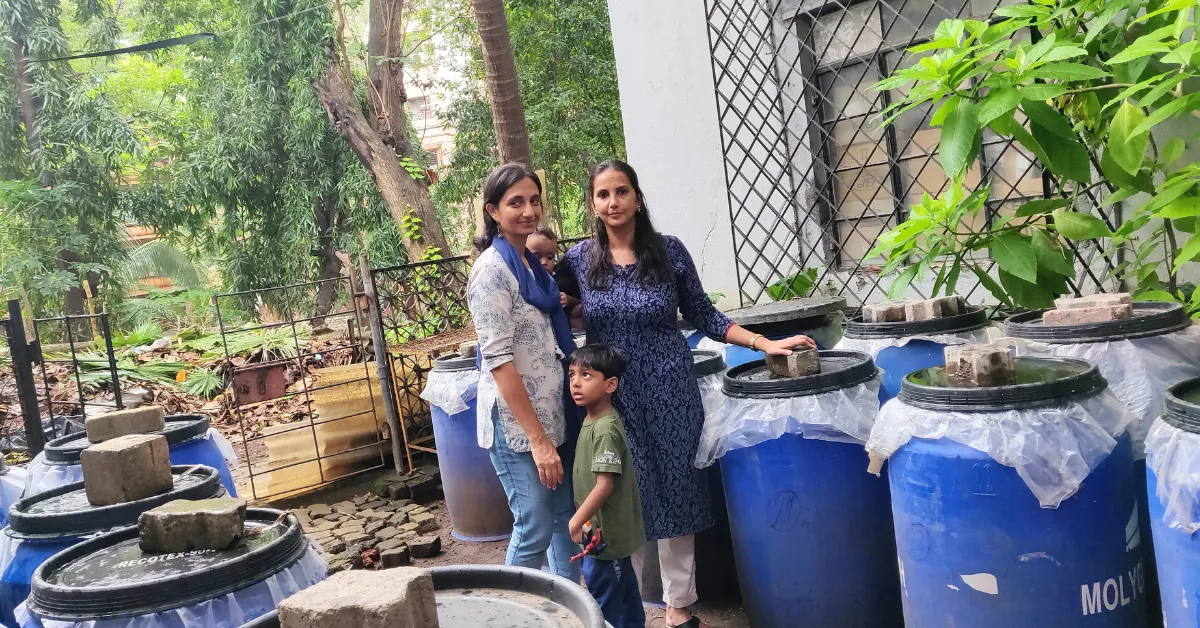
On a quiet afternoon in Mumbai, two large drums sit on a terrace, filled with lemon peels, jaggery, and water. Nearby, the laughter of children floats through the air. As their kids play close by, friends Sonia Verma (47) and Farheen Ali (43) check on the mixture inside the drums as it slowly ferments.
They are making bioenzyme, a natural cleaning solution created through fermentation that can break down grease, dirt, and organic waste without the harsh chemicals commonly found in conventional household cleaners.
This simple mixture became the starting point for Sonia and Farheen’s brand, ‘Urthy’. Through the brand, they turn discarded citrus peels into bioenzyme-based cleaners that can be used in homes and also support healthier soil and water systems.
Sonia and Farheen first met in 2019. Over the next few years, their conversations around sustainability continued, and a few months before launching Urthy in 2022, they began seriously discussing the idea of turning their home experiments into a brand. Their mission, they say, is both personal and urgent: helping people rethink everyday cleaning habits while restoring balance to the ecosystems affected by them.
“We didn’t just want safer homes,” Farheen says. “We wanted cleaner soil, cleaner water, and a better world for our children.”
2 mothers, 1 shared question
The story of Urthy did not begin in a lab or a boardroom. It began with a conversation between two mothers.
Farheen, who has a background in electronics engineering, had already been experimenting with bioenzymes while exploring holistic living after her children were born.
“Since before my son was born, I had been on this path of holistic living — in terms of health, lifestyle, everything,” she says. “So when I started making my own bioenzyme, I was really happy with it.”
Around the same time, Sonia was on a similar journey. A former workaholic who stepped away from her family’s cable infrastructure business, she says motherhood has shifted her perspective.
“The first time I held my kids, something shifted within me,” Sonia tells The Better India. “I started looking at everything differently — what I was bringing into the home, how it was affecting my kids, and the kind of world I wanted them to grow up in.”
The two met through a homeschooling community in Mumbai. Their children were close in age, and their conversations quickly revealed a shared curiosity about sustainability. “We realised we had both been making bioenzyme independently for years,” Farheen shares. “And we thought, wouldn’t it be amazing to bring this to the world?”
For both women, the appeal lay in its simplicity. Bioenzyme was not asking people to overhaul their lives. It offered a cleaner alternative that could fit into routines they already had.
“It’s easier to make a switch than to make a change,” Farheen explains. “Many sustainable habits require effort, like remembering a cloth bag or carrying a steel bottle. But if you can simply replace one product with another and use it the same way, anyone can do it.”
That idea of a simple switch with a large environmental impact became the foundation of Urthy.
From terrace experiments to a growing brand
The first batches of Urthy’s bioenzymes were not produced in factories.
They were made on Farheen’s terrace.
“We were wondering where we could make it because you need drums and space,” Sonia recalls. “Farheen said she had a terrace where we could keep the drums. So, our first two drums were literally on her terrace.”
Those early experiments were small, with batches of about 50 litres at a time.
But they quickly grew.
Soon, the terrace held multiple fermentation drums. Eventually, the operation moved to a larger space at Sonia’s factory office, where today dozens of drums continue the fermentation cycle.
The process itself also reflects the brand’s sustainability philosophy. The citrus peels used in Urthy’s products come from local juice vendors. Instead of being thrown away, these peels become the raw material for bioenzyme.
“We actually save these lemon peels from going into landfills,” Sonia explains. “They are used to make the bioenzyme, which then goes back into homes and eventually into our water systems.”
As the idea grew, so did the scale of their work. What started with a few drums has now expanded into over 40 fermentation units that produce a range of natural cleaning products.
“When we started, we didn’t have any project report or business plan,” Sonia says. “We just began doing what felt right. And things kept falling into place.”
So, how does citrus waste become a cleaner?
At its core, Urthy’s cleaning solution is deceptively simple.
Bioenzyme is made with citrus peels, jaggery, and water. The mixture is kept in airtight containers for about three months, until it ferments and turns into a natural cleaner.
“The liquid that comes out after fermentation is full of yeast, good bacteria, and enzymes,” Farheen explains. “Those enzymes act as catalysts to break down dirt and organic waste.”
This is what makes it different from many regular cleaners.
/filters:format(webp)/english-betterindia/media/media_files/2026/05/26/urthy-2026-05-26-13-12-37.png)
Most chemical cleaners are washed away after use. They go down the drain and may eventually reach rivers, lakes, or other water bodies. Along the way, they can affect the tiny living organisms that help keep these systems healthy.
Bioenzymes work in a gentler way. After the floor is mopped and the water goes down the drain, the liquid can continue breaking down food waste, grease, and other organic matter.
“The liquid has different enzymes that act on fats, proteins, and carbohydrates,” Farheen says. “So, when it goes into the drain, it keeps breaking down organic waste there as well.”
She adds, “It’s cleaning the floor. And it’s cleaning the water system too.”
Unlike harsh disinfectants that kill many kinds of microbes, bioenzymes allow useful microbes in the environment to survive.
Sonia first noticed this difference in a much simpler way, at home, through the floors her children played on every day. “My kids spend most of their time on the floor,” she says. “Earlier, they would come up with dirty hands and feet by the end of the day. But once I started mopping with bioenzyme, the floors stayed cleaner, and that stopped completely.”
What began as a personal discovery gradually turned into a larger mission rooted in both science and lived experience.
From homes to ecosystems: The impact of a small switch
In just four years, what began as an experiment between two mothers has grown into a small but meaningful movement.
Urthy has diverted over 1,500 kilograms of citrus waste from landfills — waste that now powers bioenzymes instead of decomposing and releasing methane. At the same time, the brand has built a community of over 200 conscious consumers adopting toxin-free cleaning routines.
Overall, the brand remains in a very nascent stage of growth, generating under Rs 2 lakh per month in sales.
/filters:format(webp)/english-betterindia/media/media_files/2026/05/26/urthy-2026-05-26-13-13-13.png)
For Farheen and Sonia, however, the goal went beyond selling a product.
They wanted people to think differently about cleaning. A clean floor was important, but they also wanted to think about where the dirty water goes after the floor is mopped. Urthy’s bioenzyme is used after mixing it with water. One litre of the concentrate can make 10 litres of cleaning liquid, so a small amount can last longer.
The founders say the liquid keeps working even after it goes down the drain. It helps break down waste in the water instead of adding more harmful chemicals to it.
According to the founders, a litre of activated citrus bioenzyme can reduce 30–50 mg/litre of pollutants such as COD and BOD (two indicators used to measure pollution levels in water), increase soil microbial activity by up to 30 percent, and prevent methane emissions from citrus waste that would otherwise rot in landfills.
The product also helps in another way. Lemon peels that would have been thrown away are used to make the cleaner instead. The product has no toxic chemicals, artificial fragrances, or strong chemical ingredients.
But for Sonia and Farheen, the real impact is easiest to see inside the homes where people use Urthy every day.
‘I feel safe using it’
For Ashita, a 44-year-old arts-based therapist and unschooling parent in Pune, the switch to Urthy began through friendship.
“Farheen has been a close friend and an unschooling mom,” she says. “So when she started Urthy, it felt very natural to try it.”
Ashita had previously used conventional cleaning products. But as she became more conscious about sustainability and parenting choices, switching felt surprisingly easy. “I realised this was probably the first thing where I didn’t have to do much,” she says. “I just had to pick up a different product and start using it.”
Over time, the shift brought something many eco-friendly products promise but rarely deliver — peace of mind. “It’s comforting to know what’s going down the drains or into the plants,” she says. “With kids around the house, you want to feel safe about what you’re using.”
Ashita now uses Urthy’s floor cleaner and dishwashing solution regularly. The experience has also encouraged other sustainable habits. “It definitely made me think more about everyday waste,” she says. “In fact, it motivated me to start composting at home.”
/filters:format(webp)/english-betterindia/media/media_files/2026/05/26/urthy-2026-05-26-13-14-02.png)
For her, the biggest reason to recommend the product is simple: trust. “If you trust the people making the product and the intention behind it, that makes all the difference.”
‘Mental peace is the biggest benefit’
Ruchi, a 46-year-old parent based in Bhubaneswar, made a similar shift.
She first heard about Urthy through a community group focused on natural living. “We had tried organic cleaners earlier,” she says. “But making them ourselves was not sustainable. It required time and effort, and availability was always an issue.”
When she discovered Urthy, she decided to try it.
“We started with the floor cleaner and laundry wash,” she says. “And honestly, we haven’t looked back since. One thing that used to bother me constantly was that all the water from washing clothes or cleaning utensils eventually goes into the ground. I kept wondering what kind of chemicals we were sending there.”
Using Urthy changed that.
“The biggest benefit has been the mental peace that I’m not pushing terrible chemicals into the soil,” she explains.
Today, her family uses several of Urthy’s products — from laundry wash to handwash and multipurpose cleaners.
But for Ruchi, the deeper takeaway goes beyond a single brand. “I think it’s really about living with awareness,” she says. “Our everyday decisions affect everything around us — the soil, the water, other living beings. When you realise that, you start making different choices.”
A cleaner future, one home at a time
Today, Urthy’s journey has expanded far beyond the few fermentation drums that once sat on a terrace in Mumbai.
The brand now offers 15 products across home care, personal hygiene, and plant care, all built around the idea of turning waste into a resource. Their range includes five favourites — floor cleaner, all-purpose cleaner, dishwash, laundry, and toilet cleaner, along with plant care and pet-safe products, and they have recently launched a commercial line suitable for industrial and commercial spaces.
/filters:format(webp)/english-betterindia/media/media_files/2026/05/26/urthy-2026-05-26-13-14-37.png)
Alongside households, the founders have also begun consulting with hotels, resorts, and commercial spaces looking to transition to toxin-free cleaning systems.
“We realised something very important,” says Sonia. “The environment is too big for us to think we can fix it directly.”
Instead, real change begins with everyday choices inside our homes. “If individuals start taking care of themselves, what they bring into their homes, and what they use every day, then caring for the environment becomes a natural byproduct,” she says.
For Sonia and Farheen, that is where Urthy’s work begins: with one everyday choice inside the home.
All images courtesy Farheen Ali
Disclaimer : This story is auto aggregated by a computer programme and has not been created or edited by DOWNTHENEWS. Publisher: thebetterindia.com