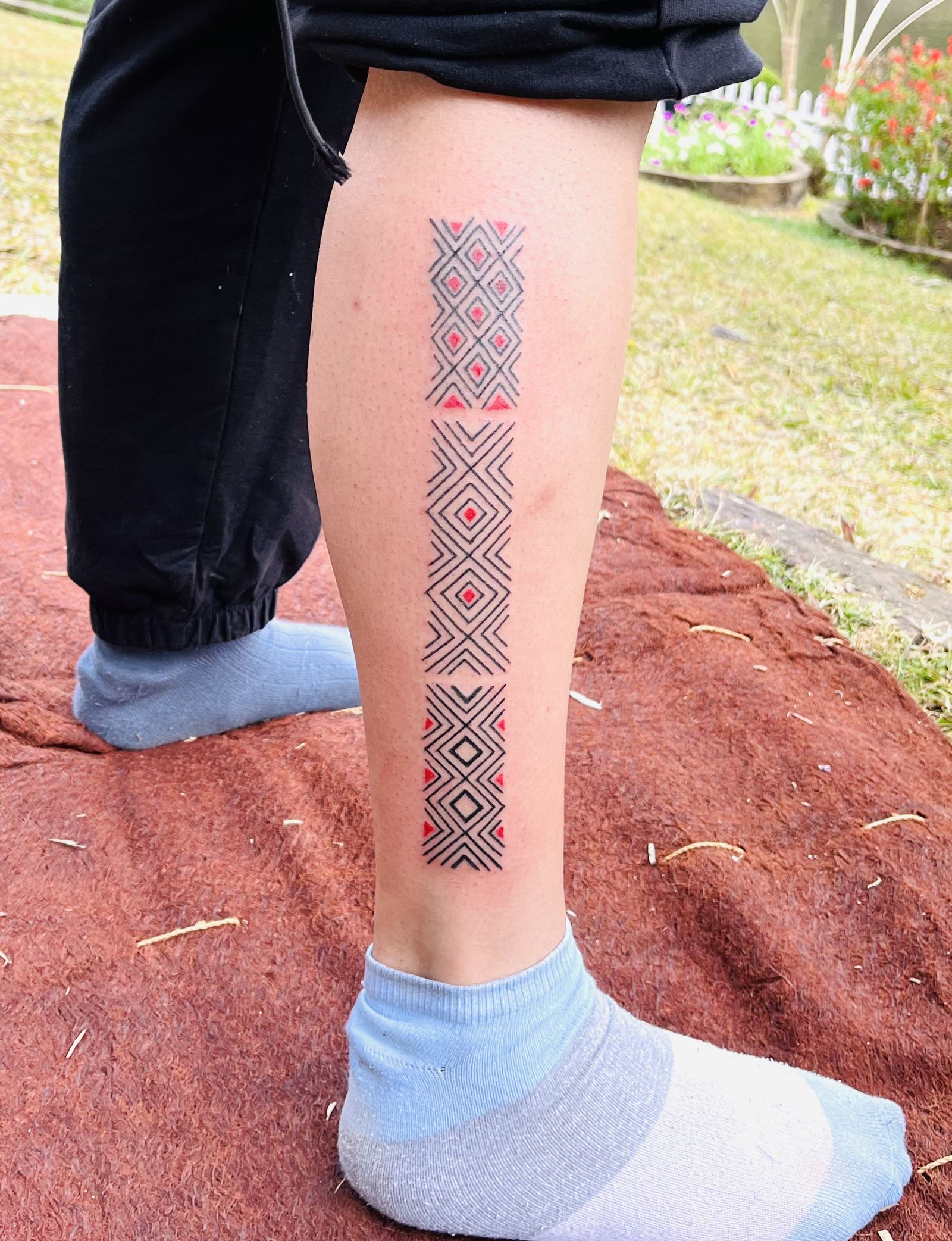
Centuries before tattoo studios, guns and sterile needles entered the fray, communities like the Toda of the Nilgiris, the Gond of Central India and the Rabari of Kutch (to name a few) practised godna (‘hand poke’). Godna might have come to be associated with criminal activity during the British Raj, but it has always been a carrier of histories that move seamlessly between body and object. The same diamond that sits in a Rabari embroidery can be etched on skin; the grid-like pattern of a handloom sari may appear along an arm.
Take Baiga godna, traditionally practised on women in Madhya Pradesh using geometric patterns inspired by everyday life—grains, honeycombs, fishnets, iron chains, mountains. Amit Arjel-Sharma, of Delhi-based Blue Blood Tree Tattoo studio, trained under Shanti Bai Maravi, a sixth-generation Baiga godna artist in Lalpur, Madhya Pradesh. Immersing himself in Baiga culture, he documented not just motifs but also how specific designs are placed on the forehead, arms, chest, back or legs according to age, gender and identity.
He has worked with the Garo community in Meghalaya where, under the guidance of master weaver Daisy Momin, he adapted Garo textile motifs, such as the ‘eye of the goddess’ and ‘warrior shield’ patterns, into tattoos. Momin herself received the first tattoo of this kind in the community. In Gujarat, he studied trajva, practised by the Rabari and Mir, where motifs such as the amba mor appear in both tattoos and weaves.
Disclaimer : This story is auto aggregated by a computer programme and has not been created or edited by DOWNTHENEWS. Publisher: vogue.in