Hezbollah said its fighters clashed with Israeli soldiers in a town north of the Litani river, beyond the boundary of Israel’s self-declared military security zone in southern Lebanon.
It comes a day after the Israeli prime minister, Benjamin Netanyahu, announced he had instructed the military to expand its operations in Lebanon with “large forces on the ground” and take control of new areas north of the Israeli-held buffer zone.
In a statement carried by the Hezbollah-owned Al Manar TV, the group said its fighters “clashed with enemy forces at point-blank range” in the town of Zawtar al-Sharqiyah, about a mile north of the Litani river.
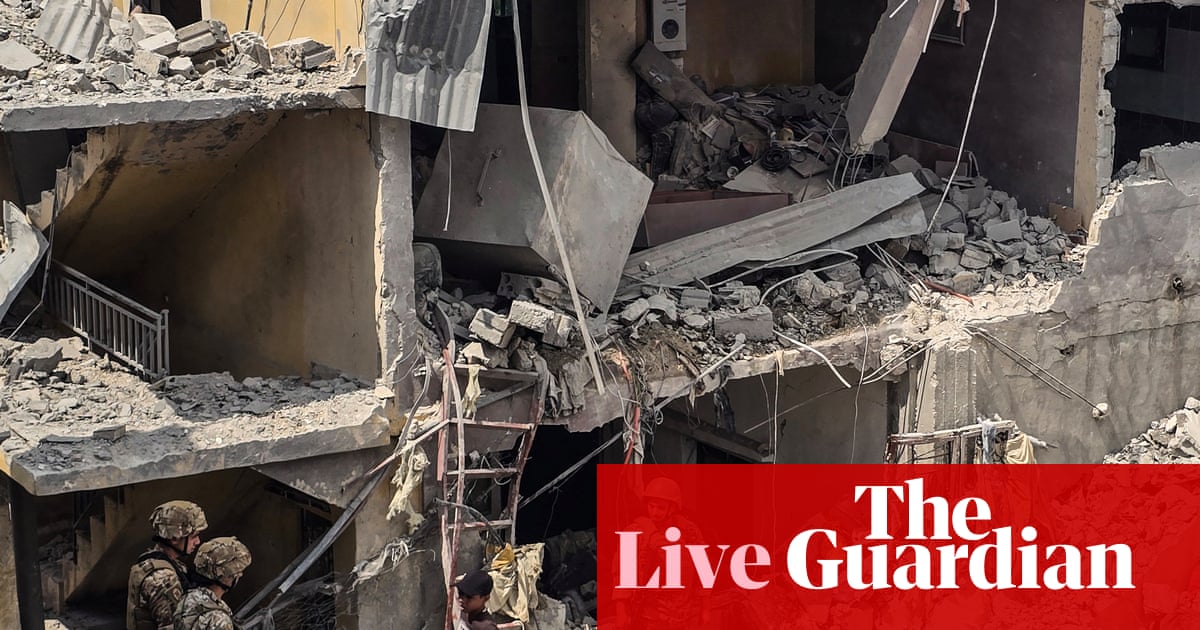
Here are some of the latest images from southern Lebanon, where Israeli airstrikes killed at least 31 people on Tuesday in one of the deadliest since a ceasefire took effect in April:
Donald Trump will host the 12th cabinet meeting of his second term on Wednesday as talks on ending the nearly three-month war with Iran reach a crucial stage amid conflicting signals over whether an agreement is close.
The gathering had originally been scheduled to take place in the bucolic setting of Camp David, the presidential retreat that had previously been the site of sensitive Middle East negotiations, including the historic Israeli-Egyptian peace accords.
But Trump switched it back to its more accustomed White House setting, citing adverse weather forecasts.
“Based on the possible bad weather conditions tomorrow, we will be having our Cabinet Meeting in the White House, and will be postponing the Cabinet trip to Camp David,” he wrote on his Truth Social platform. Heavy rain is expected in the area on Wednesday.
The initial decision to stage it at Camp David had raised eyebrows, given that Trump had visited the presidential retreat deep in the Maryland countryside, 62 miles north-west of Washington, much less frequently than most of his predecessors.
Read more:
Zawtar al-Sharqiyah is a short distance from Nabatieh, where the Israeli military has issued another warning for people to flee their homes immediately and move north of the Zahrani river.
Hezbollah said its fighters clashed with Israeli soldiers in a town north of the Litani river, beyond the boundary of Israel’s self-declared military security zone in southern Lebanon.
It comes a day after the Israeli prime minister, Benjamin Netanyahu, announced he had instructed the military to expand its operations in Lebanon with “large forces on the ground” and take control of new areas north of the Israeli-held buffer zone.
In a statement carried by the Hezbollah-owned Al Manar TV, the group said its fighters “clashed with enemy forces at point-blank range” in the town of Zawtar al-Sharqiyah, about a mile north of the Litani river.
South Korea said a probe into an attack on a cargo ship in the strait of Hormuz assessed that it likely involved an Iranian missile.
The ship, operated by South Korean shipping firm HMM Co, was struck by “two unidentified aircraft” in the strait on 4 May, causing a fire and leaving one of the vessel’s 24 crew members with minor injuries.
At a briefing today to announce the outcome of a government investigation into the attack, the first vice minister of foreign affairs, Park Yoon-joo, said: “Various pieces of evidence point toward Iran.”
But he added that Seoul had not conclusively determined who was responsible for the attack or whether it was intentional.
Components in the debris from unidentified objects that were found inside the ship indicated they were likely made in Iran, according to Park.
“Their engines were similar to turbojet engines made in Iran,” he said, adding that South Korea will summon the Iranian ambassador to share the results of the investigation and deliver a protest message.
Iran and the US have not yet reached an agreement on the strait of Hormuz, said Ali Bagheri, Iran’s deputy secretary of the supreme national security council, according to Russia’s Ria Novosti news agency.
Speaking to reporters on the sidelines of a security summit in Moscow, he said: “Until we agree on all the issues, we consider that we have agreed on nothing.”
He said Iran was negotiating with Oman on a new procedure for ships to pass the vital waterway, which has been effectively shut since the start of the war in February.
“Iran and Oman, as adjacent coastal states, are negotiating together to determine a new mechanism for passage through the strait of Hormuz,” Bagheri was quoted as saying.
When asked about Iran’s enriched uranium, he said it was “not on the agenda” in talks between Tehran and Washington, despite US president Donald Trump claiming earlier this week that it would be transferred to the US “immediately” to be destroyed.
Bagheri added that indirect negotiations are continuing.
The deputy political chief of Iran’s Islamic Revolutionary Guard Corps (IRGC) navy said renewed war with the US was unlikely but warned his country stands ready to thwart any attacks.
“Today, although the likelihood of war is low due to the enemy’s weakness, the armed forces are lying in wait with a full magazine,” Mohammad Akbarzadeh said, according to Iran’s semi-official Tasnim news agency.
He added that Iranian forces will turn Chabahar to Mahshahr along Iran’s southern coast “into a graveyard for the aggressors”.
Israel has claimed to have killed Mohammed Odeh, head of Hamas’s armed wing, in a strike on Gaza City last night.
If confirmed, his death comes just 11 days after the Israeli military killed his predecessor.
In a statement, the Israel Defense Forces (IDF) said the joint operation with intelligence agency Shin Bet targeted “several buildings” in the northern Gaza Strip which it claimed were used as a “hideout” by Odeh.
Israel considers Odeh one of the architects of the 7 October attacks.
“We committed to eliminating everyone who led the October 7 massacre,” the Israeli defence minister, Israel Katz, posted on X. “All of them are marked for death, wherever they may be.”
He added:
We committed that Hamas will not rule Gaza civilly or militarily, and so it shall be, and also the voluntary emigration plan from Gaza will be implemented – everything at the right timing and in the right manner.
Odeh was appointed as chief of the Qassam Brigades last week after his predecessor, Izz al-Din al-Haddad, was killed in an Israeli strike in Gaza on 16 May.
The continuing US-Israel war on Iran has compounded other global disasters to drive record numbers of people into hunger at a time when funding to combat famine has fallen dramatically, the head of the UN World Food Programme has said.
The WFP says 363 million people around the world are now at risk of acute hunger, 45 million of them as a result of conflict in the Middle East and the consequent oil price spike.
The surge in need comes against the backdrop of a cut in funding last year by a third, with the US, the largest donor by far, cutting its contribution by more than half.
Carl Skau, the WFP’s acting executive director since its former leader Cindy McCain stepped down for health reasons earlier this year, said the huge gap between needs and funding had forced the organisation to cut programmes supporting populations in food emergencies so as to focus on those already facing catastrophic famine.
“We take from the hungry to give to the starving. That’s the reality,” Skau told the Guardian. “Much of this is driven by conflict. Last year, we had two famines declared. That hasn’t happened in decades, so these are historic levels of hunger.”
Read more:
Muslims around the world are observing Eid al-Adha, or the Festival of Sacrifice, the second major festival in Islam. In Lebanon, war and displacement have overshadowed celebrations, as Israeli attacks continue to inflict death and destruction on the beleaguered country.
The Lebanese prime minister, Nawaf Salam, said Eid has come as Lebanon “is still enduring the most difficult circumstances, of war, destruction, and tragedies”.
“Yet Eid remains an occasion to hold fast to hope and confidence in our ability to achieve our goal of building a strong and just state to raise Lebanon up,” he wrote on X.
Welcome to the Guardian’s continuing coverage of the crisis in the Middle East.
Israel pounded Lebanon with more than 120 airstrikes on Tuesday in one of the heaviest days of bombing in weeks, Lebanese security sources said, as Israeli prime minister Benjamin Netanyahu said his military was deepening its operations in the country.
The bombing raids further strained a ceasefire announced on 16 April that was meant to halt fighting between Israel and the Lebanese armed group Hezbollah, and came as Iran said the US had violated a separate truce by striking southern Iran.
Lebanon’s health ministry said Israeli strikes had killed 31 people and wounded 40, state news agency NNA reported on Wednesday. It said 14 people were killed in the town of Burj al-Shamali in southern Lebanon, including two children and three women.
In a statement on Tuesday, Netanyahu said the Israeli military “is operating with large forces in the field and capturing and controlling areas”.
“We are fortifying the security strip to protect the northern communities,” he said in a reference to a self-declared security zone occupied by Israeli troops several kilometres inside southern Lebanon.
Hezbollah said on Tuesday it had targeted Israeli forces and tanks advancing toward the southern Lebanese town of Zawtar al-Sharqiya with explosive drones, rockets and artillery.
Here are the main developments in the Middle East conflict:
-
On Monday Netanyahu said Israel was “intensifying” its military operations in Lebanon, with the IDF operating with “large forces on the ground” in order to take control of “strategic areas”.
-
Meanwhile, the proposed peace agreement between Iran and the US seemed to remain on the table despite US bombings of Iranian targets. The Iranian foreign ministry denounced the US attack – aimed at missile launchers and efforts to lay fresh mines in the strait of Hormuz – as “an act of bad faith” and “a definitive violation of the ceasefire” and said it would not leave aggression unanswered. But Iran did not pull out of talks that were continuing under the joint mediation of Pakistan and Qatar. Here’s our report.
-
US president Donald Trump will hold a cabinet meeting on Wednesday, with the Iran war expected to be at the top of the agenda. All cabinet members, including outgoing director of national intelligence Tulsi Gabbard, who leaves her post on 30 June, were expected to attend the meeting.
-
US Central Command denied reports that that US navy has “quietly” resumed so-called ‘Project Freedom’ in the strait of Hormuz. “US forces are not currently escorting commercial vessels through the strait of Hormuz,” Centcom said in a statement shared on X.
-
Oil rose back above $100 a barrel on Tuesday, after the fresh US strikes on Iran dashed hopes of a breakthrough, with experts saying that whatever the outcome of peace talks, the global energy market may now be past the “point of no return”.
-
In Gaza, the Israel Defense Forces (IDF) claimed to have killed Hamas’s military chief Mohammed Odeh in an airstrike, 11 days after killing his predecessor. In a statement on X, the Israeli defence minister, Israel Katz, praised the IDF and intelligence agency Shin Bet for their “brilliant execution”.
Disclaimer : This story is auto aggregated by a computer programme and has not been created or edited by DOWNTHENEWS. Publisher: theguardian.com