The Morning Everything Changed
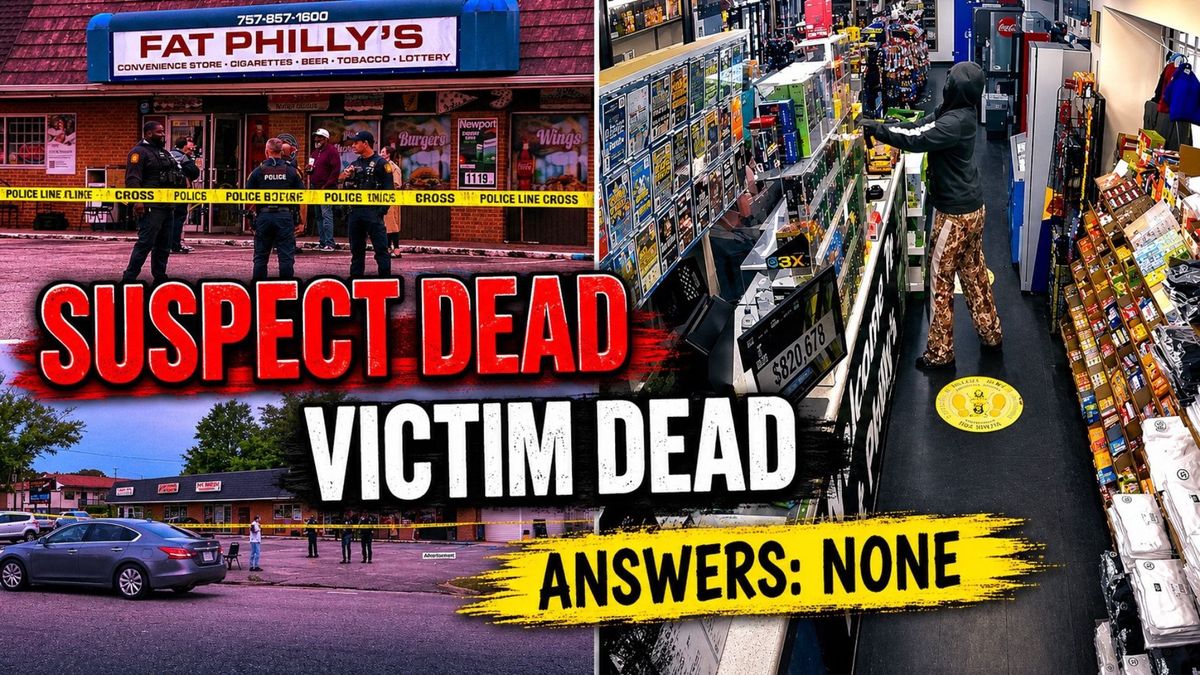
On the morning of May 23, 2026, Meghna Patel walked into Fat Philly’s supermarket in Norfolk, Virginia, unaware it would be her last shift. The 47-year-old Indian woman from Gujarat had worked at this store for a decade—long enough to know every regular customer, long enough for the work to feel routine. By 8:30 that morning, she would be dead.
Patel arrived for her shift as she had done thousands of times before. She stood behind the counter, performing the same duties that have become the invisible backbone of American convenience retail: managing the till, stocking shelves, serving customers. She was one of hundreds of thousands of Indian immigrants working in small stores across the United States—often the only face behind the counter, often working alone.
Also Read: When Dreams Die Young: The Crisis Killing Indian Students Abroad
Virginia Shooting: A Cascade of Violence in Minutes
The violence didn’t begin at Fat Philly’s supermarket on Azalea Garden Road in Virginia. It began miles away, in an alleged domestic dispute that would claim an innocent life.
At approximately 8:13 a.m., Norfolk Police responded to a home in the 3100 block of Blackwood Avenue. A stepson and stepfather were fighting. The argument escalated. The stepson, identified as Marvale R. Bond, 20 years old, left the house—then turned back and fired shots into the residence, striking his stepfather with a non-life-threatening wound.
Bond didn’t stop there. He left that house and drove to Fat Philly’s supermarket, 2700 Azalea Garden Road. What happened next was captured on CCTV footage that would circulate across social media: a masked man in a hoodie and grey jacket calmly walked into the supermarket. He approached the counter where Meghna Patel stood. He had a brief interaction with her—just a few seconds of conversation. Then he pulled a gun from his clothing.
He fired multiple shots at Patel who was working behind the counter. Patel fell. Bond climbed over the counter and fired again, ensuring she would not survive. Then he fled.
Police arrived within minutes to find Meghna Patel with life-threatening gunshot wounds. She was pronounced dead at the scene.
Also Read: Indian Student Killed in Canada, Rising Violence Sparks Concerns
Virginia Shooting: What the Police Chief Said—And Didn’t Say
The response from Norfolk Police raises more questions than answers. Norfolk Police Chief Mark Talbot addressed the media about the three incidents that morning—the domestic dispute, the shooting at Fat Philly’s, and what came next. His statement reveals the limitations of an investigation where the primary suspect is already dead.
“I am Mark Talbot, Chief of Norfolk Police department,” he began. “I am here to talk about three incidents all of which occurred between 8 and 9 this morning. The first incident occurred in the 3100 block of Blackwood Avenue. We got a call for some sort of domestic dispute between an adult male and his adult male stepson. Some argument occurred between the two of them. The stepson leaves the residence, turns back and fires a shot into the house.”
Chief Talbot then outlined the sequence that led to the murder of Patel: “The suspect then leaves that location and comes here in the 2700 block of Azalea. He goes into a business. He has a brief interaction with a clerk. He then fires numerous shots at the clerk. The police respond a short time later and find the clerk deceased. The suspect then leaves this location, drives a short distance and is found with a self inflicted gun shot.”
The chief’s conclusion was chilling. “So three tragic incidents. However, we are not looking at any suspects. If anybody happens to have encountered any of this, we would like to hear from them. But we are not looking for any suspects at this time.”
Also Read: Silenced Abroad: The Fatal Shooting of Indian Student Chirag Antil
When a reporter asked if the suspect knew the clerk—whether there was any connection between Bond and Patel—the chief’s response was damning in its brevity: “Unknown at this time.”
But more revealing than the unanswered questions was what the police chief chose to emphasise in his statement to the media. Talbot repeated it twice: “We are not looking for any suspects.” There was no promise of a deeper investigation. No assurance that authorities would pursue every lead. No indication that officials intended to uncover why an Indian woman working at a Virginia convenience store was shot dead at her workplace. The message was unmistakable: the investigation appeared to be over before it had begun. The suspect was dead. The case, effectively, was closed.
This raises a broader question about how law enforcement agencies in the United States approach cases in which the alleged shooter dies by suicide. When the suspect is no longer alive, does the inquiry into motive, circumstances, and the larger context of the crime effectively come to an end?
In this case, an Indian woman was shot dead while at work in Virginia. Yet the response from the police department appeared to indicate that the matter was considered resolved once the suspect was found dead. There was little indication of any effort to understand why Bond entered the store that morning, whether Meghna Patel had been specifically targeted, or whether the incident was entirely random.
No public information suggested attempts to reconstruct Bond’s movements before the shooting, examine whether there had been any prior connection between him and the victim, or determine if others may have had knowledge of the events leading up to the crime. With the suspect dead, the case appeared to reach a procedural conclusion — but for the victim’s family, many questions remained unanswered.
Also Read: Indian Students Killed in US: Justice Evades Amarnath Ghosh
A Family Left With Questions, No Closure
Meghna Patel is survived by her husband, Upendrabhai Patel, and two children. According to reports, all three are settled in the United States. Her elderly parents, Karsanbhai and Kapilaben, received the news in their village of Jantral in Gujarat’s Mehsana district.
Her family is now left confronting a difficult reality: the man responsible for her death also died at the scene. There will be no trial, no formal examination of motive in a court of law, and no clear opportunity to fully understand the circumstances that led to the killing. In that sense, the possibility of closure — or justice in any meaningful form — remains deeply uncertain.
A Pattern Emerging Across America
The Virginia shooting did not occur in isolation. It is part of a larger pattern of violence targeting Indian immigrants and Indian-origin individuals working in the service sector across the United States.
In January 2025, Koyyada Ravi Teja, a young food delivery worker in his mid-20s from Hyderabad, was shot and killed in in New Haven, Connecticut. Just weeks later, in February 2025, Indian-origin nurse Leelamma Lal was brutally assaulted by a psychiatric patient at a Florida hospital who made explicitly racist remarks during the attack. She suffered severe facial injuries and faced the risk of blindness.
By March 2025, the violence had claimed another life. Praveen Kumar Gampa, a student from Telangana, was shot dead in Wisconsin, at a store where he worked part-time.
The pattern intensified through the year. In September 2025, Chandra Mouli Nagamallaiah, a motel manager, was stabbed and beheaded in Dallas, Texas. The killing was caught on camera—a brutal act of violence that shocked the Indian community and raised urgent questions about the safety of the Indians in the U.S.
In September 2025 itself, Kiran Patel, an Indian-origin Gujarati immigrant was shot and killed at DD’s Food Mart, a local convenience store and gas station in South Carolina.
In October 2025, three Indian-origin hoteliers were killed in 72 hours. Two were killed in Charlotte, North Carolina and the third person was killed in Pittsburgh.
The Virginia shooting must be seen in this backdrop of rising crimes against the Indian immigrant community.
What the Numbers Actually Say About Indian American Safety
There are more than 5.2 million people of Indian origin residing in the United States today. A February 2026 survey by the Carnegie Endowment for International Peace quantifies the scale of discrimination that Indian Americans now face. The 2026 Indian American Attitudes Survey, conducted among 1,000 Indian American adults between November 2025 and January 2026, found that nearly half—48 percent—of respondents encounter racist posts targeting Indians or Indian Americans on social media “very or somewhat often” since the start of 2025.
Beyond online harassment, direct physical violence is also documented: one in four Indian Americans has been called a slur since early 2025; 9 percent have been physically threatened; 8 percent have received hate mail; 6 percent have experienced property damage; and 4 percent have been victims of physical assault. The emotional toll is severe, with 50 percent saying such racist content makes them angry, 33 percent reporting anxiety, and 31 percent feeling fearful.
This is the reality facing millions of Indian Americans today. Without institutional accountability and genuine investigation, incidents like this will continue to be treated as isolated tragedies rather than symptoms of a larger failure.
If You Knew Meghna Patel
If you knew Meghna Patel, worked with her, or are a member of her family, The Probe wants to hear from you. If you have details about her life, her work, or your frustration with how Norfolk Police have handled this case, write to us at tipusoff@theprobe.in. Your story matters. Your answers matter.
Disclaimer : This story is auto aggregated by a computer programme and has not been created or edited by DOWNTHENEWS. Publisher: theprobe.in