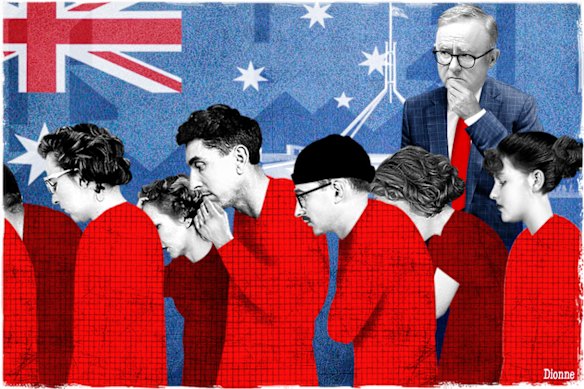
Blow it up. It’s not working, just blow the whole damn thing up. That’s the nihilistic attitude of at least one in four Australians towards conventional politics. The upswell in support for One Nation and Pauline Hanson, around whom the party was constructed way back in 1997, is a remarkable phenomenon that threatens to destroy the two-sided political model that has endured since the early years after federation.
Given how swiftly and steadily the backing for Hanson has risen, how long will it be before that one in four number becomes one in three? In a large-scale Redbridge poll, One Nation is on 28 per cent, just three points short of the ALP’s 31 per cent and well ahead of the Coalition on 21 per cent. The Essential poll this week has One Nation trailing the government by a single percentage point. But look past the polls to actual voting behaviour. At the South Australian state election, One Nation attracted 23 per cent. It then won the Farrer byelection with a primary vote of 39.5 per cent.
This is real, and if Anthony Albanese believes he’s already climbed the biggest mountains of his career by leading the ALP to election victories in 2022 and last year, he should think again. The fight he is in now will be the one that defines his legacy. At stake is whether the political system continues to be seen by the bulk of Australians as the instrument through which the nation confronts and solves its problems or becomes mostly a venue for protest, curdled nostalgia and implacable oppositionism.
Given the Labor Party’s long-held reputation as a radical party, there’s a paradoxical aspect to the fact it finds itself in the role of proving the worth of the old political order, which has decidedly favoured the conservative parties through the decades.
One Nation’s surge and the motivations that drive it present a direct challenge to Albanese’s method of leadership. When he took over as Labor leader after the party’s 2019 election defeat and faced off against the hyperactive and marketing-oriented Scott Morrison, Albanese quickly concluded that most Australians would eventually favour a quieter, more orderly politics than what Morrison was serving up. The Liberals spent three terms in office turning over leaders and posturing; Labor under Albanese would provide steady, no-drama government. Albanese’s judgment was vindicated in 2022 and again last year.
That lower-key approach worked until a few months ago, when the rush towards One Nation got up a full head of steam. Those who are derisive of voters who have swung to Hanson are correct when they point out that her party is extremely light on policies and big on anger and a desire to turn back the clock to a less complicated overwhelmingly Anglo-Celtic Australia, but they are also missing the larger picture.
There are broad sections of Australia that feel unheard and undervalued. Outside the big cities, town centres have been emptied out, rural districts have depopulated and lost services, industrial jobs in the older outer suburbs and regions have gone. Not enough people feel properly compensated for their labours. They do not feel respected.
Far from being exclusive to Australia, this is a condition in so many other industrialised countries – the US, the UK, Germany, France, Italy, just about any other Western European or Scandinavian country, and many of the former Iron Curtain nations. Nativist and populist parties have become real political forces in these places.
The move towards globalisation and neoliberal economics that’s predominated since the end of the 1970s has slowly been running out of puff. Housing has become too expensive. In Australia, since the beginning of this century, housing prices have grown at twice the rate of full-time earnings. That was always an unsustainable pattern. Throw in large-scale migration, legal and illegal, and digital information and communications changes where the truth can be lost or distorted or disrespected, and you get social breakdown and suspicion of orderly politics as a method of resolving differences and remedying economic injustice. So the chosen option for some – and quite likely many – people is to blow it all up.
Look past the generally predictable self-interested fury about the budget’s tax changes and it can be said fairly about the government that it is trying in a cack-handed way to address some of the grievances of the left-behind. But whether Albanese has what it takes to persuade enough disillusioned Australians of that remains to be seen. He has not so far blazed a trail as a leader who can sell difficult propositions. He secured the prime minister’s chair by deliberately underpromising and avoiding risks. His one big swing at advocacy – the Voice referendum in 2023, which failed spectacularly – found him wanting. Even though there’s a hard, even cynical, aspect to his political personality, he’s shown how vulnerable he can be to personal attacks. He took the Voice defeat very hard, going into a funk for several months. Treasurer Jim Chalmers jolted him out of that by persuading him to change the stage 3 tax cuts to deliver money to every taxpayer, announced in early 2024.
More recently, the weeks after the Bondi massacre, when he faced a massive media assault and rejection from large parts of the Jewish community, left him discombobulated and even bewildered. The scorn directed at him over his decision not to call a royal commission, eventually reversed, left him with stark evidence of how fragile respect for a prime minister can be in the modern day. He has been feeling the heat over the attacks on the budget. His mildly tearful reaction last weekend to the energetic and sincere ovations he received at the Victorian ALP conference, not a place that has always warmly welcomed him, was evidence of that.
There are two more years to go before the next election, but it can safely be said that federal politics has rarely been in a more febrile state than it is now. No other Australian will play a bigger role than Albanese in determining whether this turns out to be a hinge moment in the country’s history or just an admittedly wild phase to be managed.
Shaun Carney is a regular columnist, an author and former associate editor of The Age.
The Opinion newsletter is a weekly wrap of views that will challenge, champion and inform your own. Sign up here.
 Shaun Carney is a regular columnist, an author and former associate editor of The Age.
From our partners
Disclaimer : This story is auto aggregated by a computer programme and has not been created or edited by DOWNTHENEWS. Publisher: www.smh.com.au