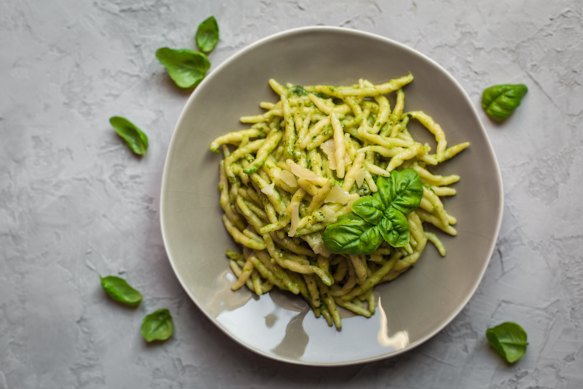

Basil. Garlic. Parmesan. Pecorino. Pine nuts. Rock salt. Extra virgin olive oil. Pesto doesn’t seem like it should be hard, but where better to learn how to do it properly than the place it originated?
We’ve come down the highway from Genoa after arriving that morning on the MSC World Europa, but this adventure is not your typical cruise excursion.
It is offered only to passengers sailing on MSC Yacht Club, an exclusive ship within a ship for those paying a premium, and today there are seven of us getting a masterclass in pesto making upstairs at the family-owned O Magazin Al Porto in Rapallo. Four Canadians, a young couple from Reunion and I; our guide also joins us at the table to sample the finished product.
Floor-to-ceiling windows offer panoramic views of the popular holiday port, but our eyes are trained on chef Michele De Mattia as he crushes the ingredients, in the correct order, in a mortar. Press and twist, he says, translated by a member of the Mussini family which has built a series of restaurants that celebrate the cuisine of the Ligurian Riviera.
Sign up for the Traveller Deals newsletter
Get exclusive travel deals delivered straight to your inbox. Sign up now.
Don’t just pound away, even if you are using a blender, we are told. The order in which the ingredients are crushed is vital: if you put basil in first, you will not end up with pesto. Rock salt, garlic and pine nuts must become a paste first, save the cheeses for last, use twice as much parmesan as pecorino, and a light olive oil so it doesn’t overpower the subtle flavours. De Mattia calls it a cold sauce; it never touches a flame and the pasta is off the boil and drained before it is mixed and served.
As important as the order is, being precise about quantity is overrated so long as the proportions are roughly right. At the annual pesto-making championships, there will be 100 versions, and each will be subtly different.
The tips are useful (15-day-old basil sprouts are best, but I cannot afford to be too fussy trying it at home) and the homespun history of the recipe is interesting. Garlic and basil have long been part of Genovese cooking, but pesto as we know it today is about 150 years old. Shipping routes are to thank: pine nuts from Pisa, pecorino from Sardinia, basil from up the road and garlic from a small village over the hill behind us.
He works up a sweat pressing and twisting, showing us how it should be done, but admits those who come to the restaurant can expect the pesto to be made in a blender. Don’t trust anyone who tells you otherwise, he says. “Thanks god for electricity,” he smiles.
For our “light lunch”, which is anything but, we have the pesto with focaccia, and with trofie, a twisted pasta from the Liguria region made of flour and water and invented in a village 10 kilometres away. There are also cuculli (chickpea fritters), vegetarian polpettone alla Genovese (a salty cake) and a white wine from down the highway.
The other joy of the excursion is being in a van small enough to navigate the windy road to Portofino, a gorgeous fishing village of pastel houses and boutiques that is an escape for the likes of Dolce&Gabbana, Berlusconi the younger and Bill Gates.
The place is inaccessible for large tour buses, and we’ve come at such a quiet time of year that it feels like we have the town to ourselves.
Espresso seems in order. On the way back to the ship in the afternoon, we visit Santa Margherita and indulge in coffee and cake. There is no particular rush back to the ship: headcounts are easy with seven, and given Yacht Club members have priority boarding, we can take in the sights.
We also pop into a gastronomia (food shop) and assess the pesto situation. There is a variety, but all look like a letdown compared to lunch.
There is debate about whether to get one with or without garlic. Given what we have heard in the morning, it is shocking. One of the men walks out of the shop with an air of bemusement. “That’s almost sacrilegious.”
THE DETAILS
CRUISE
The seven-day round trip from Barcelona visits Marseille, Genoa, Civitavecchia (Rome), Messina, Valetta and there is a day at sea. Boarding is available at every stop, so there is a steady influx of passengers. Fares for a Yacht Club deluxe suite on board MSC World Europa start from $3647 a person. A new ship, MSC World Asia, will be introduced to the route in the next northern winter. See msccruises.com.au
The writer travelled as a guest of MSC Cruises.
From our partners
Disclaimer : This story is auto aggregated by a computer programme and has not been created or edited by DOWNTHENEWS. Publisher: www.smh.com.au