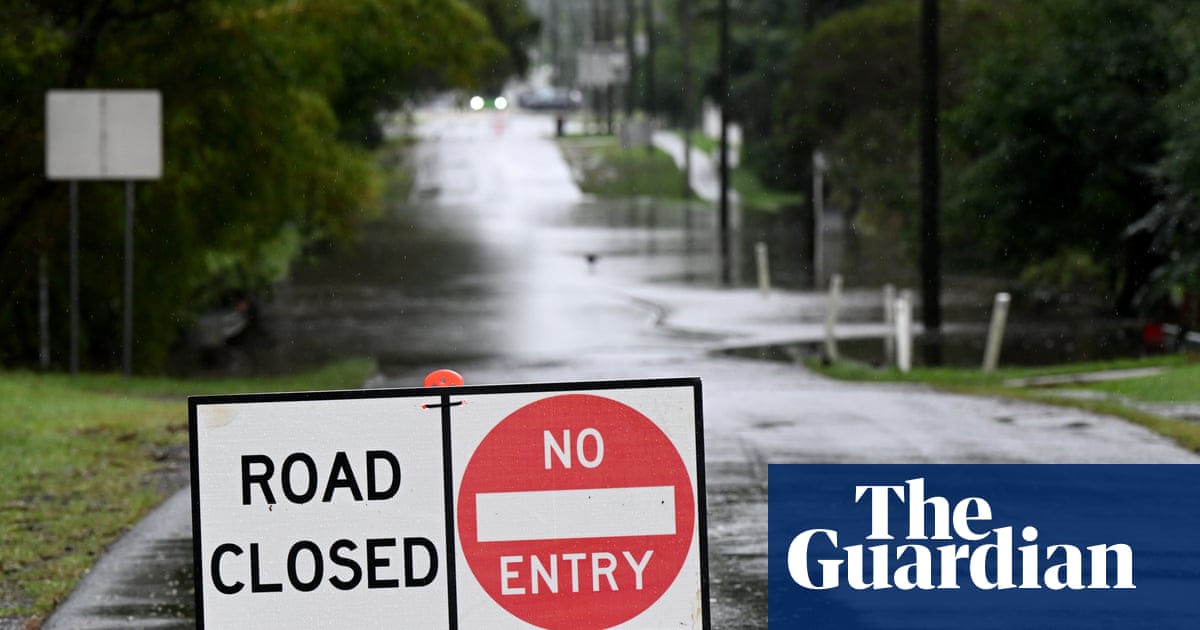
Multiple states are at risk of flash flooding on Thursday, with severe weather warnings issued in New South Wales, Queensland and Tasmania.
Ilana Cherny, a senior meteorologist at the Bureau of Meteorology, said the wet weather battering eastern Australia was being driven by a broad low-pressure trough that had drawn in “a lot of tropical moisture across the region”.
“In the midst of that trough, a low pressure system is developing and is slowly going to move offshore of New South Wales during Friday,” she said.
Heavy rainfall, with the potential to cause flash flooding, was forecast for parts of the NSW mid-north coast, the upper Hunter and adjacent districts from Thursday afternoon.
“With those falls expected in that area, we also have a flood watch out for the Hunter and parts of the mid-north coast with possible minor flooding,” Cherny said.
It came as NRMA roadside assistance employees in Canberra, Sydney, Newcastle and Wollongong began a 24-hour strike – expected to end at midnight – over pay and conditions, a representative for the Australian Manufacturing Workers Union said.
Heavy rainfall was also forecast on Thursday for southern and south-east parts of Queensland, including the Darling Downs Wide Bay and Burnett regions.
“Severe thunderstorms are also possible through to the Brisbane area and the south-east coast,” Cherny said, adding there was a risk of damaging wind gusts and large hail.
“We are expecting further severe thunderstorm warnings to be issued throughout the day, particularly through parts of southern Queensland and New South Wales,” she said.
Brisbane was hit by severe weather on Wednesday, with access to many roads temporarily cut as rain hammered down from the north. The city recorded 43mm of rain by 8.30am on Thursday.
There were also significant rainfall totals in Queensland’s parched southern interior and Darling Downs. The highest total in the 24 hours to 7am on Thursday was 88mm at Tindarra on Bungil Creek, near Roma in the state’s central west. More rain was expected on Thursday, in good news for the region’s farmers.
In Tasmania, flood warnings were in place for the St Paul’s River and the South Esk River. Eastern parts of the state saw rainfall totals over 100mm, with 251mm recorded at Gray.
The rainfall was expected to ease over the weekend as the low pressure system moves offshore, but “we could see some hazardous surf redeveloping up the east coast”, Cherny said.
The climate crisis is making Australia more vulnerable to extreme weather and natural disasters, including intense rainfall. For each 1C of warming, the atmosphere can hold 7% more moisture. Rainfall intensities can be greater than this because, as raindrops form, they also release energy into a system.
– with AAP
Disclaimer : This story is auto aggregated by a computer programme and has not been created or edited by DOWNTHENEWS. Publisher: theguardian.com