

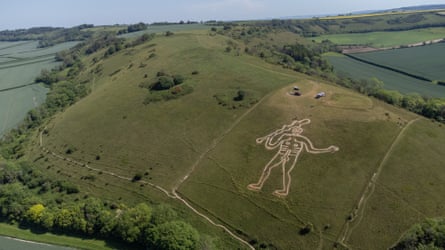
For centuries, the custodians of the Cerne Giant have clambered up the dizzyingly steep hill every decade or so to rechalk the outline, making sure the hulking figure can be seen far and wide across the rolling Dorset countryside.
But the painstaking job, which involves hacking out the grubby old chalk by hand and packing in fresh, felt all the more urgent this week because effects put down to the climate emergency are making the giant a little duller and perhaps a touch more fragile.
“The giant is hundreds of years old but the modern world is certainly affecting him,” said Luke Dawson, a National Trust lead ranger, as he supervised workers and volunteers who were at work restoring the giant to gleaming glory.
“We’ve noticed algae growth starting to dull the giant’s bright white outline. We can’t say for certain what’s driving that, but warmer, wetter conditions may be a factor. The milder winters and wetter summers make perfect growing conditions.
“We’re also seeing more intense rainfall, which can increase water runoff and gradually wear away the chalk, so we’re planning further monitoring to understand the impacts.”
The custom has been to rechalk the 55-metre-tall giant roughly every seven to 10 years. It was last done in 2019 and before that in 2008.
“It may be we have to adapt and perhaps rechalk more often,” Dawson said. “We will also explore ways to retain more water within the landscape, for example by allowing areas of scrub to develop and establishing permanent grassland.”
The rechalking technique is being adapted. In 2008 and 2017, it involved packing in dry chalk and tamping it down. “But that’s very difficult because the hill is so steep,” Dawson said.
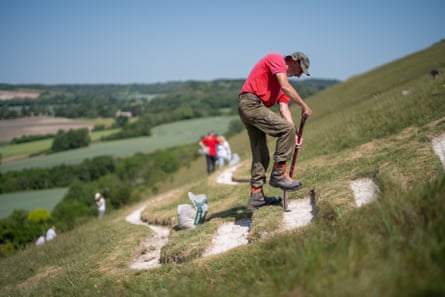
So this time they are experimenting with mixing chalk (they need 17 tonnes of it) with water to create a paste. Dawson said: “It’s like a putty, which makes it easier to make it stick.”
Despite the problems faced, the sight of workers and volunteers scrambling across Britain’s largest chalk hill figure on a bright late spring day was a joyful one. “It’s a beloved figure,” Dawson said. “Everyone in the village has a connection with the giant.”
The National Trust, which owns the site, leads the work but willing helpers so far have included a local vicar and staff from Cerne Abbas Brewery. Children from nearby schools are also booked in to help.
The hot weather means there have had to be adaptations. In previous years there have been morning and afternoon shifts, but the latter are being cancelled because of the heat.
Workers have been rechalking for 20 minutes an hour and two gazebos are perched on top of the hill to provide shade. Walnut and lemon cake are on offer, but no chocolate because of the melting risk.
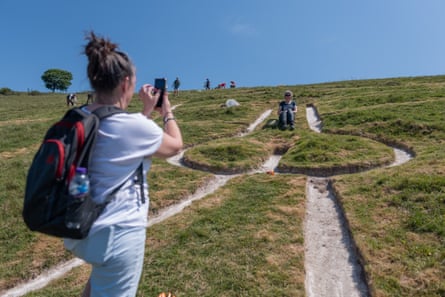
Earlier this year a nationwide fundraising appeal enabled the National Trust to buy significant areas of land around the giant, which it says will help protect the wider landscape.
The appeal, backed by Stephen Fry, reached its £330,000 target in 60 days, with donations flooding in from across the UK and as far afield as Australia, Japan and Iceland.
Some of those who donated won the chance to help with the rechalking, including Debby van den Berg, a 51-year-old civil servant from Gouda in the Netherlands.
She admitted her family were surprised when she revealed she would spend holiday time rechalking a West Country giant. “But this is so special, so English,” she said during a break from working on the club.
Van den Berg was puzzled that a figure with such prominent private parts was to be found in the English countryside. “We think of the Brits as reserved but I don’t think this figure would have survived in Holland,” she said.
Jane Hanney-Martin, 50, a museums manager from the West Midlands, was scraping away the old chalk and vegetation with a mattock. “It’s lovely to be part of something so special,” she said. “Lumping the old chalk uphill to get it away is hard work but it’s worth it.”
The giant’s origins have long puzzled historians, prompting theories that it is a depiction of Hercules or a satirical rendering of Oliver Cromwell.
In 2021, the trust commissioned scientific analysis that revealed it was probably created in the late Saxon period, between AD700 and AD1100.
Lunch – sandwiches from a local pub – was brought up in a Fortnum & Mason wicker basket. The rechalkers took time to catch their breath, take in the expansive views and try to spot the butterflies that flit here, including the endangered Duke of Burgundy.
Michael Clarke, a National Trust area ranger who has helped care for the giant for 33 years and is a veteran of four rechalkings, said he was fond of the grand old figure and had noticed the effect the changing climate was having.
“Last time, we did the rechalking in the late summer/early autumn and the rain washed a lot of it away. We get complaints when he’s not as bright as people want.
“The warm weather should dry out the chalk paste nicely and hopefully he’ll just about be as good as new again when we’re done here.”
Disclaimer : This story is auto aggregated by a computer programme and has not been created or edited by DOWNTHENEWS. Publisher: theguardian.com



