
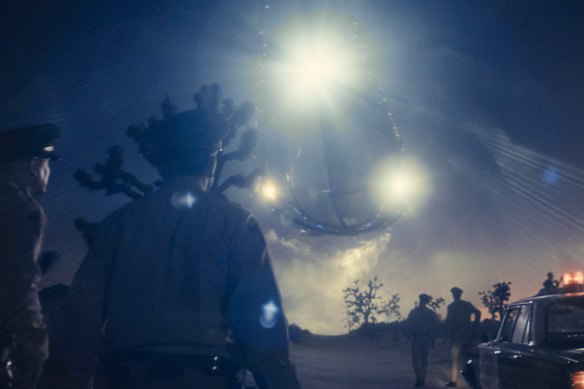
As the Pentagon throws open its extra-terrestrial files, Disclosure Day depicts encounters of an even closer kind.
The “Fermi paradox” – named after the Italian-American physicist Enrico Fermi – describes a simple contradiction: in an infinite universe, with infinite planets, and therefore infinite possibilities for intelligent lifeforms to arise, why, oh why, do we appear to be the only ones? Statistically speaking, the universe should be teeming with sentient beings and we should have had multiple well-documented encounters with them by now.
Instead? Crickets. It seems to be just us humans, sending an endless succession of exploratory probes, radio transmissions and golden vinyl records (as per the Voyager expeditions) out into the impartial void of space, desperately hoping that someone will send back their own mixtape. But where some hear crickets, others smell conspiracy. The last century-or-so has been replete with supposed extraterrestrial encounters, from sightings of mysterious lights in the sky, to firsthand accounts of alien abductions, to whatever’s going on in Area 51 – all, we’re told, hushed up by clandestine government agencies.
This age of alien obfuscation might be coming to an end, though. An unusually declassification-happy Pentagon has released hundreds of documents in recent years pertaining to both modern and historical sightings of UAPs (“unidentified anomalous phenomena”, the somewhat corporate rebranding of “UFO”). During a 2023 Congressional subcommittee hearing, former United States Air Force intelligence officer-turned-whistleblower David Grusch claimed under oath to have knowledge of his government’s “multi-decade UAP crash retrieval and reverse-engineering program”. In more informal interviews, he said the US had been storing and studying “non-human” spacecraft and “biologics” (read: dead aliens) right under everyone’s noses.
Even former US president Barack Obama, when asked on a podcast whether aliens are real, replied: “They’re real … but I haven’t seen them.” (He later clarified this was said “in the spirit of the podcast”, but as far as the internet was concerned, the cat was well and truly out of the bag.)
And during a conversation at March’s SXSW festival in Austin, Texas, Steven Spielberg – probably the filmmaker most closely associated with bringing extraterrestrial spectacle to modern audiences – weighed in. Discussing the likelihood of aliens currently cohabiting with us on Earth, he said: “I don’t know any more than any of you do, but I have a very strong, sneaking suspicion that we are not alone here on Earth right now.” It’s all enough to make The X-Files’ Fox Mulder throw up his hands and say I told you so.
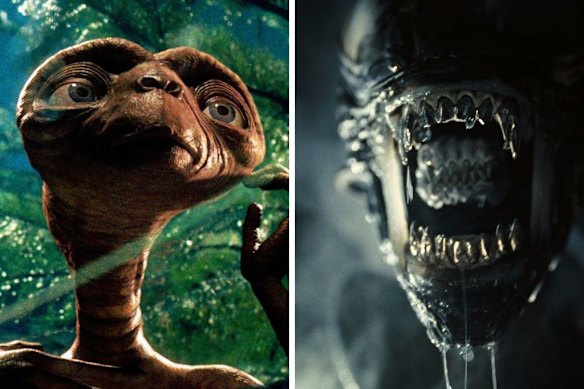
But while we may be living in a golden age of alien trutherism, one thing remains very much up in the air: precisely what sort of aliens are we talking about? Cute and cuddly, or prone to planetary conquest? Where do they sit on the spectrum between the murderous xenomorphs of Ridley Scott’s Alien and, say … ALF?
Spielberg’s own filmography offers a handy tasting menu of the various forms these otherworldly beings might take. Two of his earliest movies cleverly inverted the Roswell-era alien fever that must have permeated much of his Arizona childhood in the mid-20th century. Close Encounters of the Third Kind (1977) begins with nefarious nocturnal sightings and kidnappings, before mellowing out into an awe-inducing exchange of intergalactic knowledge between species. His follow-up, E.T. the Extra-Terrestrial (1982), took this line of thinking even further: what if the alien visitors we were raised to fear were found not only to be benign, omnipotent tourists, but in fact surprisingly huggable hobgoblins with eyes like Einstein and the nose of a pug that a suburban child might like to keep as a pet?
The Fermi paradox comes with a few possible solutions to the question of whether we’re alone in the universe. One is that we’re the first species to ever reach this level of intelligence; the first to ever look up at the sky and wonder who else is out there. Another is that we’re dead last; that a billion years of interplanetary diplomacy came and went before we even crawled out of the swamp, and we’re too late to the party.
A third possible explanation – and scarily, perhaps the most likely one – comes down to something called the “dark forest hypothesis”. In essence: it doesn’t pay to stand at the verge of a dark forest, or any hostile wilderness for that matter, and wave and shout and jump around when the reality is you simply don’t know who or what is out there. The galaxies on either side of us could be literally brimming with intelligent life – and they could be receiving every transmission we’ve ever sent – they just have the good sense to keep their mouths shut and not broadcast their location, lest some other even more intelligent, and far less friendly, civilisation catches wind of them.
H.G. Wells’ 1898 novel The War of the Worlds tapped into this dark-forest anxiety and set the template for a century of all-out invasion narratives, from The Day of the Triffids to The Day the Earth Stood Still. Spielberg’s own 2005 interpretation is a wildly bleak portrait of post-9/11 America. Clearly the director’s view of potential human-extraterrestrial relations had soured somewhat in the post-E.T. years, from kids and aliens sharing Reece’s Pieces to unstoppable tripods vaporising hordes of fleeing human refugees.
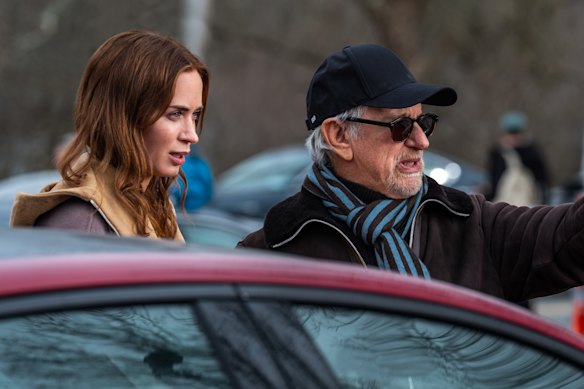
Spielberg was at SXSW to promote his upcoming film Disclosure Day – the “disclosure” being the moment long prophesied by alien truthers when world governments finally come clean about the existence of other-worldly life on Earth. His newest foray into alien fiction certainly seems to lean into Invasion of the Body Snatchers territory, where instead of monstrous flowers or adorable gargoyles, the aliens among us are indistinguishable from our partners, our parents, our neighbours and friends. Such stories suggest that the people around you are being replaced, one by one, and soon you’ll be the only real one left. Or worse: it could just be you and your mate, both armed with flamethrowers, waiting to see which one of you turns into a giant howling blob, as in John Carpenter’s 1982 The Thing.
I admit that none of these options are particularly appealing. Even the possibility of a cute, E.T.-like companion comes with undue levels of mischief and government attention. Personally, I’m somewhat more inclined towards the “ancient astronaut” school of thinking, where these celestial visitors came to Earth a very long time ago to explore and possibly help build Stonehenge or a pyramid or two. We see them in 1995’s The Fifth Element and even briefly at the end of Spielberg’s 2008 Indiana Jones and the Kingdom of the Crystal Skull.
If these wizened wanderers are ever inclined to visit Earth again, perhaps instead of building more tourist attractions, they could give us a hand with some affordable housing – maybe even the long-promised Melbourne-to-Sydney high-speed rail link. Wouldn’t that be a gift from the heavens?
Disclosure Day opens on June 11.
Want more Movies? We’ve got you.
Disclaimer : This story is auto aggregated by a computer programme and has not been created or edited by DOWNTHENEWS. Publisher: www.smh.com.au


