Lamborghini squad Abt Sportsline could lose its second-place finish in the Nurburgring 24 Hours after failing a crucial post-race check this week.
Motorsport’s sister website Motorsport-Total.com has learned from several corroborating sources that the engine output of the #84 Lamborghini Huracan GT3 Evo2 did not match the reference values during a dyno test on Tuesday. These values were established there in the run-up to the race and used to determine the Balance of Performance (BoP).
A spokesperson for the race also confirmed this: “During a routine inspection of a total of six GT3 vehicles (SP9 class), irregularities were detected in the Red Bull Team Abt Lamborghini Huracan GT3 Evo2 with #84. During inspections of the other five vehicles from Aston Martin, BMW, Ford, Mercedes-AMG, and Porsche – including tests on a dynamometer to measure power – no issues were found in the days following the event.”
The technical stewards’ report has since been “forwarded to the race stewards”, “who will convene in the coming days and give team representatives the opportunity to comment on the incident. Until then, the race result remains provisional.”
20bhp too many? Why the Abt Lamborghini failed the test
There have been reports that the Red Bull-liveried car driven by Mirko Bortolotti, Patric Niederhauser, and polesetter Luca Engstler exceeded the reference values by around 20bhp. According to this, the engine power would be outside the tolerance limit, which, according to the regulations, is 2% to account for possible variations among engines. At an estimated 500bhp, the tolerance would be 10bhp.
Since the #84 Abt-Lamborghini was the only one of six selected cars that could not be inspected on Tuesday following the 24-hour race, the measurement was postponed by one week. The cause is said to have been a defective clutch.
Immediately after the race, the top-finishing vehicles from the six strongest manufacturers were sealed, loaded onto a tow truck, and secured for a follow-up inspection. These included the victorious #80 Winward Mercedes, the second-placed Abt Lamborghini, the #34 Walkenhorst Aston Martin (3rd), the #99 Rowe BMW (4th), the #24 Lionspeed Porsche (6th), and the #67 HRT Ford (8th).
Abt Lamborghini in a restricted area: was there suspicion?
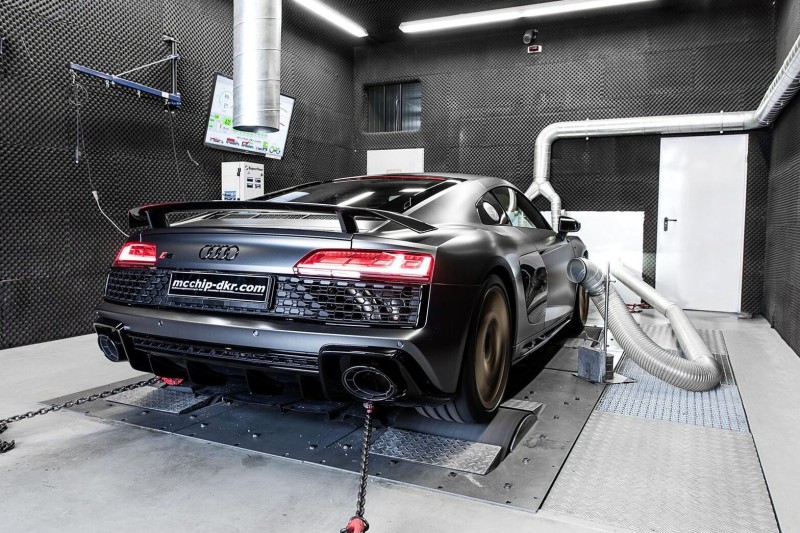
The teams did not regain access to their vehicles until two days later at McChip’s dyno facility in Mechernich – 50km away from the Nurburgring – to fit them with the necessary components for inspection. All of this took place under the strict supervision of officials from ADAC North Rhine-Westphalia. The cars were then measured on the test bench in time slots from 10am until the evening hours.
The race cars were tested on McChip’s dynamometer in Mechernich
Photo: McChip
Eyewitnesses report that the Abt Lamborghini was the only car not to be seen all day and was apparently secured in a cordoned-off area, leading to speculation that officials already had suspicions about the car.
After no irregularities were found in the first five vehicles, the test on the Abt Lamborghini was halted. On the vehicle that was the last to go on the “roller” in the evening, a broken clutch was reportedly discovered during warm-up.
The clutch must function on the dynamometer, as the vehicle’s performance is calculated once again during the ‘coasting’ phase. After the test was halted, the vehicle was sealed, picked up by a towing company, and locked away to be re-inspected a week later – on Tuesday following the DTM weekend in Zandvoort.
The clutch replacement was carried out on Monday by Abt mechanics under supervision; the following day, the team had to return to the McChip dynamometer at 2pm. If everything goes according to plan, the inspection on a naturally aspirated vehicle like the Lamborghini takes less than an hour. However, according to information from Motorsport-Total.com, measurements were still being taken at 6pm. This is because irregularities came to light.
The process resumed on Wednesday morning, as the outside temperature on Tuesday was significantly higher than during the reference measurement in 2025; however, due to a technical issue with the vehicle, no result was obtained. A high air temperature – as was the case during the decisive measurement – would actually work in Abt’s favor in this instance, since engines lose power in the heat.
According to eyewitnesses, the Abt Lamborghini was subsequently seen on a tow truck heading back toward the Nurburgring. It is safe to assume that the car was secured again, as – depending on how things proceed – further investigations may be necessary.
Disqualification not yet confirmed: what happens next
As for what happens next, the chairman of the race stewards, who has already received the technical committee’s report on the irregularities during technical inspection, will set a date for a hearing at which the Abt team can also present its case. This hearing is expected to take place shortly. Disqualification would follow thereafter.
But even then, the matter would likely not be settled, as the team would then have 96 hours to file an appeal, which would lead to a further hearing before a sports court of the DMSB (German Motor Sport Federation). Therefore, it could still take weeks before the result of the 24-hour race is finally official.
It wouldn’t be the first time a team has stumbled over a follow-up test on the dynamometer. In 2019, the “Grello” was also disqualified for excessive engine power, causing Manthey to lose second place. At the time, the Porsche team requested another measurement using a modified testing method, but that too showed the engine output exceeded the specified limits. The team subsequently decided not to appeal.
Data comparison: did the less favourable BoP have no effect?
Anomalies had already been identified by officials in the race data, as the speeds for the airflow restrictor mandated by BoP were apparently too high – specifically for both Abt Lamborghinis and the privately entered Konrad Lamborghini.
Based on 20% of the highest top speeds of the respective cars in Sector 8 on the Dottinger Hohe – which are more representative than the maximum top speeds due to potential slipstreaming – the #84 Abt Lamborghini achieved an average of 275.2km/h. This is despite the fact that the car reached only 268km/h on Thursday night in Qualifying 2 with a 0.5mm larger restrictor – meaning more engine power.
The BoP adjustment, which was unfavourable for the Lamborghini, took place on Friday morning – and apparently had only a limited effect, as the #84 Huracan also achieved a top speed of 269km/h in Top Qualifying 3, held on Friday. With a time of 8m11.123s, it also secured the first Lamborghini pole position in the 24-hour race.
The lap times of the Abt Lamborghinis in the race were also extremely impressive: Patric Niederhauser set the fastest lap of the race in the #84 with a time of 8m08.758s – making him 0.755s faster than Nicky Catsburg in the #130 Abt Lamborghini in Schaeffler livery. Christopher Mies in the HRT Ford posted the third-fastest lap time of 8m11.247s, while Max Verstappen’s best lap time was 8m12.818s.
If you look at the average of the 20 fastest race laps for all cars that finished, you get a more realistic picture, since traffic, Code 60 phases, and conditions play a major role: the #84 clocked an 8m14.058s, followed by the sister #130 Abt car with 8m16.893s and the HRT-Ford in third place in 8m17.001s. The winning Winward-Mercedes car achieved an average of 8:17.812 in these statistics.
And the theoretically fastest laps, calculated from a car’s best nine sector times, paint a similar picture: The #130 clocked an 8m04.022s, while the #84 recorded an 8m05.163s. The third-fastest theoretical best machine was the Winward-Mercedes winning car (#80) with an 8m06.752s.
We want your opinion!
What would you like to see on Motorsport.com?
– The Motorsport.com Team
Disclaimer : This story is auto aggregated by a computer programme and has not been created or edited by DOWNTHENEWS. Publisher: motorsport.com