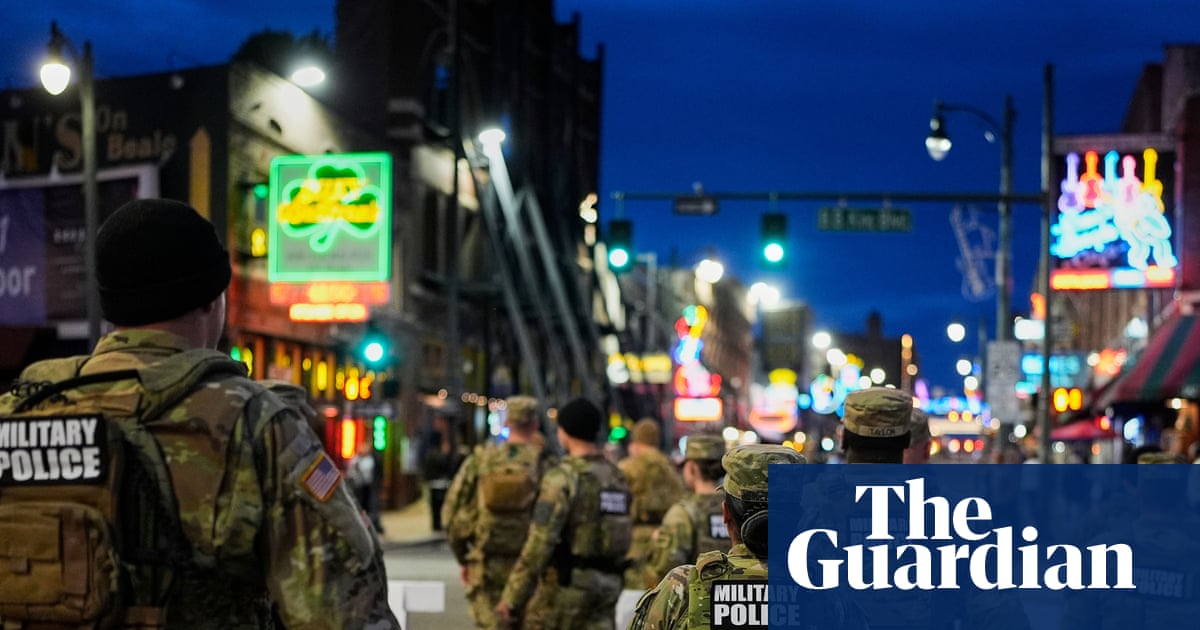
An anti-crime taskforce ordered by Donald Trump onto the streets of Memphis has been accused of targeting community observers with widespread intimidation including “immense force”.
Agents have been “retaliating against, intimidating, and harassing” observers attempting to monitor the federal taskforce’s activity, according to the American Civil Liberties Union (ACLU) of Tennessee, which alleges that officials have tailed cars, surveilled homes and even “falsely arrested” a community observer.
The ACLU filed a lawsuit this month against Tennessee state and federal officials administering the anti-crime initiative.
Additional declarations filed on Thursday by six community observers detail “cowboy tactics” they say have been used in recent months, from bumper-riding their cars in unmarked vehicles and pre-textual traffic stops to an arbitrary arrest.
The taskforce was launched last September by Tennessee’s Republican governor, Bill Lee, following an executive order by Trump, who cited the persistently high rate of violent crime in Memphis. Lee promptly activated the national guard and flooded his state’s second-largest city with more than 2,000 state and federal police officers.
The US marshals service declined to comment on the ACLU’s allegations that agents and officers have targeted activists attempting to monitor the taskforce. Gadyaces S Serralta, director of the service, chairs the taskforce.
‘Taken away my peace’
Hunter Demster, lead litigant in the case, alleged that police officers surveilled his home, and the homes of other activists who had been trying to observe the taskforce’s activities.
He described an alleged incident in which a masked agent driving an unmarked black Ford Expedition sped up and swerved toward him while he was standing near a grassy median. The vehicle turned sharply as it approached, missing him by two inches, he said in his declaration.
In another alleged incident, an agent Demster had not previously met addressed him by name from the loudspeaker of a truck.
“When I am home alone and I hear a branch snap, my heart drops,” Demster said in his declaration. “The presence of these unmarked vehicles outside my home gives me a scary, uneasy feeling that has taken away my peace inside my own home.”
The six plaintiffs in the lawsuit offered meticulous documentation to support their allegations of retaliation by the taskforce.
US Customs and Border Protection revoked the decade-long Global Entry expedited border screening program status of James West, a retired anesthesiologist, less than a month after he began photographing the activities of the taskforce, according to his declaration. The official email notification stated he no longer met requirements because he may be “subject to a law enforcement investigation” or was suspected of “conduct related to terrorism”.
‘I was shocked and scared’
Jessica Chodor described her arrest – recorded on an officer’s body camera – after she began filming taskforce officers last October. She alleged that she had already had several other incidents where police interfered with her observations.
“I exclaimed to him: ‘you’re on Live’ which means being recorded and broadcast to social media in real time,” Chodor said in her declaration. “When I told him that, Trooper Suzore tackled me to the ground with immense force. Once I was on the ground, he and another person pinned me to the ground facedown. I was shocked and scared. I did not know what was happening or understand that they were arresting me, because I hadn’t broken any laws and they did not tell me I was under arrest.”
Chodor spent 27 hours in an overcrowded jail cell with a broken toilet, she said, before being released. The state dropped its charge of resisting official detention in December.
The ACLU alleges that the taskforce’s methods amount to unconstitutional retaliation.
Tennessee lawmakers passed the Halo law in 2025, which made intentionally approaching a police officer within 25ft an arrestable offense – a class B misdemeanor – for failing to withdraw after the instruction of an officer.
The ACLU lawsuit contends that taskforce officers have weaponized this law, pushing witnesses far beyond a 25ft perimeter by walking toward them to back them away from a scene, refusing to define where the 25ft buffer begins, telling them they must stay 25ft away from the furthest agent – or from an empty, parked cruiser – or saying “it is where I say it is” and “25ft isn’t a thing – you have to get back to where I want you”.
In a filing earlier this month, the ACLU claimed that taskforce agents “are issuing verbal threats, including threats of arrest” in response to “constitutionally protected” information gathering: “They are taunting Plaintiffs by name when they arrive at scenes of Task Force activity, tailing Plaintiffs in their vehicles, and sitting outside Plaintiffs’ homes – often after photographing Plaintiffs’ faces and license plate numbers and presumably placing their personal information into databases for the purpose of enabling further surveillance and retaliation. And they have used excessive force against and falsely arrested, to date, one of the Plaintiffs.”
‘They’re looking at this’
Trump, Lee and law enforcement officials have repeatedly touted their claims of the taskforce’s success.
“Overall crime in Memphis is down more than 43% compared to the same period last year – a dramatic drop from the bloodshed ushered in by the failed policies of the past,” the White House said in a release before Trump’s visit to Memphis in March. “Last year, the city recorded fewer than 200 murders for the first time since 2019, with shootings dropping nearly 40% from the previous year.”
By mid-March, the taskforce had made more than 7,000 arrests, seized more than 1,000 illegal guns and reunited more than 150 missing children with their parents, according to the Trump administration.
“For years, our leaders allowed entire cities in America to be destroyed by crime, drugs and gang violence,” Trump said at a roundtable discussion that month.
“Tolerating this violence was always a choice … They’re looking at this all over the country, what you’re doing,” he said to Tennessee house speaker Cameron Sexton. “They’re studying it.”
But violent crime had been falling sharply in Memphis before the taskforce started making arrests. Crime has been falling in cities large and small across the US since 2022, due largely to youth population and post-pandemic secular trends.
Disclaimer : This story is auto aggregated by a computer programme and has not been created or edited by DOWNTHENEWS. Publisher: theguardian.com