
Last year, New York Magazine’s art critic of three decades reviewed Donald Trump’s doodles buried in the unsealed Jeffrey Epstein files. His assessment was not kind.
“Colouring book stuff,” Jerry Saltz said of the skylines Trump scrawled on correspondence to the notorious convicted paedophile. A sketch of a skyscraper looked like “a business card screwed up.” Of a risque birthday card drawn in the shape of a woman’s body parts, Saltz said it was no better than “Playboy art”.
Saltz is not precious about the art he reviews. He knows what moves him, despises crass art commercialisation and always says exactly what he thinks. Take Banksy, for instance.
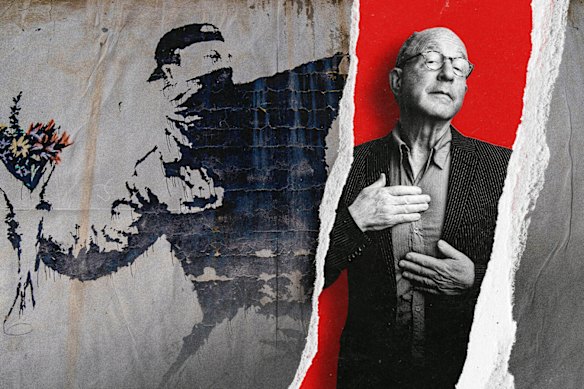
“I hate Banksy’s work because it is conventional,” Saltz says over the phone from New York. “It tells you exactly what to think. He’s a good political cartoonist, a pundit. It all has to be sassy and nasty and in-your-face, and that’s what the British like.”
The plainspoken Saltz is headed to Sydney to deliver his no-nonsense assessment of the direction of art and culture for the Vivid festival. At age 73, Saltz is one of only a dozen or so full-time magazine staff art critics left in the United States. Yet he is perhaps better known today for his massive daily presence on Instagram, subverting the top-down model of cultural gatekeeping he also represents.
He critiques art at a moment of both unprecedented democratisation and entrenched self-aggrandisement. At one end, there have never been more opportunities for artists to show their work. At the other, the global wealthy are treating masterpieces like casino chips.
When Jackson Pollock’s drip painting Number 7A, 1948, recently sold for a record-breaking $265 million, Saltz took to social media to decry the auction as less an art event than “a carnival-freak show spectacle in evening wear”.
“The grotesque price drew gasps, then the sickening applause began — applause for money itself,” Saltz says. “Oh, good: art is expensive. This market is really a tiny oligarchy: a dozen bidders, a few dealers, and everyone else pretending to witness culture instead of concentrated wealth performing for itself. It is the opposite of art.”
The excess is the worst Saltz has seen. While the art market overall has come back to earth, the top end has rebounded with prices beyond the realm of mere mortals or ordinary wage earners.
“We could take a zero off all prices over $500,000,” Saltz proposes. “The beginner [artist] is now making, let’s say, $35,000 — although your readers will look at that and go, ‘What the hell is he talking about? I make $1,000’.
“I’m not talking about the 99 per cent of us who do not make money from what we do. I’m only addressing the 1 per cent that gets 99 per cent of the attention. It makes me sick. I wonder, where are the critics for the other 99 per cent? That’s who I want to write about.”
In his twenties, Saltz was himself a walking stereotype of the starving creative. Painting in the realm of abstract painting, he had a couple of sold-out gallery shows, museum acquisitions, and a grant, but was constantly struggling.
“Mice crawled on me at night; I showered at other people’s houses and had no heat,” he would recall in a landmark essay, My Life as a Failed Artist. Filled with a bitter, paralysing envy and self-doubt, he realised he wasn’t built for the crushing loneliness of the studio. He gave it up completely and spent years driving a long-haul truck and working as a chauffeur.
Desperate to stay in the art world, he taught himself to write, entering the critics’ circle at the ripe age of 39. Fast forward to 2018, and Saltz was awarded the Pulitzer Prize for Criticism for exposing his soul in that same essay.
Saltz visits 25 to 30 galleries weekly, and often boosts unknown artists. He used to visit artists’ studios but no longer. “I will only see art in a gallery, a museum, or a public space,” he says. “I am not interested in any special inside point of view. I never speak to the artist, I’m not writing for the artist. If they want to tell me the work is about a sunny desert island, I’m not interested in hearing it. I want the object to speak for itself.”
If he has a complaint about professional criticism in the US today, it’s that it has become too toothless. “No one writes negative criticism in America any more,” he says.
“I do, my wife used to, there are others, but it is rare.” A pioneer in adopting social media as a platform for criticism, he relishes the immediacy of Instagram. “Right now, I’m just this guy at the corner of the bar that people will engage with, and I’m really happy they are.”
Australia’s Archibald Portrait Prize has been at the vortex of a central question that has dogged humankind since it picked up a paintbrush: What is good art? It’s populism and an art prize wrapped into one, drawing strong opinions, many of them critical for overlooking works by established artists for inferior celebrity paintings or the preferencing of artists by commercial galleries.
For Saltz, figurative painting isn’t about flawless technique. He values artistic vitality and bypasses sterile, photographic replication and rigid academic styles in search of something more urgent — an inventive, lively manipulation of space, colour, and paint itself.
“I’m not against populism. Andy Warhol said, in the future, everyone will be famous for 15 minutes. In the future, everyone will be famous to 15 people. In fact, that’s the way music is now. There is so much music available, and art can be that way too.
“More artists are getting shows and being talked about. That means an artist from Sydney has the same chances as an artist from Berlin, Copenhagen or Beijing. The bad news is that 85 per cent of it is crappola, that makes it harder to sort through the mess. You can find moments of transcendence and beauty, but it’s rare. Eighty-five per cent of art made during the High Renaissance was garbage, too — we just never had to see it.”
Every critic has a blind spot, and Saltz loves nothing more than scouring thrift stores to buy anonymous, outside art. He and his wife, former New York Times art critic Roberta Smith, avidly collect “bad ceramics” — the more eccentric, flawed, and downright weird, the better, though he draws a firm line at paintings of clowns and dogs. He is a stranger to the Australian art scene but is an admirer of Sidney Nolan and his iconic Ned Kelly series, celebrating it as pure, brilliant narrative.
Saltz’s unapologetic habit of weaving politics into his professional art criticism comes from a deeply painful, personal place. Having lost family to Stalin’s regime in Estonia, he views America as the place that saved him. “I am the son of an illegal immigrant from Estonia. Everyone in my family was murdered.” His fierce, public criticism of Trump has routinely brought him death threats, but he remains unrepentant.
Even after decades of looking at thousands of shows a year, Saltz still visits the Metropolitan Museum of Art once a week and can come across work that renders him completely speechless. It might be a towering, world-famous masterpiece, or it could be a tiny piece of medieval ivory no bigger than his thumb. “If I see one good thing, on a day in the galleries, even one area of a painting that turns me on, I’ve had a great day.”
For the artists currently staring at a blank canvas in Sydney, Melbourne, or New York, terrified that their work is stupid or self-indulgent, the critic offers some tough-love advice.
“You have to work, work, work, work. I’m not interested in you talking about your work. You have to hang out with other artists of your own generation—you are a vampire, and if you don’t, you will shrivel up and die. You need to make an enemy of envy; it will eat you alive. Accept that you might not make money. But I want to tell every artist that if you work, and you show up, you will be able to have a life lived in art. And that is success. That’s what I wish for all artists.”
From our partners
Disclaimer : This story is auto aggregated by a computer programme and has not been created or edited by DOWNTHENEWS. Publisher: www.smh.com.au