
In my final opinion column as religion editor of The Age I played a practical joke on the opinion editor, a good friend, by filing my article in Latin. I used Google Translate – a form of artificial intelligence. A decade on, I fear the joke is on me.
That is the only time I have used AI in writing, but its meteoric rise might be society-defining, very soon if not already. It cannot be left to the dominant voices.
Who today believes Mark Zuckerberg or Elon Musk or the Chinese or American governments have the faintest interest in the public good compared with the power, control, efficiency, wealth and military might they can extract from AI?
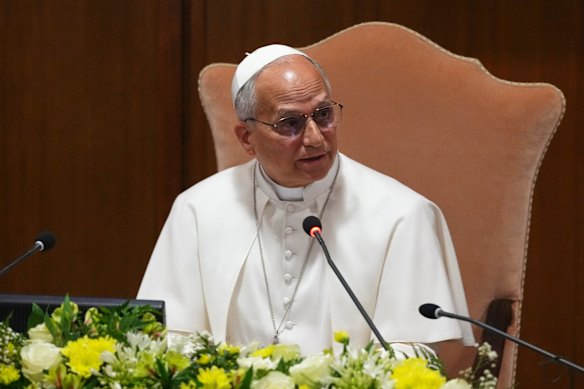
Pope Leo XIV’s encyclical on AI, Magnifica Humanitas, last Monday shows that, in him, ordinary humans do have a champion. For Leo, the most important stakeholders are the masses who are not billionaires or technocrats but whose lives are already massively affected for good and ill by AI.
With the advent of calculators, people often lost the ability to do mental arithmetic. Now that we are ready to outsource so much thinking itself, the cost may be incalculable.
Studies suggest the average IQ in the West has already been dropping for 15 years. The ability to reason critically is diminishing, while society has become ever more atomistic and fragmented, creating a pandemic of loneliness that AI’s purveyors are eager to fill with a meretricious alternative.
Into this arena, Leo has brought a calm, reflective, compassionate voice that rightly puts people at the centre.
He identifies the challenge in his first sentence: “Humanity, created by God in all its grandeur, is today facing a pivotal choice: either to construct a new Tower of Babel or to build the city in which God and humanity dwell together.”
Babel is the biblical story of humanity attempting to usurp God; the parallels are clear.
Leo does not reject science or technology, but “embraces them with gratitude and realism, and grounds them within a higher vocation”. They can alleviate suffering and open up possibilities – so long as they are oriented to the common good, justice and care for the vulnerable and creation.
They must be servant, not master, not subjecting people to the mentality of power or normalising an anti-human paradigm.
Our relationship with life seems to be in crisis today, Leo writes. In the technocratic mindset, “limits” – incapacity, illness, old age, suffering, vulnerability – are a defect to be corrected. But limits are part of being human, often a passageway to flourishing.
Leo identifies not only the problem but the antidote: cultivate human relationships and physical community, reduce reliance on social media, be AI-savvy and stop sharing disinformation.
Barney Zwartz is a senior fellow of the Centre for Public Christianity.
 Barney Zwartz, a senior fellow of the Centre for Public Christianity, was religion editor of The Age from 2002 to 2013.
From our partners
Disclaimer : This story is auto aggregated by a computer programme and has not been created or edited by DOWNTHENEWS. Publisher: www.smh.com.au


