
Ticket queues of 125,000 fans, more than 80 per cent of the MCG sold in the first wave and a local fan base that has grown by more than half in four years: the National Football League says its Australian gamble has been vindicated before a single down has even been played at September’s Rams-49ers opener.
The first regular-season match on Australian soil – the Los Angeles Rams hosting the San Francisco 49ers at 10.35am AEST on Friday, September 11 – anchors a multipronged commercial push that the league hopes will turn a relatively small Australian footprint into a significant revenue stream.
NFL Australia and New Zealand general manager Charlotte Offord told this masthead the league had locked in a “two-plus-one” multi-year contract with the Victorian government – two confirmed games over four years, with an option for a third – and grown its local fan base from 5.7 million to 8.8 million in four years.
“We don’t just enter a market and leave,” Offord said. “We come in to invest and stay.”
The league makes money from the Australian market in four ways: free-to-air broadcast rights, subscription streaming, sponsorships, and game-day economics, including a confidential cheque from the host state.
Seven Network holds the free-to-air rights and extended its deal in August 2025 to take Thursday Night Football live and free on Friday mornings. Seven’s 2024 NFL season coverage reached 4.7 million Australians, the network has said, and the Philadelphia Eagles’ Super Bowl LIX win pulled more than 2.6 million viewers across Seven and 7plus.
The terms are undisclosed but small against domestic codes: the AFL’s $4.5 billion deal with Seven and Foxtel runs to more than $600 million a year through 2031, and the NRL’s deal with Nine and Foxtel tops $400 million annually.
Then there’s subscription revenue: international streaming sits inside a 10-year deal with Foxtel parent company DAZN, which sells NFL Game Pass in Australia at $32.99 a month for Season Pro.
DAZN reported a 23 per cent jump in paid subscribers globally during the 2024 season. The league has also landed a number of local sponsors, including Unilever-owned Hellmann’s and South Australian wine label Y Series.
The Allan government beat off pitches from “multiple different states and cities”, Offord said. Melbourne’s status as “the major events capital”, the MCG’s 100,000-seat capacity and the walkability of the precinct were decisive.
The financial arrangement remains commercial-in-confidence, with Premier Jacinta Allan declining to disclose how much taxpayers are contributing. Visit Victoria chair Andy Penn, the former Telstra chief executive, has said the partnership would translate into jobs in a visitor economy worth about $40 billion a year.
Sport and major events minister Steve Dimopoulos said the deal had already paid off in global exposure. “The opportunity to host an NFL game is only afforded to the world’s biggest cities, such as London, Paris, Madrid, Berlin and Melbourne,” he told this masthead.
Victorian tourism content – the Phillip Island penguins, the state’s golf courses, Melbourne’s dining scene – has been pushed to more than 7 million NFL fans in key markets and run on the 70,000-square-foot infinity screen at the Rams’ home, SoFi Stadium.
The early tourism numbers support the government’s case, with hotel bookings for September 10 and 11 running four times higher than the same dates last year, according to STR data, while American flight searches for Melbourne in early September are up 149 per cent. Fans from more than 35 countries have bought tickets.
I’m a little bit worried about it being at the MCG because there’s going to be a lot of dead space.
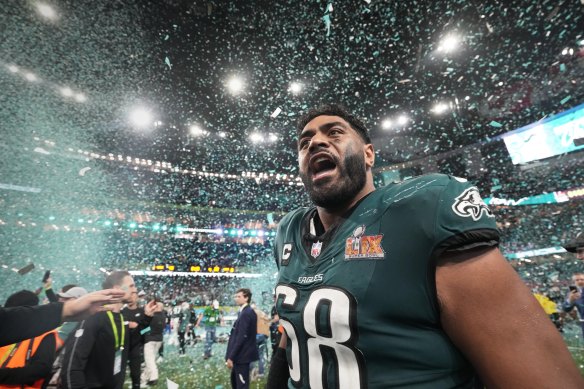
Philadelphia Eagles offensive tackle Jordan Mailata
Visiting Melbourne in April, NFL commissioner Roger Goodell singled out the city’s events track record. “This community knows how to do big events,” he said. “We saw the passion and the understanding of what it takes to do an event like this. They’re pros.”
That has done little to soothe critics in New South Wales, where opposition leader Mark Speakman called the state Labor government’s failure to bid a “spectacular failure”, arguing the government had not offered “a single cent to the NFL”. NSW does not appear to have lodged a formal bid despite Accor Stadium offering a rectangular configuration better suited to gridiron than the MCG’s oval.
Even Philadelphia Eagles offensive tackle Jordan Mailata – Australia’s most prominent NFL player – told this masthead the MCG dimensions worried him. “I’m a little bit worried about it being at the MCG because there’s going to be a lot of dead space,” the Super Bowl winner said. Mailata was in Australia for a side role as Amazon Australia’s packaging reduction officer, leading campaigns advocating for sustainable delivery and reductions in excess packaging.
Despite the venue concern, the Sydney-raised Mailata is bullish on the league’s prospects here, suggesting the match could “start funding some local leagues”.
On his home state’s failure to land the fixture: “We didn’t bid for it. I’m glad someone picked up the tab, and we’re able to bring the game back here.”
The league’s global product also leans on a data partnership with US firm NetApp – its official intelligent data infrastructure partner – which manages player-tracking, broadcast video and fan analytics across team sites and league data centres.
Offord plays down the idea of head-on competition with the AFL or NRL, noting the NFL season overlaps with the AFL by only about four weeks. “We see ourselves as complementary,” she said.
The grassroots level is where things are more directly contested. NFL flag football has grown from 10 Australian schools three years ago to 740 today, Offord said, and the league has committed to sending a free kit to every school in the country over the next two years, a program that competes for participation time with AFL Auskick and NRL development pathways.
Mailata, who came through rugby league before being drafted by the Eagles in 2018, sees the NFL capturing what he calls “tweeners” – kids too big for some codes but not always suited to AFL or rugby league. “Hopefully, we get more Aussies in the NFL, and more Pacific Islanders too,” he said.
Time-zone friction remains the league’s biggest commercial hurdle. “We’re on Fridays and Monday mornings,” Offord said. “They’re not the most optimal times.”
The Business Briefing newsletter delivers major stories, exclusive coverage and expert opinion. Sign up to get it every weekday morning.
 David Swan is the technology editor for The Age and The Sydney Morning Herald. He was previously technology editor for The Australian newspaper.Connect via X or email.
From our partners
Disclaimer : This story is auto aggregated by a computer programme and has not been created or edited by DOWNTHENEWS. Publisher: www.smh.com.au