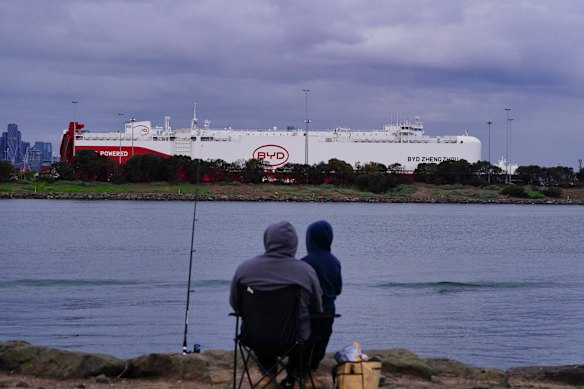

The arrival of a purpose-built ship owned by Chinese car manufacturer BYD that docked in Melbourne on Sunday carrying 5000 vehicles has been described by an analyst as a “turning point” in the electrification of Australian road transport.
The BYD Zhengzhou, one of a fleet of eight car-carrying ships owned and operated by BYD, normally carries vehicles from China to South America but was dispatched to Australia following a spike in interest in electric cars in March.
“What we saw with the oil crisis in the Middle East was a really strong demand for EVs, in particular around March, and that was the main reason for us bringing the vessel to Australia,” said BYD Australia’s chief operating officer Stephen Collins.
“That’s what really led to the vessel, and it really is leveraging what I would call BYD’s vertically integrated supply chain, which is arguably the quickest in the automotive world.”
The US- and Israel-led war on Iran, which all but blocked the passage of fuel shipments through the critical Strait of Hormuz, triggered an energy crisis that pushed up oil prices and led to a surge in demand for electric cars around the world.
Bloomberg reported that 206,200 electric cars were sold in Europe in March this year during the first four weeks of the war, a 44 per cent increase over the year-earlier period. In South Korea sales doubled, and in Italy they jumped 76 per cent.
Energy analyst Tim Buckley, the director of the think tank Climate Energy Finance, said BYD now controls every aspect of its operations, from the mining of critical materials and the design and manufacture of batteries and parts, to the construction of the vehicles themselves and their delivery around the world.
As a result, it can rapidly respond to demand spikes, like the one caused by oil price increases created by the United States and Israeli attack on Iran. As well as its factories in China, it has new plants in Thailand, Brazil and Uzbekistan, allowing it not only to serve rapidly growing markets across Asia and South America but to step around tariffs in some jurisdictions applied to Chinese-manufactured vehicles.
“It’s a turning point for EVs in Australia,” Buckley said. “It is an acceleration of the energy system transformation here in Australia.
“We’ve actually made really good progress in the last four years but what the war in Iran has done is highlighted the critical security benefits of energy independence, which comes from the accelerated deployment of EVs, both in our passenger vehicles, in our freight, and in our mining sectors.
“I’m in awe of the vertical integration that the Chinese battery and EV manufacturers have achieved in very short order, all the way from the lithium and nickel and copper mines through the batteries, through the EVs, through the distribution, and now even in owning the transportation system to get their EVs to market globally.”
In China, BYD has a manufacturing line dedicated to producing right-hand drive vehicles for Australia and New Zealand that is capable of constructing a vehicle in 52 seconds, The Australian Financial Review reported earlier this year.
The company’s internal structure also helped it respond quickly to changes in demand, said Collins, with Australian executives in daily contact with a regional leader who has a direct line to the company’s chairman.
“It’s a very flat organisation and it’s an organisation that makes quick decisions and doesn’t dwell. I would say literally within a few weeks of us seeing that spike in demand we had global approval for more production and shipping,” he said.
One of BYD’s competitors dismissed the significance of the vessel’s arrival in Australia. “Three, four years ago we leased two boats of our own, and so we could also do a picture of our 5000 coming in every month at every port. All those two boats do is go between Thailand and Australia delivering Rangers and Everests,” said Ford Australia marketing director Ambrose Henderson, Drive reported.
“I think part of this [BYD story] is some PR, part of this is some sensationalisation, if I can put it that way.
According to an analysis published this month by the International Energy Agency, countries that rely on oil imports, the energy security benefits of EVs could shape future policy choices.
It said China’s fleet of EVs displaced the use of 1 million barrels of oil a day last year and is set to displace 2.7 million barrels a day by 2030, with a further million barrels to be displaced by electric trucks by 2035.
On Friday, Climate Change and Energy Minister Chris Bowen announced an expansion to a trial of vehicle-to-grid infrastructure in Australia, which allows users to feed stored electricity back to the local power grid.
“EV take-up in Australia is at record levels. When we came to office, one Australian bought an electric vehicle every 50 minutes. Now, one Australian buys an electric vehicle every three minutes,” he said.
He noted that Australia had just recorded a slight decline in transport emissions. “Although it is only a small reduction in transport emissions, 0.6 per cent, it is the first meaningful and sustained reduction in transport emissions outside of COVID, when it was illegal to leave our houses.”
Start the day with a summary of the day’s most important and interesting stories, analysis and insights. Sign up for our Morning Edition newsletter.
 Nick O’Malley is National Environment and Climate Editor for The Sydney Morning Herald and The Age. He is also a senior writer and a former US correspondent.Connect via email.
From our partners
Disclaimer : This story is auto aggregated by a computer programme and has not been created or edited by DOWNTHENEWS. Publisher: www.smh.com.au