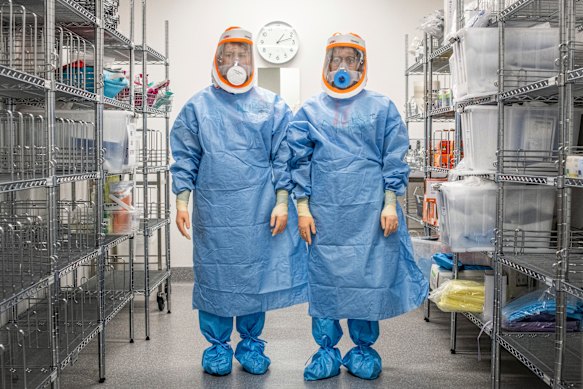

Not even air can escape the NSW Biocontainment Centre.
Tucked away in a tower at Westmead Health Precinct, a handful of staff patrol the bare halls and empty beds, waiting patiently – and preparing endlessly – for the moment of “activation”.
The purpose-built facility is the first and most sophisticated of its kind in Australia, designed to treat and safely isolate patients with “high consequence infectious diseases” such as Ebola or hantavirus.
The level-four biocontainment centre – the most secure categorisation possible – features six negative pressure rooms that ensure, even when a door is opened, that airborne pathogens cannot flow outside.
Infectious diseases physician and clinical microbiologist Dr Matthew O’Sullivan, who leads the centre, says exiting a patient room is a “complex process” and can take longer than half an hour.
In an exit room – known as a doffing room – staff follow a specialised procedure to change out of their personal protective equipment (PPE), monitored both by a colleague and a camera for any errors. This attire is then heat sterilised before it’s disposed of.
In the next (camera-free) room, doctors and nurses shower before donning clean clothes.
The warmth and discomfort of PPE mean that clinicians cannot stay in a patient room for long, so staff are on constant rotation. A workforce of 130 people has trained at the unit and waits on standby in other areas of the hospital, ready when the need arises.
Even sewage is kept separate from the public system, instead being sent directly to a decontamination plant. While O’Sullivan says the risk of a disease such as Ebola spreading from someone flushing waste down the toilet is “really low”, the unit was built for the unknown.
It’s possible that a disease may emerge “where that might actually be an important mechanism of transmission”, he says, with the idea to future-proof the unit to provide such safety.
A separate lift connects the centre to an isolated ambulance bay and a helipad on the roof, averting transit through public waiting areas. Highly infectious patients are safely transported with an EpiShuttle – reminiscent of a transparent coffin on wheels – which O’Sullivan says is “essentially a portable biocontainment unit” that seals the patient – and the disease – inside.
The biocontainment centre was designed just after the 2014 Ebola outbreak, when O’Sullivan says it was recognised that to “really provide state-of-the-art care” for these diseases, a purpose-built unit is needed, rather than a ward that has been retrofitted into an existing area of a hospital.
The facility opened in 2023 and has been put to the test once, when initial estimates suspected mpox (formerly called monkeypox) would be far deadlier than was later confirmed. Other wards at Westmead are used regularly to treat diseases of lower risk.
“High consequence infectious diseases” is a special categorisation for rare but deadly infections that pose a threat to the community and healthcare workers, requiring a system-level response. NSW Health initially prepared the ward for returnees from the hantavirus-hit cruise, before they were redirected to a Perth facility, and any Ebola patients would also be isolated at the biocontainment centre. Other diseases of “high consequence” include bird flu, nipah virus and smallpox.
Although he understands public concern, O’Sullivan says diseases such as hantavirus and Ebola are “very uncommon in Australia” and unlikely to cause a widespread outbreak. “The reason we manage them in an environment like this is to prevent that,” he says. “They’re not something the general population needs to worry about.”
From our partners
Disclaimer : This story is auto aggregated by a computer programme and has not been created or edited by DOWNTHENEWS. Publisher: www.smh.com.au